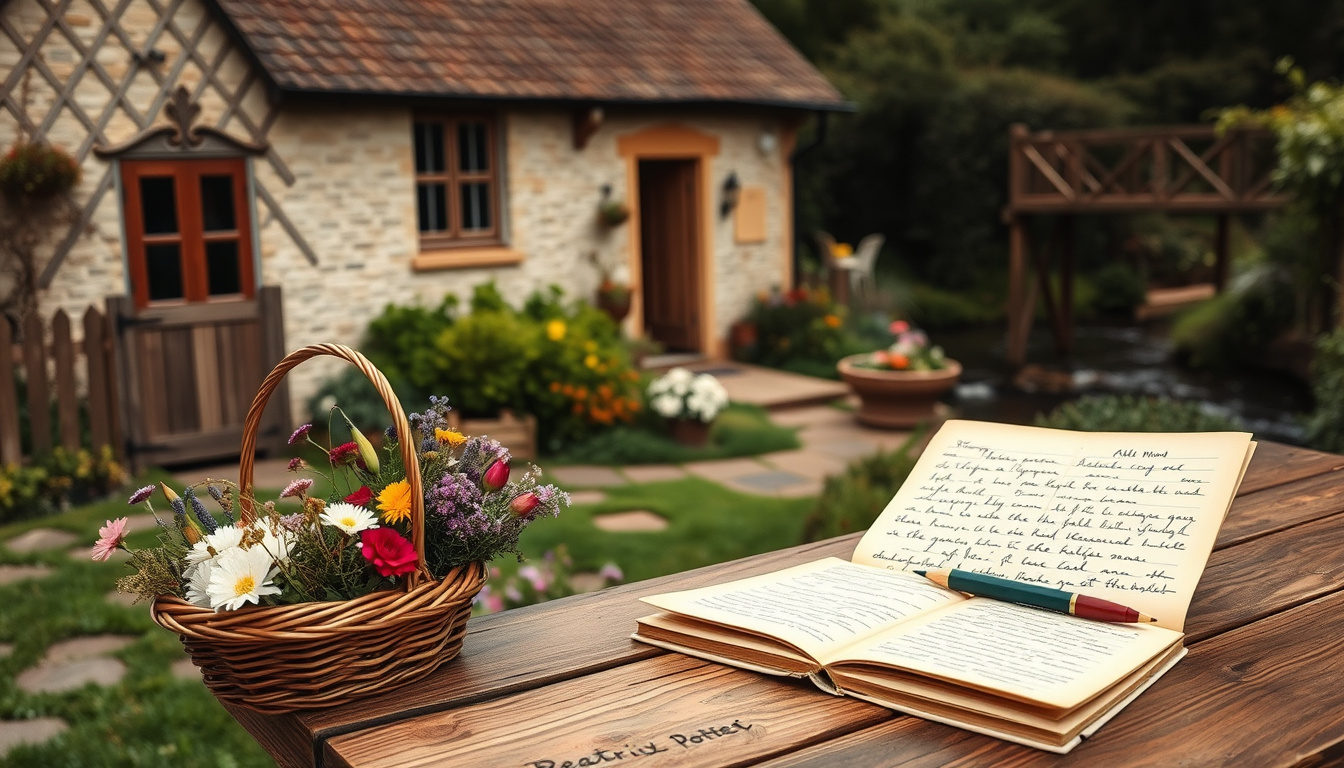
Few children’s authors have left as lasting a mark as Beatrix Potter — but her story goes far beyond Peter Rabbit. She was a natural scientist, a sharp land investor, and a quiet rebel who turned book royalties into a conservation empire that still shapes the English Lake District.
Born: 28 July 1866 ·
Died: 22 December 1943 ·
Most famous book: The Tale of Peter Rabbit ·
Age at marriage: 47 ·
Number of published books: 23 ·
Spouse: William Heelis
Quick snapshot
- Born 28 July 1866 in London (Encyclopædia Britannica (reference work))
- Created The Tale of Peter Rabbit (1902) (The Morgan Library & Museum (institution))
- Married William Heelis in 1913 (Victoria and Albert Museum (art & design museum))
- Bequeathed 4,000+ acres to the National Trust (The Morgan Library & Museum (institution))
- Exact nature of any chronic physical illness (Victoria and Albert Museum (art & design museum) notes speculation only)
- Whether she had a diagnosed mental health condition (Victoria and Albert Museum (art & design museum) makes no mention)
- Authoritative documentation of a family link to Kate Middleton (no official genealogical source published) (Victoria and Albert Museum (art & design museum))
- 1866–1943: lifetime spans Victorian era to WWII (Encyclopædia Britannica)
- 1905: buys Hill Top Farm, Lake District (National Trust (conservation charity))
- 1913: marries William Heelis (Victoria and Albert Museum)
- By 1930: de facto land agent for the National Trust (The Beatrix Potter Society (scholarly society))
- Her conservation model continues via the National Trust (National Trust)
- Hill Top Farm open to the public – 400,000+ visitors per year (est.) (National Trust)
- Literary estate still managed by the Beatrix Potter Society (National Trust)
seven key facts, one pattern: each row traces a different chapter of a life that started in a London drawing room and ended on a Lake District hill farm.
| Attribute | Detail |
|---|---|
| Full name | Helen Beatrix Potter |
| Born | 28 July 1866, London, England |
| Died | 22 December 1943, Near Sawrey, England |
| Occupation | Writer, illustrator, naturalist, conservationist |
| Spouse | William Heelis (m. 1913) |
| Most famous work | The Tale of Peter Rabbit |
| Number of books | 23 (including 20 children’s tales) |
How is Kate Middleton related to Beatrix Potter?
The question surfaces repeatedly in online searches, but the evidence for a direct family link is thin. Potter was born into a London merchant family with roots in Lancashire; the Middleton family’s line runs through the Bowes‑Lyon family, which connects to the Earls of Strathmore. Some amateur genealogies suggest the two women share a distant common ancestor several generations back, but no major biographical source — including the Encyclopædia Britannica (reference work) or Victoria and Albert Museum (art & design museum) — documents a verifiable relationship. The connection, if it exists, is too distant to have played any role in either woman’s life. The pattern: the fascination says more about the public appetite for royal‑literary links than about any documented kinship.
Why did Beatrix Potter marry later in life?
Her early engagement and broken engagement to Norman Warne
Potter’s editor at Frederick Warne & Co., Norman Warne, proposed in 1905. She accepted, but her parents objected because Warne was “in trade” — a businessman, not a gentleman. Before the wedding could take place, Warne died suddenly of leukemia. The loss hit Potter hard; she later wrote that she had “lost the only man I ever cared for.”(Victoria and Albert Museum)
Potter’s obedience to her parents cost her the chance at an earlier marriage — but it also kept her financially independent, which later let her buy land and marry on her own terms.
Meeting and marrying William Heelis at age 47
Eight years after Warne’s death, Potter married William Heelis, a Lake District solicitor who had helped her purchase Hill Top Farm. They settled at Castle Cottage in Near Sawrey. Heelis was 10 years older than Potter, and the marriage was a partnership of shared interests: farming, land management, and conservation.(Victoria and Albert Museum)
The union was a quiet rebellion against her family’s expectations. She chose a provincial lawyer over a London suitor, and a working farm over a Kensington drawing room. The implication: Potter’s late marriage wasn’t a failure to find love — it was a deliberate pivot toward the life she wanted, on her own schedule.
What was Beatrix Potter’s most famous book?
The Tale of Peter Rabbit: creation and impact
The Tale of Peter Rabbit began in 1893 as a picture letter to the son of her former governess. Potter later expanded it, self‑published 250 copies, and then accepted a deal from Frederick Warne & Co. in 1902. The book has sold more than 45 million copies worldwide and has never been out of print.(Victoria and Albert Museum)
The commercial success of Peter Rabbit gave Potter the financial freedom to pursue her real passion: buying and protecting farmland in the Lake District. (Lakelovers, regional travel site)
Other beloved titles
- The Tale of Squirrel Nutkin (1903) — features a red squirrel who loses his tail.
- The Tale of Jemima Puddle‑Duck (1908) — a farm duck outwits a fox.
- The Tale of Tom Kitten (1907) — set at Hill Top Farm.
What this means: Peter Rabbit is the flagship, but the series as a whole reinforced Potter’s ability to generate the steady income that funded her conservation work. Every sale was a brick in a growing estate.
What health issues did Beatrix Potter face?
The chronic illness debate
Throughout her adult life, Potter suffered from a weakened constitution. Several biographers have speculated about an autoimmune condition — possibly rheumatoid arthritis or lupus — because of her recurring joint pain and fatigue. However, no definitive diagnosis exists in her medical records, which have not survived.(Victoria and Albert Museum) (American Scientist, science magazine)
If Potter did struggle with a chronic condition, her productivity — 23 books, dozens of scientific illustrations, and a 4,000‑acre land portfolio — becomes even more remarkable.
Mental health challenges
Some modern commentators have raised the possibility that Potter experienced depression or anxiety, particularly after Warne’s death. Victoria and Albert Museum records no evidence of a clinical diagnosis. The speculation appears to stem from her reclusive later years, which were more likely a product of her single‑minded focus on farming than of any mental illness.
The catch: Without primary medical records, labeling Potter’s personality as “ill” risks reading modern categories into a Victorian life that valued privacy and hard work above introspection.
What was Beatrix Potter’s legacy beyond children’s books?
Her work as a mycologist and scientific illustrator
Long before Peter Rabbit, Potter was drawing fungi. She produced hundreds of meticulous watercolours of mushrooms and lichens, noted the symbiotic relationship between algae and fungi (a discovery later credited to others), and wrote a scientific paper that was presented — though not by her, because women were barred — at the Linnean Society in 1897. (American Scientist)
Conservation efforts: the National Trust and the Lake District
Potter used the proceeds from her books to buy land in the Lake District. By 1930 she was a de facto land agent for the National Trust (UK conservation charity), advising on which farms to acquire and how to manage them. When she died in 1943, she bequeathed 15 farms and more than 4,000 acres to the Trust. (The Beatrix Potter Society)
Her vision — that thriving farms, not theme parks, protect landscapes — still guides the Trust’s management of the Lake District today. The pattern: Potter’s quiet rebellion against the commercialisation of the countryside was funded by the very commercial success of her books, turning capital into conservation.
Timeline
- – Born in London to Rupert and Helen Potter (Victoria and Albert Museum)
- – Wrote the picture letter that became The Tale of Peter Rabbit (The Morgan Library & Museum)
- – The Tale of Peter Rabbit published commercially (The Morgan Library & Museum)
- – Norman Warne proposed; he died later that year (Victoria and Albert Museum)
- – Married William Heelis (Victoria and Albert Museum)
- – Died at Hill Top Farm, age 77 (The Morgan Library & Museum)
Confirmed facts
- Potter was born in 1866 and died in 1943 (Victoria and Albert Museum)
- She married William Heelis in 1913 (Victoria and Albert Museum)
- She wrote and illustrated The Tale of Peter Rabbit (The Morgan Library & Museum)
- She donated 4,000+ acres of land to the National Trust (The Morgan Library & Museum)
What’s unclear
- Whether she suffered from a specific chronic physical illness (e.g., rheumatoid arthritis) — speculation only
- Whether she had a diagnosed mental health condition — no clinical evidence
- The exact nature of her relationship with Norman Warne beyond letters
What others said
“Potter’s death left a lasting conservation legacy in the form of thousands of acres of protected land.”
— The Morgan Library & Museum (institution)
“The story of Peter Rabbit began with a picture letter to a child — a simple act that grew into a global phenomenon.”
— The Morgan Library & Museum (institution)
“Potter married William Heelis in 1913, and together they managed several farms, blending authorship with husbandry.”
— Victoria and Albert Museum (art & design museum)
Potter did not simply write children’s books. She built a financial engine that bought farmland, then protected it from development — turning private capital into a public trust. For anyone who visits the Lake District today, Potter’s choice is clear: profit from royalties, preserve landscape. She chose both. For the modern reader, the lesson is that creativity and conservation can fuel each other, if the creator is willing to rebel quietly and buy the farm.
For more on influential authors, see our guides on Margaret Atwood: The Handmaid’s Tale, Quotes, and Political Views and Emmeline Pankhurst: Life, Quotes & Suffragette Legacy.
goodreads.com, storywarren.com, en.wikipedia.org, beatrixpottersociety.org.uk, matchpedia.org
Related coverage: biography and books of Beatrix Potter fördjupar bilden av Beatrix Potter – Biography, Books, Museum and Legacy.
Frequently asked questions
Did Beatrix Potter have children?
No. Potter and William Heelis had no children. Her legacy passed to the National Trust and to her literary estate.
What animals did Beatrix Potter draw?
Rabbits, squirrels, ducks, mice, cats, foxes, hedgehogs, and many more — almost all based on her personal observations of real animals.
How many books did Beatrix Potter write?
She wrote and illustrated 23 books, 20 of which are children’s tales. The remaining three are collections of nursery rhymes and a translation of a French fairy tale.
Where is Beatrix Potter buried?
In the churchyard of St. John the Baptist Church in Near Sawrey, Cumbria, near Hill Top Farm.
What is the Beatrix Potter Society?
A charitable organization founded in 1980 to promote the study of her life and work. It manages her literary estate and supports conservation projects in the Lake District.
What is the connection between Beatrix Potter and the Lake District?
She bought Hill Top Farm in 1905 and later acquired 15 additional farms and 4,000 acres of land, which she bequeathed to the National Trust — shaping the protected landscape visitors see today.
How did Beatrix Potter die?
She died of heart disease on 22 December 1943 at Hill Top Farm, at the age of 77.
What is Beatrix Potter’s full name?
Helen Beatrix Potter. She was known publicly as Beatrix Potter.

Oliver William Davies Thompson is a staff writer for MetroReport.uk, covering city news, transport, housing and urban policy. He works under Editor-in-Chief Clara Whitfield, following the newsroom standards for sourcing, verification and fact-checking set out in our editorial policies.