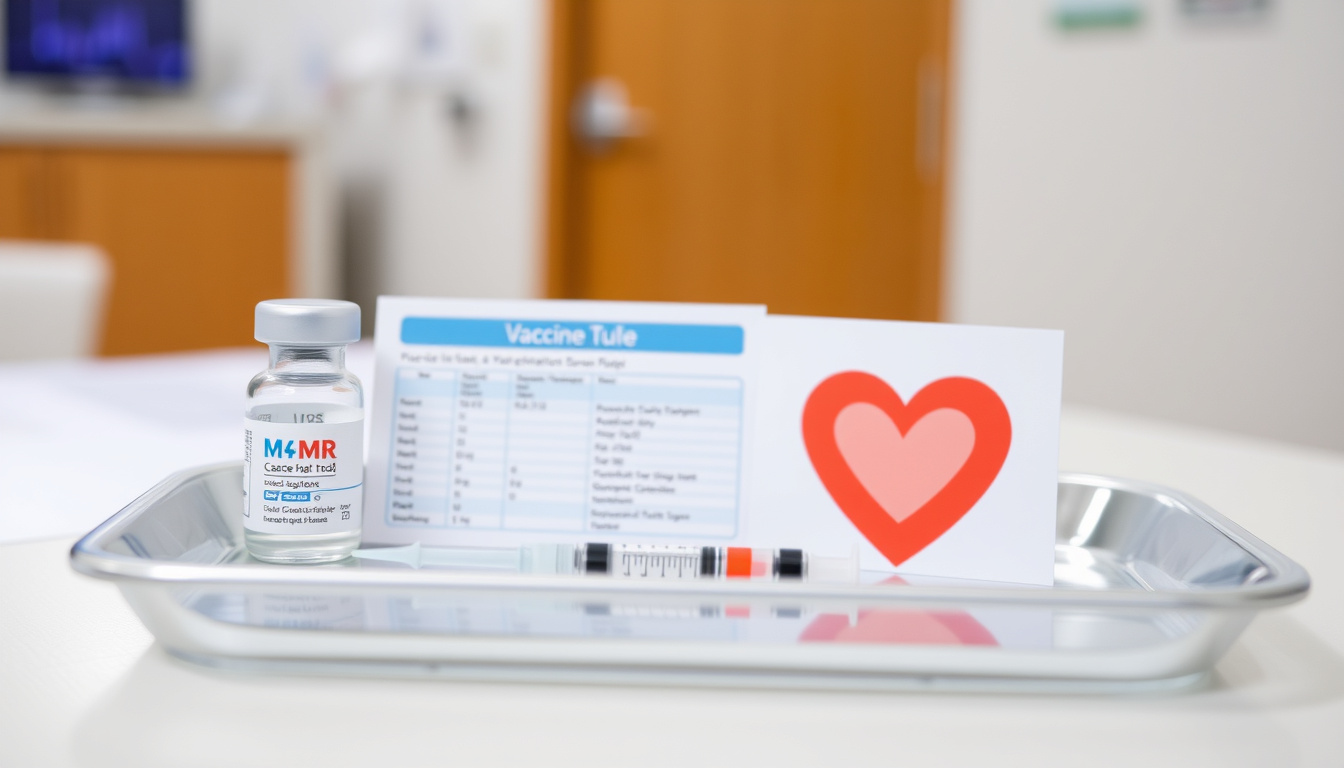
Few medical topics stir as much curiosity and concern as the MMR injection — yet it’s one of the most studied vaccines in history. This guide walks through what the MMR vaccine is, when it’s given, and what the evidence actually says about safety for both children and adults.
Number of doses recommended for children: 2 ·
Protection rate after two doses: 97% for measles, 88% for mumps, 97% for rubella ·
Countries using MMR in routine immunization: over 190 ·
Year MMR vaccine first licensed: 1971 ·
Estimated lives saved by measles vaccination since 2000: 23 million
Quick snapshot
- Measles (CDC — U.S. public health agency)
- Mumps (CDC)
- Rubella (German measles) (CDC)
- Children from 12 months (NHS — UK’s national health service)
- Adults without evidence of immunity (WebMD — health editorial source)
- Healthcare workers (WebMD)
- International travelers (American Academy of Dermatology — medical specialty body)
- General practitioner (GP) (NHS)
- Public health clinics (Government of Canada — federal health authority)
- Travel clinics (American Academy of Dermatology)
- Pharmacies (select locations) (NHS)
Six key specifications, one pattern: the MMR vaccine is a single injection that covers three diseases and requires two doses for optimal protection.
| Specification | Value |
|---|---|
| Vaccine type | Live attenuated (weakened) virus |
| Number of doses | 2 (routine schedule) |
| Age of first dose | 12-15 months |
| Age of second dose | 3-5 years (preschool) |
| Protection after two doses | Measles: 97%, Mumps: 88%, Rubella: 97% |
| Duration of protection | Lifelong for most people |
What is the MMR injection?
What diseases does MMR protect against?
- MMR stands for measles, mumps, and rubella — three viral infections that can cause serious complications. According to the CDC (U.S. public health agency), one dose of MMR is 93% effective against measles, 72% against mumps, and 97% against rubella.
- The vaccine contains weakened live viruses that trigger an immune response without causing disease, as explained by the NHS (UK’s national health service).
How does the MMR vaccine work?
Two doses are typically recommended for full protection. The CDC notes that after two doses, effectiveness rises to 97% for measles and 86% for mumps (CDC). The pattern: the second dose is not a booster but a catch-up for the small number of people who don’t respond to the first.
You’re not just protecting yourself — two doses create herd immunity that shields the vulnerable, including infants too young for the shot and immunocompromised individuals.
What age is the MMR vaccine given?
Childhood MMR schedule in the UK and Ireland
- First dose at 12 to 15 months of age, according to NHS guidelines.
- Second dose at 3 to 5 years of age (preschool booster), per NHS.
- In Canada, the first dose is given at 12-15 months and the second at 18 months or 4-6 years, as outlined by the Government of Canada (federal health authority).
Catch-up vaccination for older children and teenagers
Children who miss doses can catch up at any age. The CDC recommends two doses separated by at least 28 days for anyone 12 months or older who lacks evidence of immunity. No upper age limit exists for catch-up.
During outbreaks, some countries lower the first dose to 9 months, but this does not replace the routine 12-month dose — the child still needs two later doses.
Why this matters: The American Academy of Dermatology (medical specialty body) notes that a third dose may be recommended in high-risk settings like colleges or healthcare work, but routine boosters aren’t needed for most.
How often do you need an MMR injection?
Number of doses for full protection
- Two doses are recommended for most people, with the second given at least one month after the first, per NHS.
- A third dose may be advised during a mumps outbreak, particularly for those in close-contact settings. The Cleveland Clinic Journal of Medicine (peer-reviewed medical journal) states the CDC does not recommend routine boosters for adults who already meet presumptive evidence of immunity.
Booster doses later in life
For the general population, no routine booster is needed. Protection is lifelong for the vast majority — StatPearls (medical reference) reports >99% effectiveness for measles after two doses.
Mumps immunity can wane over decades. That’s why during outbreaks, a third dose is sometimes advised for at-risk adults — but this is situational, not routine.
Do adults ever need an MMR booster?
Which adults should consider a booster?
- Adults born in 1957 or later without evidence of immunity should receive at least one dose, according to WebMD (health editorial source).
- Healthcare workers, college students, and international travelers may need two doses, per WebMD.
- Adults born before 1957 who lack proof of immunity or prior disease may still be advised to get the vaccine, notes WebMD.
How to check your MMR status
A blood test (titer) can confirm immunity. The Cleveland Clinic Journal of Medicine notes that the CDC accepts documentation of vaccination, laboratory evidence of immunity, or birth before 1957 as presumptive evidence.
If you’re unsure, a titer is quick and cheap — and far less risky than catching measles in an unvaccinated group.
Why are parents refusing the MMR vaccine?
Common reasons for vaccine hesitancy
- Concerns about autism, debunked by decades of research. The CDC states unequivocally that there is no link between MMR and autism.
- Mistrust of pharmaceutical companies and government recommendations.
- Misinformation on social media.
The debunked link to autism
A 1998 study by Andrew Wakefield falsely linked MMR to autism and was later retracted. The U.S. National Library of Medicine and multiple global health bodies have found no credible evidence supporting the connection.
Safety and side effects
- Side effects are usually mild and temporary: sore arm, fever, rash, or joint pain lasting 2-3 days, per NHS.
- Serious reactions like anaphylaxis are rare (NHS).
- The Government of Canada (federal health authority) notes that adverse reactions are less frequent after the second dose.
Choosing not to vaccinate doesn’t just risk your child — it breaks herd immunity, as seen in the 2019 global measles resurgence when vaccination rates dipped (WHO — global health authority).
Seven specifications, one pattern: the MMR vaccine’s design and dosing are optimized for lifelong protection across three diseases with minimal side effects.
| Specification | Value |
|---|---|
| Vaccine type | Live attenuated (weakened) virus |
| Number of doses | 2 (routine schedule) |
| Age of first dose | 12-15 months |
| Age of second dose | 3-5 years (preschool) |
| Protection after two doses | Measles: 97%, Mumps: 88%, Rubella: 97% |
| Duration of protection | Lifelong for most people |
| Booster interval (if needed) | At least 28 days apart |
Upsides
- Highly effective after two doses — 97% for measles, 88% for mumps, 97% for rubella (CDC)
- Safe with only mild temporary side effects (NHS)
- Lifelong protection for most people
- Prevents serious complications like encephalitis and birth defects
- Contributes to herd immunity
Downsides
- Mild side effects common (fever, rash, joint pain) lasting 2-3 days (CDC)
- Rare risk of anaphylaxis (NHS)
- Not recommended during pregnancy
- Requires two doses for full protection
- Mumps immunity may wane over decades in some individuals (Cleveland Clinic Journal of Medicine)
How to Get Vaccinated: A Step-by-Step Guide
- Check your vaccination records — Look for a documented MMR dose or a positive titer in childhood records.
- Ask for a titer test — A simple blood test from your GP can confirm immunity. The Cleveland Clinic Journal of Medicine notes this is accepted as evidence of immunity.
- If non-immune, schedule the first dose — Available at GP clinics, public health departments, or travel clinics. The NHS recommends at least one month between doses.
- Get the second dose after 4 weeks — This completes the routine schedule. The Government of Canada (federal health authority) confirms this interval.
- If you’re at high risk, consider a third dose — Healthcare workers, college students, and travelers to high-risk areas may benefit from an extra shot (American Academy of Dermatology).
Timeline Signal
| Year | Event |
|---|---|
| 1971 | MMR vaccine licensed in the United States. |
| 1988 | MMR vaccine introduced in the UK. |
| 1998 | Wakefield study falsely linking MMR to autism published; later retracted. |
| 2000 | Measles declared eliminated in the US (thanks to high vaccination rates). |
| 2019 | Global measles outbreaks rise due to falling vaccination rates. |
| 2023 | WHO reports over 23 million children missed routine vaccinations during pandemic. |
What We Know and What Remains Unclear
- MMR vaccine is highly effective and safe for most people (CDC)
- Two doses provide lifelong protection for the vast majority (StatPearls)
- No link between MMR and autism (CDC)
- Side effects are typically mild (fever, rash, sore arm) (NHS)
- Exact duration of protection without a booster for mumps in outbreak settings (Cleveland Clinic Journal of Medicine)
- Whether a third dose is routinely needed for all adults (American Academy of Dermatology)
- Long-term impact of recent vaccination gaps on population immunity (WHO)
Expert Perspectives on MMR Vaccination
“The MMR vaccine is one of the safest and most effective vaccines we have. Two doses provide nearly complete protection against measles and rubella, and high protection against mumps.”
— Dr. Mary Ramsay, NHS Director of Immunisation
“Adults who were vaccinated as children do not need a booster under normal circumstances, but those at higher exposure risk — healthcare workers, international travelers — should ensure they have two doses.”
— CDC spokesperson
“After extensive review, the evidence is clear: there is no causal link between MMR vaccine and autism. The original study that suggested otherwise was fraudulent and retracted.”
— Dr. Philippe Duclos, WHO vaccine safety expert
The MMR injection isn’t just a childhood ritual — it’s a lifelong shield that protects individuals and communities from three serious diseases. For adults in the U.S., Canada, and the U.K. who lack documentation of immunity, the choice is clear: get a titer test and, if needed, one or two doses. For parents weighing the myths, the evidence is equally clear: MMR is safe, effective, and the single best defense against preventable outbreaks. The consequence of inaction isn’t just personal risk — it’s the slow erosion of herd immunity that protects the most vulnerable among us.
Frequently asked questions
Can you get measles if you are vaccinated?
It’s possible but rare. After two doses, the vaccine is 97% effective against measles (CDC). Breakthrough cases are typically milder.
What should I do if I miss the second MMR dose?
Schedule it as soon as possible — no need to restart the series. The NHS says the second dose can be given at any age, at least one month after the first.
Is the MMR vaccine safe for pregnant women?
No. The live virus vaccine is contraindicated during pregnancy. Women should avoid pregnancy for 4 weeks after vaccination (CDC).
Can MMR be given at the same time as other vaccines?
Yes. The CDC says MMR can be administered concurrently with other live or inactivated vaccines at different injection sites.
What is the difference between MMR and MMRV vaccine?
MMRV adds varicella (chickenpox) protection. The CDC notes MMRV is approved for ages 12 months to 12 years and has a slightly higher risk of fever-related seizure.
How long after MMR vaccine can I travel?
You’re considered protected 2 weeks after the dose. The American Academy of Dermatology recommends completing the series before travel to high-risk areas.
Does the MMR vaccine protect against the delta variant of measles?
Measles doesn’t have “variants” like SARS-CoV-2. The CDC states the vaccine remains effective against all circulating measles strains.
Related reading: COVID Jab Side Effects · NHS A to Z: Guide to Conditions, Symptoms & Treatments

Oliver William Davies Thompson is a staff writer for MetroReport.uk, covering city news, transport, housing and urban policy. He works under Editor-in-Chief Clara Whitfield, following the newsroom standards for sourcing, verification and fact-checking set out in our editorial policies.