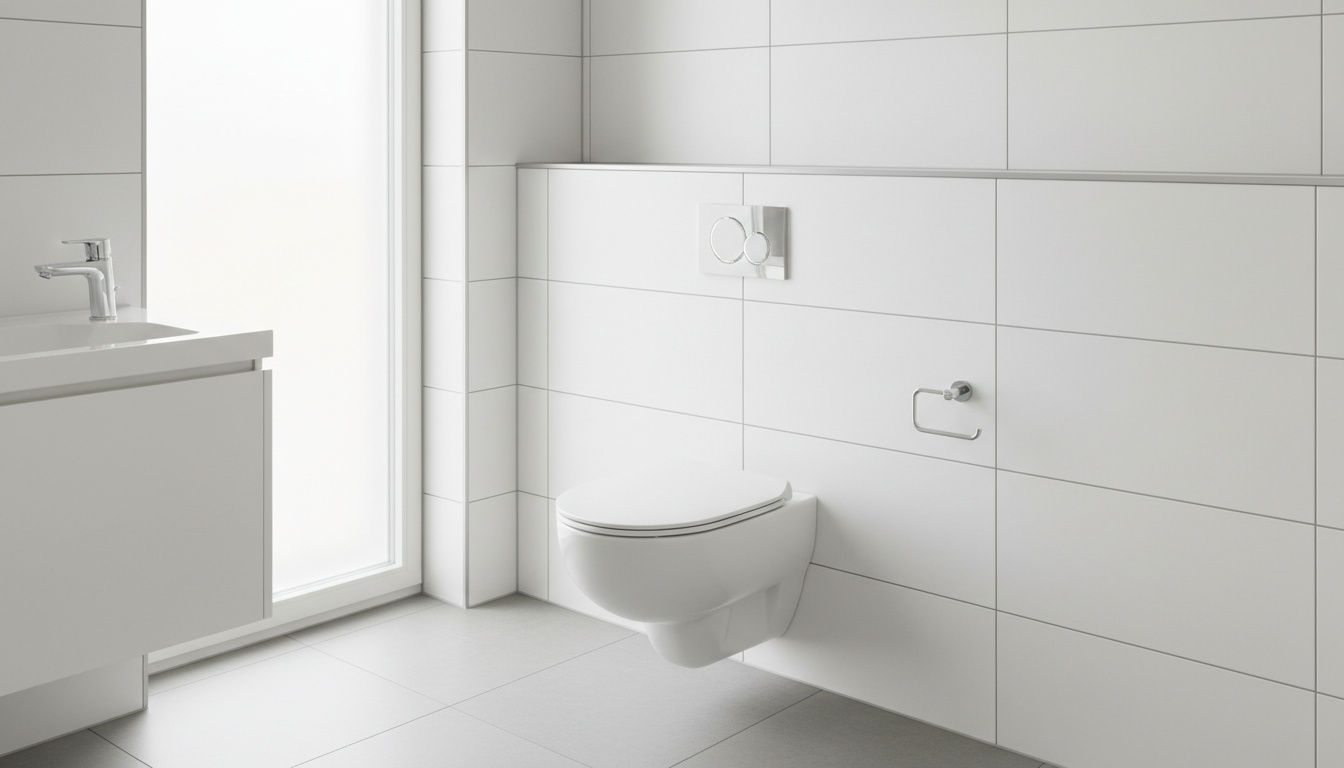
A back-to-wall toilet offers a sleek compromise between traditional floor-mounted models and fully suspended sanitaryware, concealing the cistern within the wall or a furniture unit while maintaining direct floor support. This design eliminates visible pipework and reduces the visual footprint of the bathroom fixture, appealing to homeowners seeking a minimalist aesthetic without the structural complexity of wall-hung alternatives.
Unlike close-coupled toilets where the cistern sits visibly atop the bowl, or wall-hung varieties that float entirely off the floor, back-to-wall units anchor directly to the flooring with plumbing concealed behind the stud wall or within a dedicated housing. The configuration demands careful planning during installation to ensure adequate support for the concealed cistern and proper alignment of waste pipes.
This examination draws upon manufacturer specifications, installation guidelines, and consumer testing data to evaluate the practical implications of choosing a back-to-wall toilet for residential bathrooms. The analysis covers comparative performance against alternative designs, installation requirements, maintenance protocols, and the specific constraints that influence long-term satisfaction with these fixtures.
What Is a Back to Wall Toilet?
A back-to-wall toilet sits directly on the bathroom floor while the cistern hides within a wall cavity or furniture unit, creating a streamlined silhouette without visible plumbing.
Concealed plumbing reduces visual clutter, minimizes noise during flushing, and simplifies surface cleaning compared to exposed-cistern designs.
Installation requires structural preparation for cistern housing, and future repairs demand access panel removal or unit disconnection.
Bathrooms where floor stability is preferred over wall-mounted alternatives, but where visible pipework and bulky cisterns must be eliminated.
- Spatial Economy: Concealing the cistern eliminates the protrusion of traditional tanks, reclaiming visible floor space and wall area.
- Acoustic Performance: The enclosed cistern configuration significantly dampens flushing noise compared to exposed alternatives.
- Maintenance Access: Unlike close-coupled toilets, internal mechanisms require panel removal or professional dismounting for servicing.
- Structural Support: Direct floor mounting provides perceived durability advantages over suspended wall-hung systems.
- Installation Complexity: Requires preliminary wall construction or furniture unit preparation before bowl placement.
- Compatibility Constraints: Waste outlet positioning and wall structural integrity must be verified before specification.
- Cost Positioning: Generally less expensive than wall-hung models while commanding higher installation costs than close-coupled units.
| Aspect | Specification |
|---|---|
| Mounting Type | Floor-standing with concealed cistern |
| Cistern Location | Within stud wall or furniture unit |
| Weight Support | Direct floor bearing |
| Noise Profile | Reduced (enclosed cistern) |
| Cleaning Difficulty | Moderate (easier than close-coupled, harder than wall-hung) |
| Installation Skill | Professional recommended |
| Maintenance Access | Requires removable panel or unit removal |
| Plumbing Visibility | None (fully concealed) |
Back to Wall Toilet vs Wall Hung or Close Coupled: Key Differences
| Aspect | Back-to-Wall | Wall-Hung | Close-Coupled |
|---|---|---|---|
| Installation | Floor-mounted, cistern concealed | Wall-mounted frame required | Floor-mounted, exposed cistern |
| Space Efficiency | Saves space but occupies floor area | Maximum space saving; clear floor beneath | Bulky; cistern protrudes |
| Cleaning Access | Easier than close-coupled; floor contact remains | Superior; full floor access beneath | Difficult around exposed cistern and pipes |
| Cost | Mid-range | Higher initial and installation cost | Most economical |
| Durability | Direct floor support | Frame-dependent; perceived as less sturdy | Floor supported |
Installation Methods
Back-to-wall toilets require floor fixing with the cistern housed behind the wall or within cabinetry, whereas wall-hung models demand robust steel frames capable of supporting human weight without floor contact. Comparative analysis indicates that close-coupled toilets present the simplest installation, with the cistern attached directly to the bowl requiring no concealed framing.
Spatial and Hygiene Factors
While back-to-wall designs eliminate the gap between bowl and wall where dust accumulates on close-coupled models, they retain floor contact that complicates mopping compared to the clear floor space beneath wall-hung toilets. The Back-to-Wall vs Wall-Hung Toilets comparison highlights that wall-hung units excel in accessibility for floor cleaning, though back-to-wall models offer superior stability perception for users.
Economic and Structural Considerations
Back-to-wall configurations generally command lower purchase and installation costs than wall-hung alternatives, while providing greater durability assurance through direct floor bearing. Close-coupled toilets remain the most economical option but sacrifice the streamlined aesthetic and reduced noise levels associated with concealed cisterns.
Pros and Cons of Back to Wall Toilets
Key Advantages
The concealed cistern eliminates visible pipes and bulky tanks, creating a neat appearance while saving significant space compared to traditional floor-mounted models. Documentation confirms that these units operate much more quietly during flushing due to the enclosed tank design.
Cleaning proves simpler than with conventional toilets because all pipework remains hidden, removing areas where grime typically accumulates. Most models feature comfortable heights suitable for all ages and incorporate soft-closing seats to prevent damage from slamming.
Cost benefits emerge when comparing against wall-hung alternatives, as back-to-wall toilets carry lower price points and avoid the expense of support frames. The direct floor support creates a perception of enhanced durability and stability.
Limitations and Constraints
Installation demands specialized labor to fit the toilet properly, resulting in higher costs and longer timelines than standard toilet replacement. Technical specifications note that the wall must be sturdy enough to support the toilet’s weight while maintaining compatibility with existing waste systems.
Repair access presents significant challenges because the cistern is not accessible from the side, requiring either removal of the toilet unit or opening an access panel behind the wall. This concealment means that all moving parts and the soil pipe sit behind the stud wall, complicating troubleshooting.
Any concealed cistern must be installed behind a removable panel that can be accessed when repairs are needed. Failure to provide this access necessitates destructive wall removal for maintenance.
How to Install a Back to Wall Toilet
Pre-Installation Assessment
Measuring and marking the precise location where the toilet will sit constitutes the initial phase, followed by verification that the floor can properly support the combined weight of the fixture and user. Plumbing connections including water supply and waste pipe alignment must be established before wall closure.
Concealment and Connection
The cistern installation within the wall or furniture unit typically occurs behind a removable panel to facilitate future maintenance. What is a Back-to-Wall Toilet guidelines emphasize that the soil pipe and all moving parts remain hidden behind the stud wall, complicating troubleshooting without proper access provisions.
The process requires more complex work than standard toilet installation and is often not recommended as a DIY project for most homeowners, particularly regarding concealed cistern framing and soil pipe alignment.
Bidet Integration Challenges
Installing a bidet attachment or bidet seat proves trickier with back-to-wall toilets than with standard models. If plumbing sits entirely behind a wall, professional plumber consultation becomes necessary. Consumer testing indicates that electrical bidet seats require nearby outlets, with cords potentially compromising the streamlined aesthetic.
Install the concealed cistern behind a removable panel that can be accessed without tools when repairs are needed. This placement prevents the necessity of calling a professional for simple internal tank troubleshooting.
Step-by-Step Installation Sequence
- Site preparation and floor loading verification to ensure structural adequacy.
- Waste pipe and water supply rough-in behind the intended wall location.
- Cistern frame installation within the stud wall or furniture unit.
- Wall closure with removable access panel installation for future maintenance.
- Toilet bowl positioning and floor fixing with appropriate mounting hardware.
- Seat installation and hardware securing to the bowl.
- Water connection, flush operation testing, and leak verification.
Verified Facts and Persistent Uncertainties
| Established Information | Information Requiring Verification |
|---|---|
| Cistern concealment reduces flushing noise | Specific decibel reduction ratings across brands |
| Floor mounting provides direct structural support | Long-term durability metrics versus wall-hung alternatives |
| Installation requires removable access panels | Standardized panel dimensions across manufacturers |
| Professional installation recommended for most homeowners | Exact cost differentials between DIY and professional fitting |
| Bidet installation requires additional planning | Compatibility matrices for specific bidet models |
| Cleaning is easier than close-coupled models | Quantified time savings in maintenance schedules |
Design Context and Market Position
The back-to-wall toilet occupies a distinct position within contemporary bathroom design, bridging the gap between the utilitarian close-coupled toilet and the architecturally minimalist wall-hung variant. This configuration responds to growing demand for clutter-free environments where sanitaryware appears streamlined while maintaining the structural reassurance of floor contact.
The concealed cistern design aligns with broader trends toward integrated storage and hidden mechanics in residential bathrooms. By eliminating the visible tank, these fixtures reduce visual weight and allow designers to maximize perceived space in compact bathrooms without requiring the structural reinforcement necessary for fully suspended installations.
Expert Sources and Industry Validation
With all pipework hidden away, back-to-wall toilets are easier to clean than conventional toilets. The streamlined design simplifies bathroom maintenance.
The process requires more complex work than standard toilet installation and is often not recommended as a DIY project for most homeowners.
Back-to-wall toilets can save significant space compared to traditional floor-mounted models and are generally less expensive than wall-hung models.
Summary and Key Takeaways
Back-to-wall toilets deliver space-saving aesthetics and acoustic benefits through concealed cistern integration, though these advantages require professional installation and carefully planned maintenance access. The design suits homeowners prioritizing floor stability and streamlined appearance over the ultimate space efficiency of wall-hung alternatives or the simplicity of close-coupled models. Successful implementation depends upon verifying wall structural integrity, ensuring waste system compatibility, and installing proper access panels for future servicing, with water regulations and building regulations compliance verified before work begins.
Common Questions
What is the difference between back to wall and fully concealed cistern?
A back-to-wall toilet refers to the bowl position against the wall with the cistern hidden behind it. A fully concealed cistern specifically describes the tank mechanism being completely hidden within the wall or furniture, which is a feature of back-to-wall designs but can also apply to wall-hung toilets.
Do back-to-wall toilets save space?
Yes, by eliminating the visible cistern projection, these toilets reduce visual bulk and reclaim wall space compared to close-coupled models, though they occupy similar floor footprints to standard floor-standing toilets.
Are back-to-wall toilets suitable for small bathrooms?
They are suitable for compact bathrooms where every inch of wall space matters, but they do not offer the same floor-space advantages as wall-hung toilets which leave the floor entirely clear beneath the bowl.
How do you repair a back-to-wall toilet cistern?
Repairs require accessing the cistern through a removable panel installed behind the toilet or removing the toilet unit from the wall. Without proper access panels installed during construction, wall destruction becomes necessary.
Can you install a bidet on a back-to-wall toilet?
Installation is possible but complicated by concealed plumbing. Non-electric bidets may work with accessible water supplies, but electric seats require nearby power outlets and professional installation to maintain the aesthetic.
Do back-to-wall toilets need a frame?
Unlike wall-hung toilets, back-to-wall models do not require a support frame for the bowl itself, as they rest directly on the floor. However, the concealed cistern requires a mounting frame or support structure within the wall.
Are back-to-wall toilets quieter?
Yes, the enclosed cistern within the wall or furniture unit dampens flushing noise significantly compared to exposed cistern models, creating a quieter bathroom environment.

Oliver William Davies Thompson is a staff writer for MetroReport.uk, covering city news, transport, housing and urban policy. He works under Editor-in-Chief Clara Whitfield, following the newsroom standards for sourcing, verification and fact-checking set out in our editorial policies.