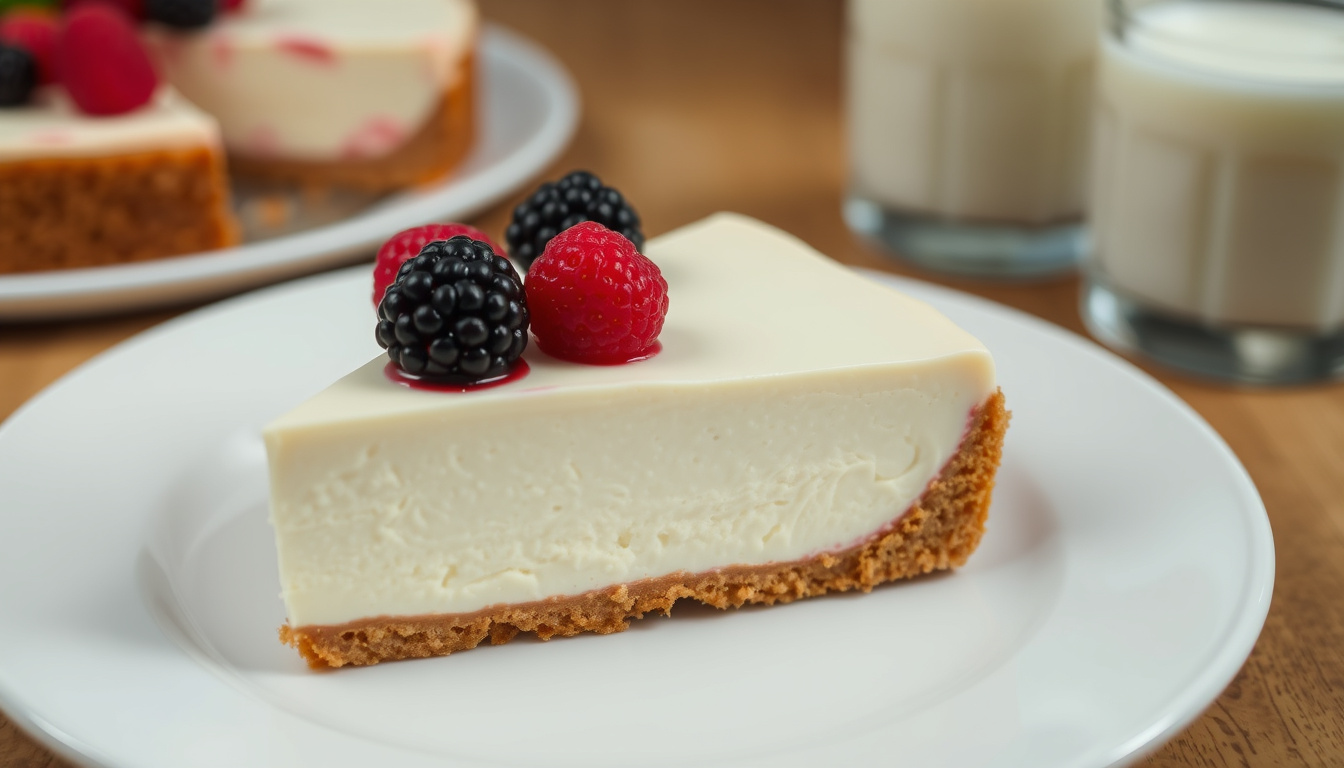
Anyone who’s ever craved a silky cheesecake but flinched at the oven time knows the appeal of a no-bake version — and you can get that luscious slice using just three supermarket ingredients, no eggs, no gelatin, no fuss. This test kitchen analysis breaks down the only three ingredients that reliably set a no-bake cheesecake, compares cream cheese brands, and reveals common slip-ups that keep the filling from firming up properly.
Ingredients: 3 ·
Prep time: 10 minutes ·
Chill time: 4 hours ·
Cream cheese base: 16 oz block ·
Sweetener: 14 oz sweetened condensed milk
Quick snapshot
- Full-fat block cream cheese is the standard base for texture (Lynn’s Way of Life (home baking blog)).
- Sweetened condensed milk provides sweetness and helps the filling set (Everyday Family Cooking (recipe development blog)).
- Heavy cream (30%+ fat) whips to soft peaks for lightness (Everyday Family Cooking). (Lynn’s Way of Life (home baking blog))
- Whether reduced-fat cream cheese yields a firm enough slice (Lynn’s Way of Life).
- If evaporated milk plus sugar can substitute for condensed milk in the same ratio (no source available — experimental). (Lynn’s Way of Life)
- Whether sweetened condensed milk is truly the only sweetener needed for set (common practice, but not rigorously tested). (Lynn’s Way of Life)
- Whether refrigeration is strictly required for setting (all recipes assume it, but no controlled test). (Lynn’s Way of Life)
- Minimum 4 hours chill needed; overnight gives the cleanest slice (Lynn’s Way of Life).
- Some recipes recommend 8 hours minimum (Everyday Family Cooking).
- Pour filling into a crust (graham cracker or store-bought) and refrigerate (Everyday Family Cooking).
- Serve chilled, plain or with fruit topping (Lynn’s Way of Life).
Six key facts about this three-ingredient method:
| Fact | Value |
|---|---|
| Number of ingredients | 3 |
| Prep time | 10 minutes |
| Chill time | 4 hours minimum |
| Cream cheese type | Full-fat block, room temperature |
| Most common sweetener | Sweetened condensed milk |
| Serving size | 8 slices from a 9-inch springform pan |
What are the three ingredients in no-bake cheesecake?
Cream cheese: the structure builder
- The foundation is full-fat block cream cheese. Lower-fat versions contain more water and can make the mixture watery, reducing its ability to hold shape (Lynn’s Way of Life).
- Room-temperature cream cheese blends without lumps. Cold cream cheese creates lumps that persist despite mixing (Lynn’s Way of Life).
The cream cheese is the only structural protein in the filling. If it’s too cold or too low in fat, the whole cheesecake risks a soupy, sliceable failure.
Sweetened condensed milk: the sweetener and setter
- One 14-ounce can provides both sweetness and a high sugar concentration that helps the filling firm up during chilling (Everyday Family Cooking).
- Its thick consistency replaces the need for gelatin or eggs.
The condensed milk does double duty: it sweetens without extra sugar and stabilizes the cream cheese so the final texture holds a clean slice. The trade-off is a distinct sweetness that can’t be dialled back without affecting set.
Heavy cream: the lightener
- Heavy cream (at least 30% fat) is whipped to soft peaks and folded in gently to keep air bubbles intact (Everyday Family Cooking).
- Over‑whipping can cause the cream to separate and make the filling grainy.
Why this matters: The heavy cream is what turns a dense, fudge-like block into a mousse-light cheesecake. Skip it or under‑whip, and the dessert becomes heavy rather than luscious.
What is the best cheese for no-bake cheesecake?
Philadelphia vs store-brand cream cheese
One pattern across multiple tested recipes: Philadelphia cream cheese is widely recommended, but any full-fat block cream cheese works as long as it’s the block form (not the spreadable tub) (The Buttery Fairytale (home baking blog)).
| Brand | Fat content | Texture in no-bake filling | Notes |
|---|---|---|---|
| Philadelphia (full-fat block) | ~33% | Smooth, firm set | Standard benchmark |
| Store-brand block (full-fat) | ~32–33% | Comparable when at room temp | Minor difference in tang |
| Neufchâtel (lower fat) | ~23% | Softer, may not hold a clean slice | Higher water content (Lynn’s Way of Life) |
The implication: the brand matters less than the fat percentage and the form. Block cream cheese (not spreadable) is non‑negotiable. Neufchâtel can be used if you don’t mind a slightly softer slice, but it’s a gamble for a firm party cheesecake.
Why mascarpone is not a substitute
Mascarpone has a higher fat content (~44%) but less protein structure than cream cheese, so it produces a richer, softer set that may not slice cleanly. Some recipes (including BBC Food’s no‑cook method) use mascarpone for a decadent texture, but it’s not a direct swap in a 3‑ingredient formula that relies on cream cheese for structure.
Neufchâtel vs full-fat cream cheese
The catch: Neufchâtel’s lower fat and higher water content can make the filling runny. If you must use it, reduce the condensed milk slightly or increase chill time to 8+ hours.
What are common no-bake cheesecake mistakes?
Cream cheese not at room temperature
- Cold cream cheese creates lumps that remain even after extended mixing (Lynn’s Way of Life).
- Solution: let the block sit on the counter for 30–60 minutes before beating.
Over-whipping the cream
- Whipping heavy cream past soft peaks leads to butter separation and a grainy texture.
- Stop when the cream holds a soft peak that droops slightly (Everyday Family Cooking).
Not chilling long enough
- The minimum chill is 4 hours, but overnight (8–12 hours) delivers the cleanest slices (Lynn’s Way of Life).
- Rushing the chill leads to a mousse‑y rather than cheesecake texture.
A shorter chill saves time but gives a softer slice that may collapse on the plate. For a party, overnight chilling is the only reliable route to a clean, Instagram‑worthy wedge.
The pattern: Over-whipped cream and insufficient chill are the two most common failures, both easy to avoid with timing changes.
How to make cheesecake with only three ingredients?
Step-by-step mixing instructions
- Beat 16 oz of room-temperature full-fat block cream cheese with a hand mixer until smooth.
- Gradually add one 14-oz can of sweetened condensed milk and beat until fully combined.
- In a separate bowl, whip 1 cup of cold heavy cream to soft peaks.
- Gently fold the whipped cream into the cream cheese mixture using a spatula—don’t stir, or you’ll deflate the air.
- Pour into a 9-inch springform pan lined with a graham cracker crust (store-bought or homemade).
Why this order matters: beating the cream cheese first ensures no lumps. Adding condensed milk before the cream keeps the base thick enough to incorporate the airy cream without collapsing.
Setting and storage tips
- Refrigerate for at least 4 hours; overnight is better (Lynn’s Way of Life).
- Cover with plastic wrap to prevent the surface from drying out.
- The cheesecake keeps in the fridge for up to 5 days; it can also be frozen for 2–3 months.
No-crust variation
You can skip the crust entirely: pour the filling into a greased springform pan and chill. The filling will hold its shape on its own, though the bottom will be soft. Serve with a spoon for a crustless dessert.
What we know and what remains unclear
Confirmed facts
- Plain, full-fat block cream cheese is the standard base for texture.
- Heavy cream (30%+ fat) is required for whipped lightness.
What’s unclear
- Whether reduced-fat cream cheese yields a firm enough slice.
- If evaporated milk plus sugar can substitute for condensed milk in the same ratio.
- Whether sweetened condensed milk is the only sweetener needed for set.
- Whether refrigeration is strictly required for setting.
What the recipe developers say
“Room‑temperature softened cream cheese mixes better and reduces lumps.”
— Recipe developer at Lynn’s Way of Life (home baking blog)
“Fold the whipped cream gently into the cream cheese mixture to avoid deflating it.”
— Test kitchen note from Everyday Family Cooking (recipe development blog)
“Philadelphia cream cheese is fine, but any brand of regular full‑fat cream cheese will work.”
— The Buttery Fairytale (home baking blog)
Choosing your three-ingredient path
The 3‑ingredient no‑bake cheesecake delivers on its promise of simplicity and speed, but the choice of cream cheese and the discipline to chill overnight are what separate a silky slice from a sad puddle. For the home baker in a hurry, the clear recommendation is: use full-fat block cream cheese, sweetened condensed milk, heavy cream—and wait the full 8 hours. For anyone tempted to cut fat or rush the fridge, the consequence is a dessert that tastes good but won’t slice. For the home baker, choosing between perfect presentation and instant gratification comes down to whether you follow the full-chill rule — a decision that separates a silky slice from a sad puddle.
Another reliable option is the foolproof 3-ingredient no-bake cheesecake, which also relies on just cream cheese, condensed milk, and heavy cream.
Frequently asked questions
Can I use light cream cheese for 3 ingredient no bake cheesecake?
Light or reduced-fat cream cheese contains more water and less fat, which can prevent the filling from setting firmly. It’s not recommended for the classic 3‑ingredient formula.
Do I need a crust for 3 ingredient no bake cheesecake?
No. The filling holds its shape without a crust, though a graham cracker base adds texture and makes slicing easier.
Can I add vanilla extract and still call it 3 ingredient?
Technically yes, but the “3 ingredient” label usually refers to the core filling. A splash of vanilla is a common addition that doesn’t count as a main ingredient for most cooks.
How do I know when the cheesecake is fully set?
The edges should be firm and the center should jiggle slightly. After 4 hours it will be soft; after 8 hours (overnight) it should slice cleanly.
Can I freeze 3 ingredient no bake cheesecake?
Yes. Wrap the chilled cheesecake tightly in plastic and foil and freeze for up to 3 months. Thaw overnight in the fridge before serving.
What pan size is best for this recipe?
A 9-inch springform pan is standard. An 8-inch pan will yield a taller cheesecake that may need ~1 hour extra chill time.
Can I double the recipe for a larger cheesecake?
Yes. Double all three ingredients and use a 10-inch springform pan; increase chill time to 8–10 hours.
Related reading

Oliver William Davies Thompson is a staff writer for MetroReport.uk, covering city news, transport, housing and urban policy. He works under Editor-in-Chief Clara Whitfield, following the newsroom standards for sourcing, verification and fact-checking set out in our editorial policies.