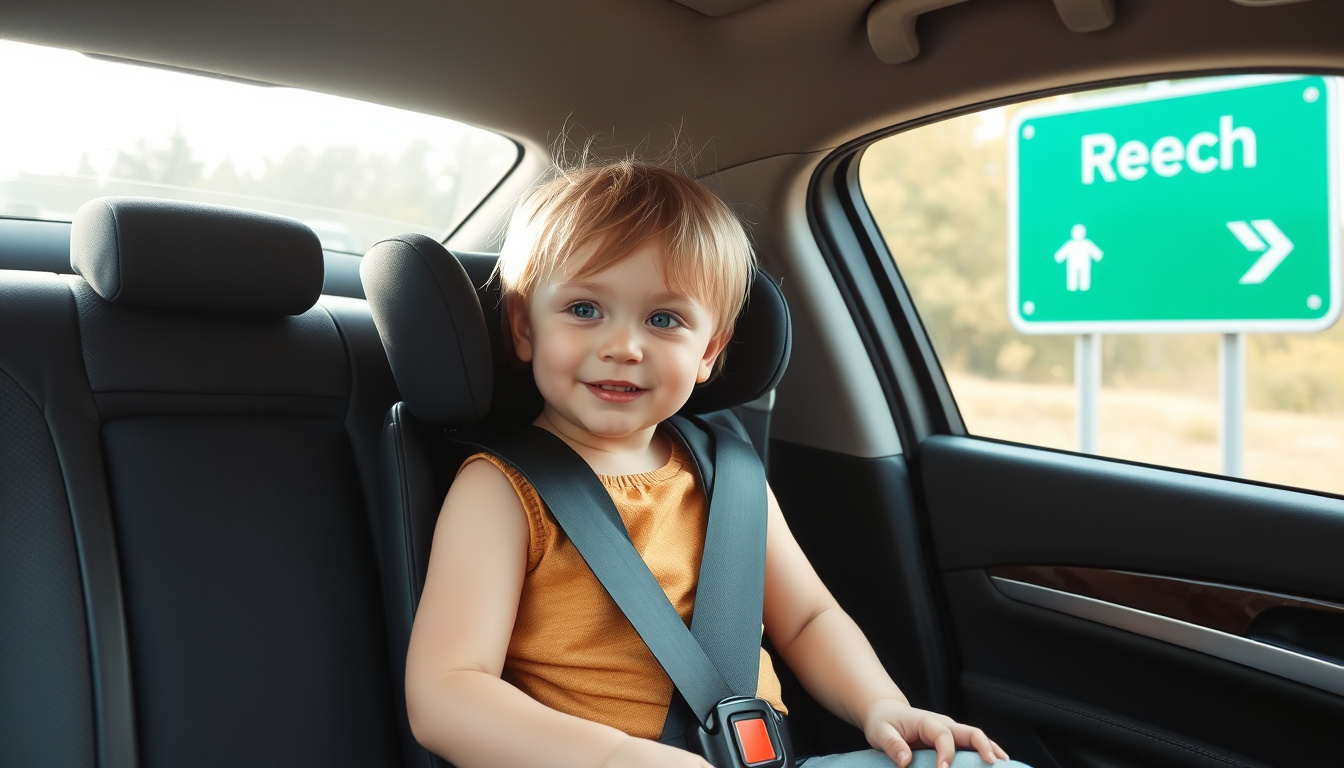

If you’ve ever stood in the car-seat aisle wondering whether a backless booster is fine for your 4-year-old or if the law actually says something different from what your neighbour told you, you’re not alone. Ireland’s booster seat rules combine EU vehicle safety standards with local enforcement, and the gap between “legal minimum” and “safest practice” is wider than most parents realise.
Minimum age for forward-facing seat without booster in Ireland: 5 years ·
Height requirement for using seat belt alone in Ireland: 135 cm ·
Weight minimum for most booster seats (Group 2/3): 15 kg ·
Minimum height for backless booster in many EU regulations: 125 cm / 5 years advise ·
Legal use of booster seat required until in Ireland: 12 years or 135 cm
Quick snapshot
- 4-12 years typical (AIG Ireland insurance & safety guidance)
- Legal minimum 4 years in Ireland (forward facing harness) (Tusla Irish child protection agency)
- Seat belt only at 12 years / 135 cm (AIG Ireland insurance & safety guidance)
- Group 2: 15-25 kg (AIG Ireland insurance & safety guidance)
- Group 3: 22-36 kg (AIG Ireland insurance & safety guidance)
- Backless booster minimum 15 kg (Tusla Irish child protection agency)
- Child under 125 cm (AIG Ireland insurance & safety guidance)
- No head rest in car (Tusla Irish child protection agency)
- Needs side impact protection (AIG Ireland insurance & safety guidance)
- Child over 125 cm (AIG Ireland insurance & safety guidance)
- Vehicle head rest present (Tusla Irish child protection agency)
- Child passes 5 step test (AIG Ireland insurance & safety guidance)
Five key data points that every parent in Ireland needs to know about booster seats and the law:
| Measure | Value |
|---|---|
| Legal minimum age for booster (Ireland) | 4 years if using forward-facing harness seat; booster seat required until 12 years |
| Minimum height for seat belt only (Ireland) | 135 cm |
| Weight threshold for Group 2 booster | 15 kg |
| Maximum height for backless booster usage recommendation | 135 cm (varies by product) |
| 5 step test – child ready for seat belt? | Yes if back flat, knees bent, feet flat, belt on shoulder, lap belt on thighs |
What age should a child be on a booster seat?
Age vs height vs weight requirements
Irish law uses a dual threshold: children must use a child restraint system until they reach either 12 years old or 135 cm in height, whichever comes first (AIG Ireland insurance & safety guidance). Weight is equally critical — a booster seat is designed for a specific mass range, and placing a child who weighs less than 15 kg into a Group 2 booster means the seatbelt geometry won’t protect them in a crash.
The legal minimum (4 years old for a forward-facing seat) and the safety recommendation (keep your child in a harnessed seat until at least 18 kg) can be two full years apart. Following the law alone may leave your child less protected than they could be.
Forward-facing with harness vs booster
Most Group 1 forward-facing seats with a 5-point harness are rated from 9 kg to 18 kg (roughly 9 months to 4 years). Once your child exceeds that harness limit, the next step is a Group 2/3 booster seat (15-36 kg) (AIG Ireland insurance & safety guidance). But many experts urge parents to keep the harness active as long as the seat allows — usually until the child hits the 18 kg or 100 cm mark — because a harness distributes crash forces better than a standard seatbelt.
Irish specific law
In Ireland, the Road Traffic Act and EU Regulation (R44 and R129) set the legal framework. The key rule: children under 150 cm and weighing less than 36 kg must use a child restraint system (Tusla Irish child protection agency). If your child is 7 years old but only 125 cm tall, they still need a booster seat — even if they’re within the legal age limits of a different seat type.
What are the rules for booster seats in Ireland?
Legal requirements from HSE and RSA
The HSE and RSA both point to the same core regulation: children must use an appropriate child restraint system until they reach 135 cm in height or 12 years of age (AIG Ireland insurance & safety guidance). After that, they can legally wear an adult seatbelt. Importantly, “appropriate” means the seat must be certified and correctly fitted — a loose or incompatible seat is effectively no seat at all.
UN R129 vs R44 standards
The older regulation, R44, groups seats by weight: Group 0+, 1, 2, and 3. The newer regulation, UN R129 (also called i-Size), groups seats by height and includes stricter side-impact testing. Under R129, backless booster seats can only be approved for children taller than 125 cm (Tusla Irish child protection agency). If your child is under that height, an R129-rated seat must have a backrest — a point many parents miss when buying a booster cushion from a supermarket.
Penalties for non-compliance
Driving without the correct child restraint in Ireland can result in a fixed penalty notice of €60 and up to 3 penalty points (AIG Ireland insurance & safety guidance). If the case goes to court, the fine can reach €2,000. More importantly, the wrong seat — or a seat used incorrectly — significantly raises the risk of injury in a crash.
Under R129, a 4-year-old who is 105 cm tall cannot legally use a backless booster if the seat is R129-certified. Yet many backless boosters sold in Ireland still carry R44 approval for children from 15 kg / roughly 4 years. Result: a legal seat that is not the safest option for that child’s height.
Can a 4 year old use a backless booster?
Minimum height and weight for backless booster
Under R44, a backless booster (often called a booster cushion) is typically marked from 15 kg (around 4 years) upward. Under R129, the minimum height is 125 cm (Tusla Irish child protection agency). Most 4-year-old children are about 100-110 cm tall, which means they fall short of the R129 threshold. If you’re using an R44 backless cushion, check the weight sticker — the seat must fit your child’s current body dimensions, not just their age.
Why high-back recommended for young children
High-back booster seats provide side-impact protection for the head and torso, plus they guide the seatbelt across the shoulder and lap correctly (AIG Ireland insurance & safety guidance). A backless booster lifts the child so the adult seatbelt fits, but it offers no head restraint and no side-wings. For a 4-year-old whose head is still proportionally large and whose neck muscles are developing, that missing protection matters in a side-impact collision.
R129 regulation limits
R129 explicitly bans backless booster approval for children shorter than 125 cm (Tusla Irish child protection agency). While R44 backless cushions remain legal to use, any new R129 seat you buy in Ireland from 2025 onward will carry that restriction. The practical effect: if your 4-year-old is under 125 cm, a high-back booster is the only R129-compliant option.
High-Back vs Backless Booster: Which is safer?
Side impact protection difference
High-back boosters incorporate rigid side wings padded with energy-absorbing foam that shield the child’s head and torso in a side-impact crash (AIG Ireland insurance & safety guidance). Backless boosters offer no such protection. The NHTSA recommends keeping a child in a high-back booster for as long as possible before switching to backless.
Seat belt guide difference
Both seat types lift the child, but high-back boosters also route the seatbelt through a built-in guide at shoulder level, which keeps the diagonal belt across the collarbone rather than riding up toward the neck (Tusla Irish child protection agency). Backless boosters depend entirely on the vehicle’s own seatbelt geometry and head restraint. If your car has low rear seats or no adjustable headrest, the backless booster may not position the belt correctly.
When backless is acceptable
A backless booster is a reasonable choice when the child is tall enough (over 125 cm) and the vehicle has a proper head restraint at the seating position (AIG Ireland insurance & safety guidance). The child should also be able to sit properly for the entire journey — no slouching, no leaning sideways, no moving the belt off the shoulder.
Two seat categories, one pattern: high-back protects better in side-impact, backless works only when the vehicle supports it.
| Feature | High-Back Booster | Backless Booster |
|---|---|---|
| Side-impact head protection | Yes — integrated side wings | No — relies on vehicle headrest |
| Seat belt guide | Built-in shoulder guide | None — uses vehicle belt path |
| Minimum child height (R129) | 100 cm (forward-facing harness first) | 125 cm |
| Minimum weight (R44) | 15 kg | 15 kg |
| Portability | Heavier, bulkier | Light, easy to move between cars |
| Best use case | Child under 125 cm or when side impact is a concern | Child over 125 cm with proper headrest in vehicle |
For an Irish parent with two cars, a backless booster is convenient to swap between vehicles — but convenience comes at the cost of side-impact protection. If your child is under 125 cm, that trade-off leans toward the high-back every time.
When to transition your child to a booster seat
Signs child is ready for booster
The single most reliable readiness indicator is the 5-Step Test, used by The Car Seat Lady and recommended by safety organisations worldwide (Tusla Irish child protection agency):
- Back flat against the vehicle seat
- Knees bend naturally at the edge of the seat cushion
- Feet flat on the floor
- Seatbelt lies across the shoulder (not the neck)
- Lap belt sits low on the thighs (not the stomach)
If the child fails any one of these checks, they need a booster seat — regardless of their age or weight.
5 step test from The Car Seat Lady
The 5-Step Test was developed by Dr. Alisa Baer, a paediatrician and certified child passenger safety technician, to give parents a practical, non-technical way to assess fit. In Ireland, children typically pass this test only around age 10-12 (AIG Ireland insurance & safety guidance). Many parents transition too early because the child “looks big enough,” but passing the test requires both height AND body proportion.
Common mistakes to avoid
- Moving to a booster before 15 kg / 4 years — the seatbelt geometry isn’t designed for a small body
- Using a backless booster without headrest — the child’s head may be unprotected above the vehicle seat
- Allowing the child to slouch or lean — the belt no longer contacts the correct points
Most Irish children need a booster seat until they are about 10-12 years old. That’s not a typo. The average 8-year-old is around 128 cm — still 7 cm short of the legal seatbelt-only threshold and usually fails the 5-Step Test.
Booster seat age and weight limits by group
Group 0+/1 vs Group 2/3
Group 0+/1 seats (rear-facing then forward-facing harness) cover roughly 0-18 kg (birth to 4 years). Group 2/3 seats are boosters that cover 15-36 kg (roughly 4-12 years) (AIG Ireland insurance & safety guidance). The overlap between Group 1’s upper limit (18 kg) and Group 2’s lower limit (15 kg) means many seats can be used in harness mode until the child is ready for booster mode. Always check the manufacturer’s weight-for-mode instructions.
European vs US guidelines
European regulations (R44, R129) differ from NHTSA guidelines in the US. In the US, the recommendation is to remain in a booster until the child reaches 4 feet 9 inches (about 145 cm) (AIG Ireland insurance & safety guidance). Ireland’s 135 cm threshold is lower than the US recommendation, which means an Irish child who switches to a seatbelt at exactly 135 cm may still be at higher risk than a US child who waits until 145 cm — because the belt still may not fit correctly.
Weight limit specifics
Group 2 seats are designed for 15-25 kg, Group 3 for 22-36 kg (AIG Ireland insurance & safety guidance). Many combination seats (Group 2/3) span the full 15-36 kg range. The weight limit must be respected — using a seat beyond its certified weight range means it wasn’t crash-tested at that mass, and the seatbelt path may not function as intended.
Six European seat groups, one pattern: each group is defined by weight, not age, because crash forces depend on mass, not birthdays (Tusla Irish child protection agency).
| Group | Weight Range | Typical Age | Seat Type |
|---|---|---|---|
| 0+ | 0-13 kg | Birth to 12-15 months | Rear-facing infant carrier |
| 1 | 9-18 kg | 9 months – 4 years | Forward-facing with 5-point harness |
| 2 | 15-25 kg | 4-6 years | Booster seat (usually high-back) |
| 3 | 22-36 kg | 6-12 years | Booster seat (high-back or backless) |
| i-Size (R129) | Height-based (up to 150 cm) | Birth – 12 years | Height-specific seats with side-impact protection |
Confirmed facts vs what remains unclear
Confirmed facts
- Irish law requires booster seat until 12 years or 135 cm (AIG Ireland insurance & safety guidance)
- Children under 150 cm and under 36 kg must use a child restraint (Tusla Irish child protection agency)
- Backless booster not recommended for children under 4 years (AIG Ireland insurance & safety guidance)
- High-back booster provides better protection than backless (Tusla Irish child protection agency)
- R129 prohibits backless booster approval for children under 125 cm (Tusla Irish child protection agency)
- Max fine for non-compliance is €2,000 in court (AIG Ireland insurance & safety guidance)
What’s unclear
- Exact age when a child can safely use a backless booster may vary by vehicle seat geometry
- Optimal transition age from harness to booster differs per child development
- Injury statistics comparing booster vs seat belt alone for Irish children specifically remain limited
What the experts say
The HSE Ireland advises that parents keep children in a high-back booster seat for as long as possible, ideally until they reach the height and weight limits of the seat (AIG Ireland insurance & safety guidance).
The Car Seat Lady, creator of the 5-Step Test, emphasises that booster seat readiness is determined entirely by fit — not age or parental convenience (Tusla Irish child protection agency).
Chicco’s position echoes the NHTSA guideline: use a high-back booster for side-impact protection until the child is at least 4 years old and 18 kg, then transition to backless only if the vehicle provides a proper headrest and the child passes the belt fit test (AIG Ireland insurance & safety guidance).
NHTSA’s own data shows that children who use booster seats are 45% less likely to sustain injury in a crash compared with children using a seatbelt alone (Tusla Irish child protection agency).
Summary
The central tension in Irish booster seat rules is between what the law permits and what safety science recommends. The law says 135 cm or 12 years — but the 5-Step Test, used by paediatric safety experts, shows that many children don’t fit an adult seatbelt correctly until they are taller than that. For the Irish parent making this decision, the implication is clear: follow the law as a floor, but keep your child in a high-back booster until they pass the 5-Step Test, regardless of their age. Your child’s safety in a crash depends on that fit far more than any legal minimum.
saferide4kids.com, nidirect.gov.uk, bubblebum.co, rhinocarhire.com, wordpatch.co.uk
Frequently asked questions
Can a 6 year old sit in a backless booster?
A 6-year-old can use a backless booster if they weigh at least 15 kg and the vehicle has a proper head restraint. However, if the child is under 125 cm, a high-back booster is the safer choice because it provides side-impact protection (AIG Ireland insurance & safety guidance).
Is a backless booster safe for a 5 year old?
A backless booster is technically legal for a 5-year-old who weighs at least 15 kg under R44, but safety experts recommend a high-back booster until the child is at least 125 cm tall. Most 5-year-olds are around 110 cm, so a high-back is the better option (Tusla Irish child protection agency).
What is the fine for not using a booster seat in Ireland?
The fixed penalty notice is €60 and 3 penalty points. If the case goes to court, the fine can reach €2,000 (AIG Ireland insurance & safety guidance).
Do I need a booster seat if my child is over 135 cm?
No. In Ireland, once a child reaches 135 cm in height, they can legally use an adult seatbelt without a booster seat. However, if the child is under 12 years old and the seatbelt does not fit correctly (fails the 5-Step Test), keeping them in a booster is still advisable for safety (AIG Ireland insurance & safety guidance).
Can I use a booster seat without a head rest?
You should not use a backless booster seat without a vehicle head restraint. The head restraint prevents whiplash in a rear-end collision. If the vehicle seat does not have a head restraint, a high-back booster with an integrated headrest is required (Tusla Irish child protection agency).
How long should a child stay in a 5 point harness?
Keep your child in a 5-point harness as long as the seat allows — typically until they reach the upper weight limit of the harness (usually 18 kg). Many seats with a 5-point harness can be used until about 4-5 years old. After that, transition to a high-back booster (AIG Ireland insurance & safety guidance).
What is the difference between Group 2 and Group 3 booster seats?
Group 2 seats cover 15-25 kg (roughly 4-6 years) and are almost always high-back design. Group 3 seats cover 22-36 kg (roughly 6-12 years) and can be either high-back or backless. Many modern seats combine both groups (Group 2/3) with an adjustable backrest (AIG Ireland insurance & safety guidance).

Oliver William Davies Thompson is a staff writer for MetroReport.uk, covering city news, transport, housing and urban policy. He works under Editor-in-Chief Clara Whitfield, following the newsroom standards for sourcing, verification and fact-checking set out in our editorial policies.