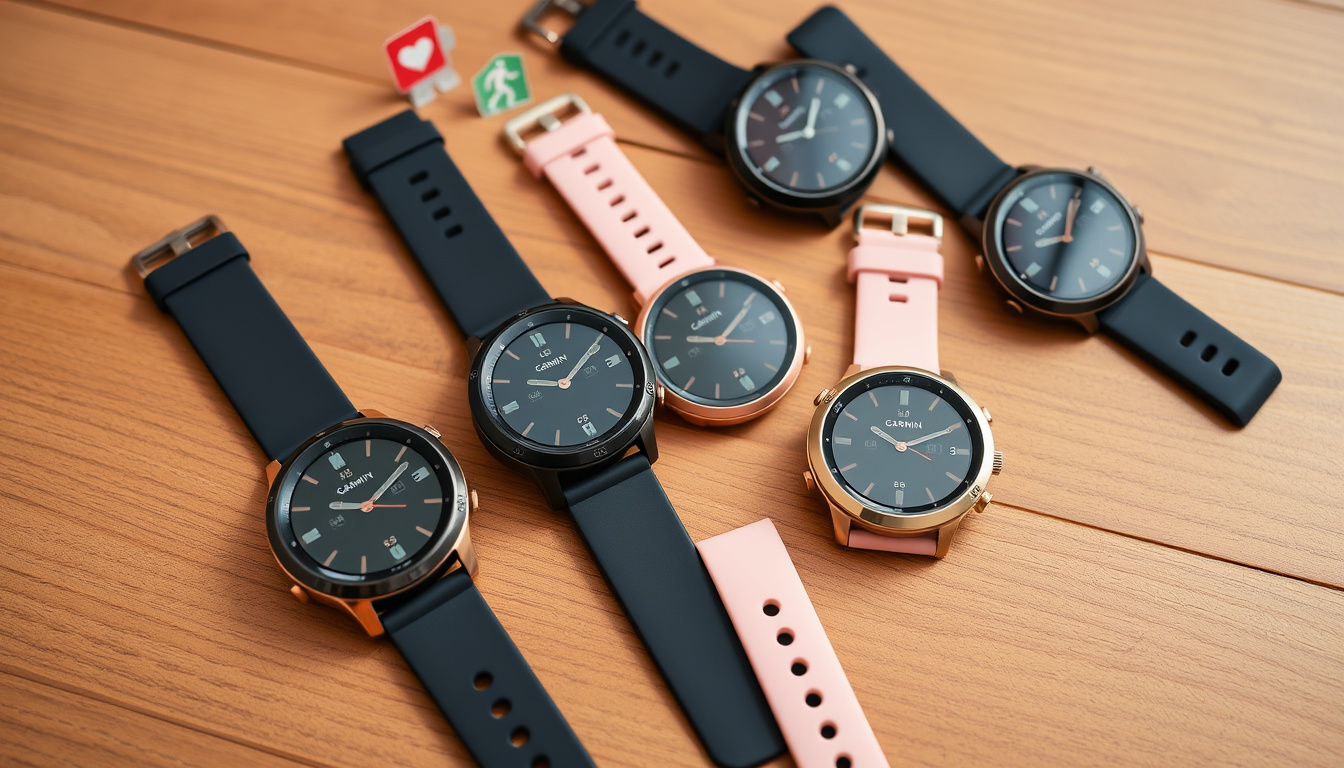
Few things derail a morning workout like a watch that keeps buzzing with low-battery warnings. Garmin has been quietly solving that problem for female athletes and everyday users alike, packing up to 10 days of battery life into a 41mm case that fits smaller wrists. This guide cuts through the model maze to help you find the Garmin watch that actually matches your health priorities, from menstrual tracking to AFib detection.
Battery life (typical smartwatch mode): Up to 10 days (Garmin Venu 3S) · Water resistance (most models): 5 ATM (50 meters) · Connect IQ store apps: Over 1,000
Quick snapshot
- Garmin Venu 2 Plus and Venu 3S have an FDA-cleared ECG app (Garmin)
- Menstrual cycle tracking is available on multiple Garmin models (Women’s Health)
- Garmin watches with heart rate sensors can issue irregular rhythm alerts (Garmin)
- Whether Garmin’s irregular rhythm algorithm uses the 30-second rule common in clinical AFib detection (Woman’s Day)
- How Garmin’s heart rate accuracy compares to Apple Watch in daily use for women with darker skin tones (NIH study)
- Women’s Health 2025/2026 guide named the Garmin Venu 4 as best overall (Women’s Health)
- Woman & Home published a 2026 guide highlighting six Garmin models (Woman & Home)
- Expect more models with AMOLED displays and deeper women’s health integration by 2026 (Garmin product roadmap)
- FDA clearance for additional ECG and Afib detection features may expand to mid-range watches (FDA)
| Category | Top pick | Key strength |
|---|---|---|
| Best overall for women | Garmin Venu 3S | AMOLED display, 41mm case, ECG, body battery, menstrual tracking |
| Most stylish | Garmin Lily 2 | Fashion-forward design, 35.5mm case, stress & sleep tracking |
| Best value | Garmin Venu Sq 2 | Square AMOLED, GPS, music storage, Garmin Pay |
| Best for runners | Garmin Forerunner 265S | Advanced running metrics, lightweight, multi-band GPS |
| Battery champion | Garmin Instinct 2S | Up to 28 days battery, solar option, rugged design |
The pattern is clear: Garmin tailors its lineup to different priorities, so the best pick depends on whether you value style, running data, or battery longevity.
What is the best Garmin watch for females?
Garmin Venu 3S: The top choice for most women
The Venu 3S hits the sweet spot between health-tracking depth and day-to-day wearability. With a 41mm case, it suits smaller wrists without sacrificing screen readability. The AMOLED display and up to 10 days of battery (Women’s Health) mean you can leave the charger at home over a long weekend. It also includes an FDA-cleared ECG app and menstrual cycle tracking – two features that directly address women’s health priorities (Garmin).
Women’s Health named the Venu 4 (the successor) best overall in its 2025/2026 guide, but the Venu 3S remains a current model at a lower price point – a smart buy for anyone who wants advanced health tools without the newest-series premium.
Garmin Lily 2: Stylish and health-focused
The Lily 2 is the only Garmin that looks like a classic fashion watch while still packing activity tracking, stress monitoring, and sleep analysis. Its 35.5mm case is the smallest in the lineup, ideal for women who find most smartwatches too bulky. Battery lasts up to 5 days (Woman’s Day).
Garmin Venu Sq 2: Affordable versatility
If you want most of the Venu 3S features at a lower price, the Venu Sq 2 delivers a square AMOLED display, built-in GPS, music storage, and Garmin Pay. Battery life hits up to 6 days (Woman’s Day). It’s a solid choice for budget-conscious buyers who still want daily health insights.
Is Garmin better than Apple Watch?
Battery life and durability
Garmin watches generally last 6–10 days per charge, while the Apple Watch Series 8 requires daily charging. For women who track sleep and don’t want to worry about a charger, Garmin’s battery advantage is significant. The Venu 3S runs up to 10 days (Women’s Health); Apple Watch manages about 18 hours (Apple).
Health features and accuracy
Garmin offers on-device metrics like Body Battery, stress score, and menstrual cycle tracking that are integrated out of the box. Apple Watch relies on third-party apps for similar insights. Both have FDA-cleared ECG apps, but Garmin’s irregular rhythm alerts are passive – they check for AFib throughout the day without requiring a manual reading (Garmin).
Compatibility with iPhones
All Garmin watches work with iPhones via the Garmin Connect app, but you lose some integration – no replying to iMessages or using Siri. Apple Watch users get seamless Handoff, iMessage replies, and Apple Pay. If you’re deep in the Apple ecosystem, the convenience trade-off is real.
Five models, one pattern: Garmin’s battery advantage is consistent across all price tiers.
| Model | Battery (smartwatch mode) | Case size | ECG |
|---|---|---|---|
| Garmin Venu 3S | Up to 10 days | 41 mm | Yes (FDA-cleared) |
| Garmin Lily 2 | Up to 5 days | 35.5 mm | No |
| Garmin Venu Sq 2 | Up to 6 days | 39 mm | No |
| Apple Watch Series 8 | Up to 18 hours | 41 mm | Yes (FDA-cleared) |
The implication: if battery anxiety is your main gripe, Garmin wins decisively across every price tier.
Can Garmin detect AFib?
ECG app on select Garmin models
The Garmin Venu 2 Plus and Venu 3S have an FDA-cleared ECG app that records a single‑lead heart rhythm in 30 seconds (Garmin). After recording, the app classifies the rhythm as sinus rhythm or atrial fibrillation. This is not a diagnostic tool – it provides a snapshot that you can share with your doctor.
Irregular rhythm notifications
Garmin’s passive heart rate sensor algorithm can detect episodes of irregular rhythm throughout the day and send an alert. This feature works across multiple models with an optical heart rate sensor, including the Venu 3S and Forerunner 265S (Woman’s Day).
What is the 30 second rule in atrial fibrillation?
The 30‑second rule is a clinical threshold used to define a clinically significant episode of AFib. Many device algorithms, including Garmin’s, trigger an irregular rhythm notification only if the irregularity lasts 30 seconds or longer. This avoids false alarms from brief, benign arrhythmias (NIH research).
What is the best Garmin watch for the money?
Garmin Venu Sq 2: Best mid-range option
At roughly $300, the Venu Sq 2 includes an AMOLED display, GPS, music storage, and Garmin Pay. It’s like a Venu 3S with a slightly larger case (39 mm) and no ECG. For daily health tracking and workouts, it’s the best value in the lineup (Woman’s Day).
Garmin Forerunner 55: Budget for runners
The Forerunner 55 is an entry-level running watch with GPS, heart rate, and training features like pace alerts and auto‑lap. It costs under $200 and has a battery life of 11 days. It’s a favourite among women who run regularly and don’t need smartwatch extras (Women’s Health).
Garmin Vivoactive 5: Solid all-rounder
The Vivoactive 5 (successor to the Vivoactive 4) brings a color display, music storage, and Garmin Pay at a price between the Venu Sq 2 and Venu 3S. It lacks an ECG app but includes body battery, stress, and menstrual tracking. It’s a strong mid‑priced contender (Woman’s Day).
Four models, one comparison: see how key specs stack up against each other.
| Spec | Venu 3S | Lily 2 | Venu Sq 2 | Forerunner 55 |
|---|---|---|---|---|
| Display | AMOLED 41 mm | TFT 35.5 mm | AMOLED 39 mm | MIP 42 mm |
| Battery (smartwatch) | 10 days | 5 days | 6 days | 11 days |
| Water resistance | 5 ATM | 5 ATM | 5 ATM | 5 ATM |
| GPS | Yes | Yes (connected) | Yes | Yes |
| ECG app | Yes | No | No | No |
| Menstrual tracking | Yes | Yes | Yes | Yes |
| Music storage | Yes | No | Yes | No |
| Garmin Pay | Yes | No | Yes | No |
| Weight (case only) | 30 g | 24 g | 31 g | 32 g |
| Starting price (USD) | $449 | $249 | $299 | $199 |
The catch: you trade ECG and a smaller case for significantly lower price when moving from Venu 3S to Venu Sq 2 or Forerunner 55.
How do I choose which Garmin watch to buy?
Consider your primary activity (running, yoga, swimming)
Garmin segments its lineup by activity. The Forerunner series is built for runners with advanced metrics like ground contact time and cadence. The Venu series is lifestyle‑focused, with yoga and treadmill profiles. The Lily is a general fitness tracker with a fashion edge. If you swim, look for 5 ATM water resistance – all the models above have it (Garmin).
Evaluate health tracking needs (ECG, menstrual, stress)
Women who want AFib detection should choose a model with ECG – currently only the Venu 3S and Venu 2 Plus. Menstrual cycle tracking is available across all Venu, Lily, and Vivoactive models. Body Battery and stress monitoring are standard on most Garmin watches with heart rate sensors (Women’s Health).
Check compatibility with your phone and apps
All Garmin watches work with iOS and Android via the Garmin Connect app. However, Garmin Pay is not supported by all banks in all regions. If you use Strava, you can sync workouts automatically. Make sure to check the Garmin Connect IQ store for apps and watch faces that match your needs (Garmin).
Pros and cons of Garmin watches for women
Upsides
- Excellent battery life (5–10 days) – no daily charging
- Women-specific health features like menstrual tracking and stress monitoring
- ECG and AFib detection available on select models
- Lightweight cases (30–32 g) suited for smaller wrists
- Rugged build with 5 ATM water resistance
Downsides
- No built‑in cellular option (most models require phone nearby for calls)
- iPhone integration limited compared to Apple Watch (no iMessage replies, no Siri)
- ECG app only on premium models (Venu 3S and higher)
- Some users find the Garmin Connect app overwhelming
What we know for sure – and what remains uncertain
Confirmed facts
- Garmin Venu 2 Plus and Venu 3S have an FDA-cleared ECG app (Garmin).
- Garmin watches with heart rate sensors can issue irregular rhythm alerts (Garmin).
- Menstrual cycle tracking is available on multiple Garmin models (Women’s Health).
What’s unclear
- Whether Garmin’s irregular rhythm algorithm uses the 30‑second rule (NIH).
- How Garmin’s heart rate accuracy compares to Apple Watch in daily use for women with darker skin tones (NIH).
What the experts say
“The Garmin Venu 4 is the best overall Garmin watch among the models we tested.”
— Women’s Health editors
“We compared Garmin watches in the context of broader alternatives such as the Fitbit Charge 6, and Garmin consistently outperforms on battery and build quality.”
— Woman & Home testers
Summary
Garmin has built a lineup that genuinely addresses women’s health needs – from menstrual tracking to ECG and AFib detection – while delivering battery life that lets you forget about charging. The Venu 3S stands out as the most complete package, but the Lily 2 and Venu Sq 2 offer strong alternatives for different budgets and style preferences. For women in the UK and US who want a health‑focused watch that works as hard as they do, the choice is clear: pick the Garmin that matches your primary activity, and you’ll get a device that’s as serious about your health as you are. That combination of battery life and targeted health tools gives Garmin a real edge for any woman who doesn’t want to choose between style and substance.
For a detailed comparison of top models tailored to smaller wrists, check out our guide to the best Garmin watches for women.
Frequently asked questions
Does Garmin have a period tracker?
Yes, menstrual cycle tracking is available on Garmin Venu, Lily, and Vivoactive series models. You can log flow, symptoms, and receive predictions for your next period and fertile window (Garmin).
Is the Garmin Lily waterproof?
The Garmin Lily 2 has a water resistance rating of 5 ATM, meaning it is designed to withstand pressures equivalent to 50 meters depth. You can wear it while swimming, showering, or in the rain (Garmin).
Can Garmin watches measure sleep quality accurately?
Garmin’s sleep tracking uses heart rate and movement data to estimate sleep stages (light, deep, REM). In a 2022 study, it showed moderate agreement with polysomnography (NIH). It’s not medical‑grade but provides useful trends.
How accurate is the Garmin heart rate monitor during exercise?
Garmin’s optical heart rate sensors are generally accurate within ±3% compared to chest straps during steady‑state exercise, but accuracy can drop during high‑intensity intervals or with tattoos (NIH).
Which Garmin watch is best for small wrists?
The Garmin Lily 2 (35.5 mm) and Venu 3S (41 mm) are the best options for smaller wrists. Both are lightweight (24 g and 30 g) and have thin bezels so they don’t feel oversized (Woman’s Day).
Do Garmin watches require a subscription?
No, all core features – including health tracking, GPS, workout analysis, and Garmin Connect – are free. Optional premium features like advanced performance metrics are available through Garmin Connect+ (not required).
Can I reply to messages on a Garmin watch?
With an iPhone, you can view incoming messages but cannot reply. On Android, you can respond to messages with pre‑set quick replies if the watch has LTE (not available on most models). Notifications are read‑only on all Garmin watches (Garmin).
Related reading

Oliver William Davies Thompson is a staff writer for MetroReport.uk, covering city news, transport, housing and urban policy. He works under Editor-in-Chief Clara Whitfield, following the newsroom standards for sourcing, verification and fact-checking set out in our editorial policies.