
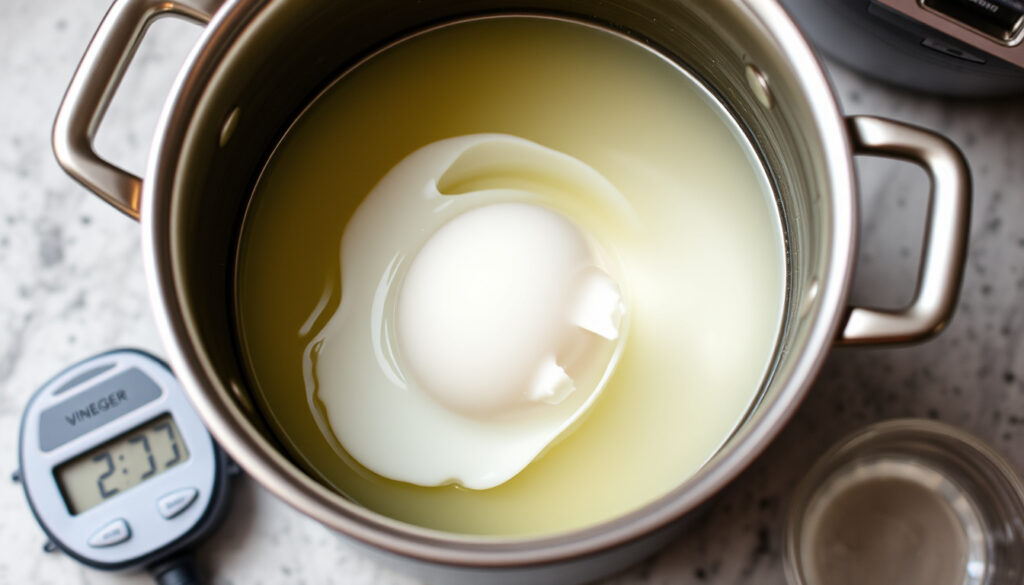
There’s something deeply satisfying about cutting into a perfectly poached egg and watching that golden yolk spill out. But the timing can feel like a guessing game — this guide lays out exact poaching times, the techniques that actually work, and the common mistakes to avoid, so you can get it right every time.
Standard poaching time: 3-4 minutes ·
Ideal water temperature: 180-190°F (82-88°C) ·
Vinegar per quart of water: 1 tablespoon ·
Egg freshness test: Float test (fresh eggs sink)
Quick snapshot
- Poaching time 3-4 minutes for runny yolk (RecipeTin Eats (food blog))
- Vinegar helps set whites quickly (Vital Farms (egg producer))
- Fresh eggs hold shape better (Vital Farms (egg producer))
- Exact microwave time varies by wattage (RecipeTin Eats (food blog) notes variation)
- Lid on vs off preference is debated among chefs (RecipeTin Eats (food blog))
- 3 min for soft yolk, 5 min for firmer (Wholefully (healthy living blog))
- Microwave: 60-90 seconds (RecipeTin Eats (food blog)) (Wholefully (healthy living blog))
- Silicone cup method: 3-4 min at simmer (Wholefully (healthy living blog))
- Try the whirlpool vs silicone cup method
- Adjust timing based on egg size and desired set
- Master making ahead and reheating
Four key numbers that define the perfect poach — each from tested kitchen methods.
| Factor | Value |
|---|---|
| Standard time | 3-4 minutes |
| Ideal water temp | 180-190°F (82-88°C) |
| Vinegar per quart | 1 tbsp |
| Egg freshness test | Float test — fresh eggs sink |
How long does it take to poach an egg?
Standard poaching time for runny yolk
- Most recipes agree on 3 to 4 minutes in simmering water for a perfectly runny yolk.
- RecipeTin Eats calls for about 2 minutes, with 1½ minutes giving just-cooked whites and still-liquid yolk (RecipeTin Eats (food blog)).
- Wholefully gives a range of 2 minutes for soft, 4 minutes for hard after reducing from a boil (Wholefully (healthy living blog)).
How to test for doneness
- Gently poke the white with a slotted spoon — it should feel set, not jiggly.
- Lift the egg slightly: if the white clings to the spoon and the yolk moves loosely underneath, it’s ready.
- For a firmer yolk, extend cooking by 1–2 minutes, watching carefully.
Factors affecting cooking time (egg size, temperature)
- Egg size matters: a jumbo egg takes about 30–60 seconds longer than a large.
- Water temperature should stay at a gentle simmer — bubbles from the base but no surface break (RecipeTin Eats (food blog)).
- Cooler water slows cooking; boiling water shreds the white.
The implication: mastery of poached eggs relies more on recognizing visual cues than strictly adhering to the clock.
What is the secret to making perfect poached eggs?
Using fresh eggs
- Fresh eggs have thicker whites that hold together — the white clings tightly to the yolk instead of spreading out in wispy tendrils.
- Check freshness with the float test: a fresh egg sinks and lies flat on its side.
The whirlpool method
- Stir the simmering water in one direction to create a gentle vortex, then drop the egg into the centre.
- Wholefully and RecipeTin Eats both recommend this technique to wrap the white around the yolk (Wholefully (healthy living blog); RecipeTin Eats (food blog)).
Adding vinegar to the water
- About 1 tablespoon of white vinegar per quart of water helps the egg white coagulate faster — a tip backed by both Vital Farms (egg producer) and Wholefully (healthy living blog).
- Too much vinegar can affect taste, so stick to the ratio.
Straining the egg before poaching
- Crack the egg into a fine-mesh strainer over a bowl. The thin, watery white drains away, leaving only the thick white that sets into a neat shape.
- RecipeTin Eats says this step “reduces untidy wisps” and is one of the most effective tweaks (RecipeTin Eats (food blog)).
The difference between a pristine poached egg and a ragged “jellyfish” is often just two steps: straining and a splash of vinegar. Together they cost 10 extra seconds but change the final look completely.
The pattern across expert sources is consistent: small preparatory steps yield disproportionate improvements in presentation.
Do you poach with the lid on or off?
Poaching with lid on: pros and cons
- Keeping the lid on traps steam, which can cook the top of the egg faster.
- But it also increases the risk of overcooking — the yolk can set before the white is fully done.
Poaching with lid off: recommended technique
- Most professional cooks poach uncovered so they can see the egg at all times.
- RecipeTin Eats notes that bubbles from the base should be visible, but no surface disturbance (RecipeTin Eats (food blog)).
Should you turn off the heat?
- Some chefs turn off the heat after adding the egg and let the residual warmth finish the cooking — gentle heat helps avoid a rubbery white.
- Wholefully uses this method in one of its four approaches, with the egg cooked for 4 minutes after the heat is off (Wholefully (healthy living blog)).
What this means for the home cook is that vigilance and control trump any set-it-and-forget-it approach.
What are common mistakes when poaching eggs?
Using old eggs
- Old eggs have thin, watery whites that spread out into frayed edges.
- The float test is your friend: old eggs stand upright in water or float.
Water too hot or too cold
- Boiling water shreds the egg white instantly; too-cold water means the white disperses before setting.
- The sweet spot is 180-190°F — small bubbles rising from the pan bottom but the surface stays still.
Not using vinegar or salt
- Vinegar accelerates coagulation. Salt breaks it down, so hold the salt until after cooking.
- Vital Farms recommends 1 tablespoon of white vinegar per pot (Vital Farms (egg producer)).
Overcrowding the pan
- Adding too many eggs at once drops the water temperature, making the whites spread.
- Stick to 2–3 eggs at most in a standard saucepan.
Not draining the egg
- Skipping the strainer step lets the thin white create messy “angel wings.”
- A quick strain fixes this — it’s the single easiest improvement.
You can skip the vinegar and still get decent results with very fresh eggs. But if your eggs are a few days old, vinegar and straining become non‑negotiable for a tidy poach.
The catch: skipping these steps might still produce a decent egg, but consistency demands discipline.
Can you poach an egg in 3 minutes?
3-minute poached egg method
- Yes — a small egg in very hot (but not boiling) water can be done in 3 minutes.
- Jamie Oliver simmers his cling‑film‑wrapped eggs for 6–7 minutes, but for a loose poach in water, 3 minutes works for a runny centre (Jamie Oliver (chef)).
How to poach an egg in a microwave (60-90 seconds)
- Crack the egg into a microwave-safe bowl with ½ cup water and a splash of vinegar.
- Cover and microwave on high for 60–90 seconds (timings depend on your microwave’s wattage — start at 60 and add 10 seconds as needed).
- RecipeTin Eats notes that microwave results vary widely, so test once to learn your machine’s sweet spot (RecipeTin Eats (food blog)).
Poaching in a silicone cup
- Grease the cup, crack the egg in, and place the cup in simmering water for 3–4 minutes.
- The cup holds the egg’s shape, so you don’t need a whirlpool.
Poaching without a poacher
- Use the whirlpool method with a slotted spoon.
- Or use a small ramekin to gently lower the egg into the water — RecipeTin Eats suggests teacups to reduce the drop distance (RecipeTin Eats (food blog)).
The implication for enthusiasts is that modern shortcuts like microwaves and silicone cups lower the barrier to entry without sacrificing quality.
Step‑by‑step poaching guide
- Start with fresh eggs — test freshness with a float or simply check the pack date. Fresh whites stay compact.
- Bring water to a boil, then reduce to a simmer — small bubbles from the pan bottom, no surface break.
- Add 1 tablespoon of white vinegar per quart of water to help the white set.
- Crack the egg into a fine‑mesh strainer to remove watery whites.
- Gently tip the egg from the strainer into a small bowl or teacup — this makes lowering it into the water easier.
- Create a gentle whirlpool with a spoon, then slide the egg into the centre.
- Cook for 3–4 minutes (or 2 minutes for very soft, 5 minutes for firm). For multiple eggs, add them one by one within 15 seconds (RecipeTin Eats (food blog)).
- Remove with a slotted spoon, drain briefly on a paper towel, and serve immediately.
Rotate the egg 20 seconds in — RecipeTin Eats confirms this simple twist helps the white wrap evenly, giving you a perfectly rounded result every time.
What’s clear and what’s still debated
Confirmed facts
- Poaching time for runny yolk: 3–4 minutes in simmering water.
- Vinegar (1 tbsp per quart) helps the white coagulate quickly.
- Fresh eggs yield the best shape — thin whites make wispy edges.
What’s unclear
- Exact microwave time varies by wattage — test your own machine.
- Lid on vs lid off is a matter of preference, not universal best practice.
- Whether to turn off the heat vs maintain a bare simmer is debated among chefs.
- Straining the egg removes the watery white that causes ragged edges — widely practiced but precise efficacy varies by egg freshness.
- The whirlpool method wraps the white around the yolk effectively — technique outcome is highly dependent on water movement consistency.
What the experts say
“Straining the egg makes all the difference. You get rid of the thin white that floats away and you’re left with a neat, compact shape.”
— RecipeTin Eats (food blog)
“Poached eggs can be cooked in simmering water for about 6 to 7 minutes for a runny yolk. The cling‑film method is a great cheat for perfect shape.”
The takeaway for home cooks is simple: start with the freshest eggs you can find, use a strainer, add a splash of vinegar, and keep the water at a gentle simmer. For the classic runny yolk, aim for 3 to 4 minutes. If you want a more forgiving method, silicone cups or the microwave can get you similar results with less skill required. For the brunch lover or the Sunday‑morning cook, the choice is no longer a guessing game — pick your method, set your timer, and enjoy that perfect golden spill.
For a more comprehensive breakdown of cooking times, see this detailed poaching timing guide that covers every method in depth.
Frequently asked questions
What temperature should the water be for poached eggs?
Between 180-190°F (82-88°C) — a gentle simmer with small bubbles rising from the pan bottom but no surface break.
Should I add salt to poached eggs?
No — salt breaks down the egg white and makes it spread. Add salt after cooking.
How do I poach an egg without vinegar?
Use very fresh eggs and strain them. You can also poach in milk or broth, though texture will be slightly different.
Can I poach eggs ahead of time?
Yes. Poach them just underdone, plunge into an ice water bath, and refrigerate. Reheat in simmering water for 30-60 seconds.
What is the best pan for poaching eggs?
A wide, shallow saucepan (8-10 inch) gives you room to create a whirlpool and to add multiple eggs without crowding.
How many eggs can I poach at once?
In a standard pan, no more than 2-3 at a time. More than that drops the water temperature and results in ragged whites.
Why do my poached eggs look like jellyfish?
That’s the thin white spreading out. Fix it by straining the egg before poaching and using fresh eggs.

Oliver William Davies Thompson is a staff writer for MetroReport.uk, covering city news, transport, housing and urban policy. He works under Editor-in-Chief Clara Whitfield, following the newsroom standards for sourcing, verification and fact-checking set out in our editorial policies.