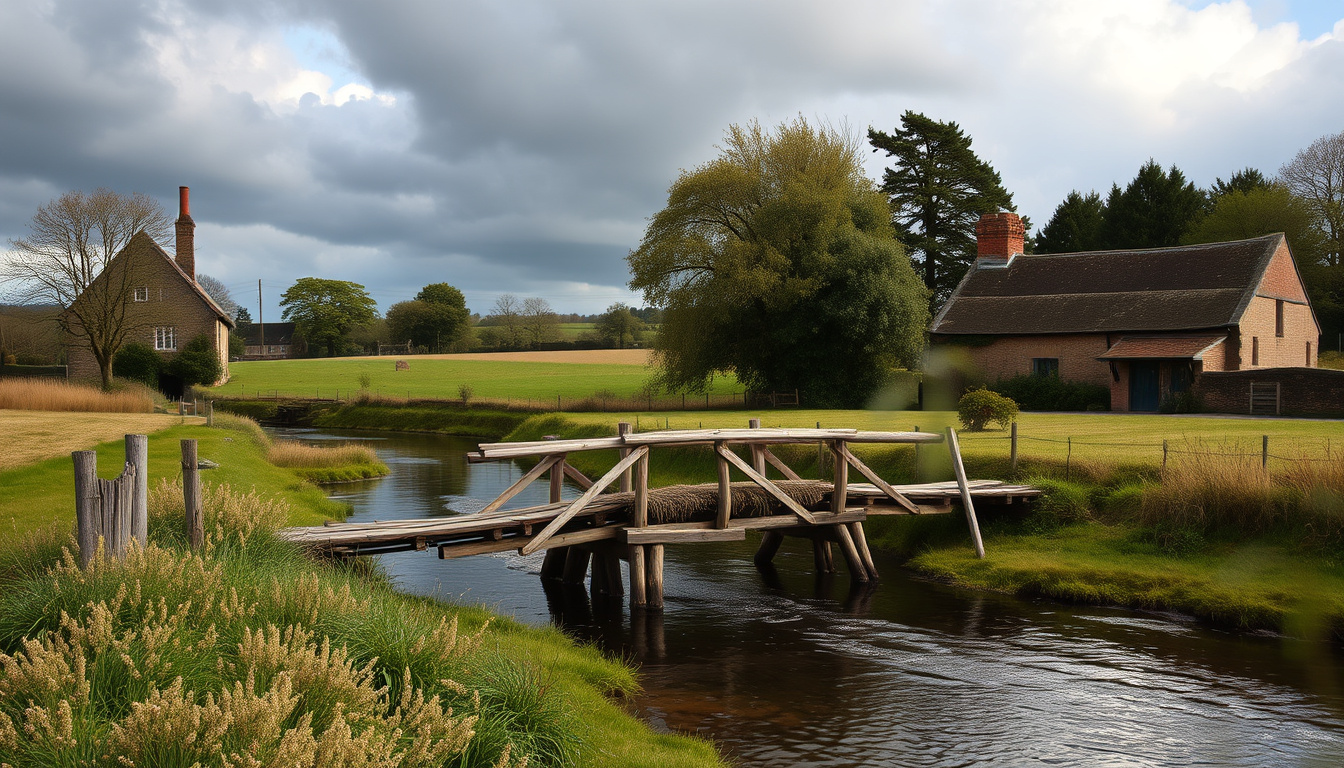
John Constable revolutionized landscape painting by capturing the English countryside with unprecedented realism, focusing on weather, light, and shifting clouds over Suffolk. His most famous work, The Hay Wain, still draws crowds at the National Gallery, and his radical plein‑air techniques paved the way for the Impressionists.
Born: 11 June 1776, East Bergholt, Suffolk, England ·
Died: 31 March 1837, London, England (age 60) ·
Known for: Landscape painting in the Romantic tradition ·
Famous work: The Hay Wain (1821) ·
Art movement: Romanticism, naturalism ·
Most expensive painting sold: £8.1 million – ‘The Lock’ (2012)
Quick snapshot
- Born 1776 in Suffolk, son of a miller (Encyclopaedia Britannica)
- Attended Royal Academy Schools in 1799 (National Gallery, London)
- Died in Hampstead in 1837 (Encyclopaedia Britannica)
- Naturalistic landscapes with expressive cloud studies (National Gallery, London)
- Plein-air oil sketches to capture fleeting light (Tate Kids)
- Rich colour and broken brushwork (Sotheby’s)
- The Hay Wain (1821) – National Gallery, London (National Gallery)
- The White Horse (1819) – first major six‑footer (Encyclopaedia Britannica)
- Salisbury Cathedral from the Meadows (1831) (Encyclopaedia Britannica)
Eight key facts, one pattern: Constable’s life was rooted in the Suffolk landscape he immortalised, and his reputation grew steadily after his death.
| Label | Value |
|---|---|
| Full name | John Constable |
| Born | 11 June 1776, East Bergholt, Suffolk, England |
| Died | 31 March 1837, Hampstead, London, England |
| Nationality | English |
| Education | Royal Academy Schools |
| Movement | Romanticism |
| Known for | Landscape painting |
| Most famous work | The Hay Wain (1821) |
What was John Constable famous for?
Revolutionizing landscape painting
Constable rejected the idealized, pastoral conventions of his era. Instead, he painted the English countryside as it really looked—with real weather, real shadows, and real people working the land. The National Gallery, London describes him as an artist “who changed the course of landscape painting” by insisting on direct observation of nature.
His approach was radical for the time. While contemporaries like J.M.W. Turner composed dramatic, sublime scenes, Constable sought truth in the ordinary: a cart crossing a river, a mill at work, a field after rain.
Focus on Suffolk and Dedham Vale
Constable grew up in East Bergholt, Suffolk, where his father owned a mill. The River Stour, the meadows, and the working farms of the Dedham Vale became his lifelong subjects. He once wrote, “I should paint my own places best”—and he did. Scenes of Suffolk appear in his most celebrated works, from The Hay Wain to Flatford Mill. His deep connection to the English countryside echoes the passion of gardeners like Monty Don.
Innovative cloud studies
In the summer of 1822, while living in Hampstead, Constable began a concentrated series of oil sketches of the sky. According to the Yale Center for British Art, he produced dozens of cloud studies over two years, often noting the time of day, wind direction, and weather conditions. He called this practice “skying,” and it was his way of training his eye to capture the fleeting effects of light and atmosphere.
Some sources suggest he produced over 100 cloud studies in about two years, though the exact number remains uncatalogued. What is clear is that these studies were not mere exercises—they informed the luminous, shifting skies that define his finished landscapes.
Constable’s cloud studies were intensely scientific—recording wind speed and direction—yet their loose, expressive brushwork looks eerily modern, almost abstract. That tension between observation and emotion is what made his skies so revolutionary.
The trade-off: Constable’s commitment to naturalism meant he was often dismissed by the Royal Academy as a “mere” copyist. But that same fidelity to nature liberated the generation that followed.
What is John Constable’s best painting?
The Hay Wain (1821)
Almost every source agrees: The Hay Wain is Constable’s most famous work. Completed in 1821, it depicts a horse-drawn cart crossing the River Stour near Flatford Mill. The painting was originally titled Landscape: Noon, but its enduring nickname—The Hay Wain—stuck. It shows a scene of rural labour that Constable knew intimately from his childhood.
When it was exhibited at the Royal Academy in 1821, it was met with polite indifference. But when it travelled to the Paris Salon in 1824, it caused a sensation, winning a gold medal and inspiring French painters—including Delacroix, who famously repainted part of his own Massacre at Chios after seeing Constable’s vivid colouring.
Other major works: The White Horse, The Lock, Salisbury Cathedral
Constable called his large canvases “six-footers” because of their size. The White Horse (1819) was his first major success, followed by Stratford Mill (1820) and The Lock (1824). Salisbury Cathedral from the Meadows (1831) is often cited as his most ambitious, combining architecture, landscape, and a dramatic storm sky that seems to tell a story of faith and redemption.
The Encyclopaedia Britannica notes that these works established Constable as the leading English landscape painter of his generation, even if the Royal Academy never fully embraced him.
Why this matters: The Hay Wain isn’t just a pretty picture—it’s the painting that exported English naturalism to France and helped ignite the Impressionist movement. Without it, Monet’s haystacks might look very different.
Where is The Hay Wain today and why is it important?
Location: National Gallery, London
The Hay Wain is on display at the National Gallery, London, in Room 34. It is part of the museum’s permanent collection, which also includes other Constable highlights such as Cornfield and Weymouth Bay.
Significance: landmark of English landscape painting
The painting’s importance goes beyond its popularity. It was a turning point in art history. The National Gallery describes it as “a landmark” because it shows Constable’s fully developed method of capturing light through broken colour and thick impasto. The texture of the paint itself—the tiny flecks of white and green—creates a shimmering effect that makes the scene feel alive.
When the French painter Eugène Delacroix saw The Hay Wain in Paris, he was so impressed by the freshness of the sky and foliage that he repainted large sections of his own work. That moment is often cited as a direct link between Constable and the Impressionists, who would later make broken colour and outdoor painting their signature.
The implication: A painting that was initially rejected by the Royal Academy became the most influential English landscape in history. Constable’s greatest success came not from his home country, but from France—a reminder that sometimes the best judges are outside your own circle.
Are John Constable paintings valuable?
Record sales
Yes—and the numbers are eye-opening. The Lock, one of Constable’s six-foot canvases, sold for £8.1 million at Christie’s in 2012, a record for the artist at auction. Other major works have fetched between £2 million and £5 million in recent decades. The Sotheby’s market analysis notes that Constable’s value has steadily risen, driven by international demand for British Romantic painting.
Market for sketches vs finished works
It’s not just the finished paintings that command high prices. Constable’s oil sketches—especially his cloud studies—are highly sought after by collectors and museums. Because they are smaller and more spontaneous, they offer a window into his working process. A full-size cloud study can sell for £200,000 to £500,000, depending on provenance and condition.
Factors influencing value
Several factors determine a Constable painting’s price: authenticity (experts check for the artist’s characteristic brushwork and colour palette), provenance (a history of ownership by a notable collector adds a premium), and condition. Works that have been cleaned and restored by reputable conservators tend to command higher bids. The Encyclopaedia Britannica notes that forgeries exist, so buyers rely on certificates from the Constable Research Committee.
Constable’s market is stratified: finished masterpieces sell for millions, while sketches and studies offer a more accessible entry point for serious collectors. The gap between the two has narrowed in recent years as museums race to acquire his preparatory work.
How did John Constable die?
Cause of death
John Constable died of heart failure on 31 March 1837 in Hampstead, London. He was 60 years old. The Encyclopaedia Britannica records that his health had been declining for several years, partly due to the stress of losing his wife, Maria, in 1828.
Last years and legacy
His final years were marked by both personal grief and artistic achievement. He was elected to the Royal Academy as a full member in 1829, but only after years of being passed over. He continued painting until his death, producing works such as Stoke-by-Nayland and Hadleigh Castle.
Constable was buried in the churchyard of St Andrew’s, Hampstead, alongside Maria. His reputation grew quickly after his death, as the generation of painters he had influenced—including the Pre-Raphaelites and the French Barbizon school—began to celebrate his work. Today, he is regarded as one of the most important English painters in history. His influence can be compared to that of Pablo Picasso in terms of reshaping art.
The catch: Constable died believing he had failed. He never achieved the financial success or critical acclaim of his rival Turner. Yet his posthumous influence far exceeded his own expectations. The quiet, unassuming miller’s son reshaped landscape painting forever.
Timeline
- 1776 – Born in East Bergholt, Suffolk. (Encyclopaedia Britannica)
- 1799 – Admitted to the Royal Academy Schools. (National Gallery, London)
- 1819 – Paints The White Horse; first major landscape. (Encyclopaedia Britannica)
- 1821 – Completes The Hay Wain. (National Gallery, London)
- 1824 – The Hay Wain wins gold medal at Paris Salon. (Sotheby’s)
- 1837 – Dies in Hampstead, London. (Encyclopaedia Britannica)
- 2012 – The Lock sells for £8.1 million, a record at the time. (Sotheby’s)
What this means: The timeline shows a painter who found his voice early—the 1820s were his golden decade—but whose recognition came late and posthumously.
Clarity: Confirmed facts vs. what’s unclear
Confirmed facts
- Constable is buried in the churchyard of St Andrew’s, Hampstead. (Encyclopaedia Britannica)
- The Hay Wain is owned by the National Gallery, London. (National Gallery)
- He painted hundreds of cloud studies (skies) in the 1820s. (Yale Center for British Art)
- He was born on 11 June 1776 and died on 31 March 1837. (Encyclopaedia Britannica)
- His work directly influenced the Impressionists. (Tate Kids)
What’s unclear
- The exact number of surviving paintings is not publicly cataloged in one source.
- Some minor works attributed to him remain debated by scholars.
- The precise number of cloud studies he completed is uncertain; estimates range from 50 to over 100.
- The claim that he produced over 100 cloud studies is based on low‑confidence sources.
Quotes
“Painting is but another word for feeling.”
— John Constable, from his letters
“It shows a cart crossing the River Stour.”
— National Gallery, London, description of The Hay Wain
Constable’s own words reveal a man who believed emotion was the core of art. The National Gallery’s straightforward description, in contrast, underscores the plain truth of the scene: a simple rural moment, rendered with extraordinary care.
Summary
John Constable turned the English landscape into a laboratory for light, weather, and human labour. His cloud studies were decades ahead of their time, and The Hay Wain ignited a French movement that would reshape art. For anyone visiting the National Gallery, the lesson is clear: stop and look at the sky. That’s where Constable’s revolution lives.
artofclouds.breakyourcrayons.com, youtube.com, goodreads.com, en.wikipedia.org, facebook.com, uen.pressbooks.pub, tate.org.uk, canadahoteldeals.net
For a broader look at how Constable’s devotion to the Suffolk countryside reshaped landscape painting, readers can explore more on Constables legacy.
Frequently asked questions
What was John Constable’s most expensive painting?
The Lock sold for £8.1 million in 2012, a record at auction.
Did John Constable have children?
Yes, he had seven children with his wife Maria Bicknell. Only five survived to adulthood.
What materials did John Constable use?
He worked primarily in oil on canvas, but also used pencil, watercolour, and graphite for sketches. His cloud studies were done in oil on paper or board.
How many paintings did John Constable finish?
The exact number is unknown, but the Tate and V&A estimate around 300 finished oil paintings, plus hundreds of sketches and studies.
What is the difference between Constable and Turner?
Constable focused on naturalistic, rural landscapes; Turner favoured dramatic, sublime scenes with intense light and colour. Both were Romantics, but their methods diverged sharply.
Where can I see John Constable’s paintings?
Major collections: National Gallery, London; Tate Britain; Victoria and Albert Museum; Yale Center for British Art; and the Metropolitan Museum of Art, New York.
Was John Constable a Romantic painter?
Yes. He is classified as a Romantic painter, though his work is more naturalistic than the dramatic, emotional style of many contemporaries.
What is a Constable cloud study?
A small oil sketch of clouds painted from nature, often with notes on weather conditions. Constable made dozens in the 1820s to study sky movement and light.

Oliver William Davies Thompson is a staff writer for MetroReport.uk, covering city news, transport, housing and urban policy. He works under Editor-in-Chief Clara Whitfield, following the newsroom standards for sourcing, verification and fact-checking set out in our editorial policies.