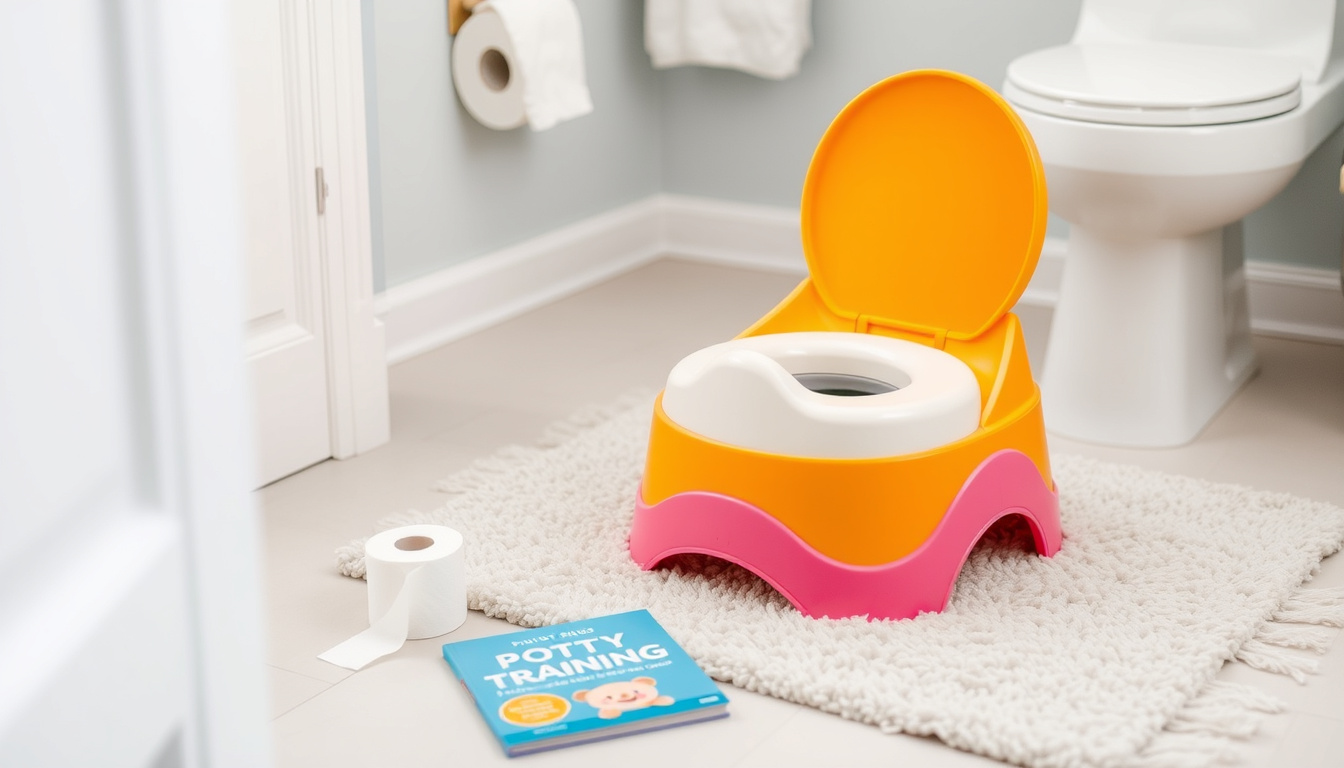
If you’ve spent any time around a toddler, you already know that potty training isn’t a single event — it’s a stretch of messy, unpredictable days. But with experts disagreeing on everything from the ideal starting age to what “potty trained” really means, it’s easy to feel like you’re already behind. This guide cuts through the noise with data-backed answers to the questions parents actually ask, from readiness signs and gender differences to what those red flags mean — and whether a 3-day method is realistic.
Average age to start training: 18–24 months ·
Average completion age: 36 months ·
3-year-olds trained: 75% ·
Common red flag: Pain during bowel movements ·
Gender gap: Boys finish 2–3 months later
Quick snapshot
- Potty training means teaching a child to use the toilet independently, including recognizing the urge, pulling down pants, using the toilet, flushing, and washing hands with minimal help (Wikipedia – reference work).
- Readiness signs typically appear between 18 and 24 months, but most children complete training by age 3 (UC Davis Health – pediatric care).
- Girls typically finish training 2–3 months earlier than boys, though overall success rates are similar (Healthline – parenting resource).
- Pain during urination or bowel movements, chronic constipation, and sudden regression after success all warrant attention (Mayo Clinic – pediatric health).
Six key facts, one pattern: timing and readiness vary more than many guides suggest, and gender differences are real but modest.
| Fact | Detail |
|---|---|
| Average age to start training | 18–24 months |
| Average completion age | 36 months |
| Percentage of 3-year-olds trained | 75% |
| Common red flag | Pain during bowel movements |
| Gender difference | Boys typically finish 2–3 months later than girls |
| Key readiness sign | Staying dry for 2+ hours |
Parents who expect a single “right age” will miss the more useful question: Is my child showing readiness signs? Pediatric guidance from UC Davis Health (pediatric care) makes clear that readiness matters more than the calendar.
What is considered potty trained?
Defining independent toileting
At its simplest, a child is potty trained when they can recognize the need to go, pull down their own pants, use the toilet, flush, and wash their hands — all with minimal assistance. The ERIC (UK children’s bowel and bladder charity) describes this as “potty learning,” a broader view that includes the child’s emotional readiness alongside the physical mechanics.
“Potty learning respects a child’s pace and reduces pressure, while the term ‘potty trained’ often implies a fixed timeline that many children cannot meet.” — ERIC (UK children’s bowel and bladder charity)
For parents, the difference between “potty learned” and “potty trained” matters: the former respects a child’s pace and reduces pressure, while the latter often implies a fixed timeline that many children cannot meet.
The role of daytime and nighttime training
Daytime dryness typically comes first, often by 36 months. Nighttime dryness follows later — usually between ages 4 and 5 — and is largely physiological. The NHS (UK health authority) notes that nighttime control depends on bladder capacity and hormone development, not training effort.
The implication: A child who is “potty trained” during the day but still wets overnight is completely normal. Confusing the two milestones can create unnecessary worry for families.
At what age are children potty trained?
Typical age range
Readiness signs usually emerge between 18 and 24 months, and most children complete daytime training by 36 months. CDC (US public health agency) developmental milestones place toileting skills in the 3-year-old range.
The age-based pattern shows a clear progression from readiness to mastery.
| Age range | Typical development |
|---|---|
| 18–24 months | Readiness signs appear (staying dry 2 hours, interest in toilet) |
| 24–36 months | Active training period; most achieve daytime dryness |
| By 36 months | 75% of children are potty trained (daytime) |
| 4–5 years | Nighttime dryness typically achieved |
Readiness signs
- Staying dry for at least two hours at a time
- Showing interest when others use the toilet
- Being able to pull pants up and down
- Communicating the need to go (verbally or nonverbally)
The American Academy of Pediatrics (AAP – child development guidance) emphasizes that waiting until a child shows multiple signs makes training faster and less stressful.
What percentage of 3-year-olds are potty trained?
Pediatric data consistently places the figure at roughly 75% for 3-year-olds in the US. That means one in four children that age is not yet fully trained — a share large enough to reassure any parent feeling behind. HealthyChildren.org (AAP parent resource) notes that the 75% figure includes children who still have occasional accidents.
What this means: The “typical” age window is wider than most parents realize. A child who isn’t trained at 3 may simply be part of the normal 25% tail, not a cause for concern.
Is potty training harder for boys or girls?
Differences in timing
Girls tend to complete potty training about 2–3 months earlier than boys, according to data reviewed by Healthline (parenting resource). However, Blueberry Pediatrics (pediatric telehealth) notes that gender itself has little to do with how early or late a child becomes fully trained — the gap is small and averages out.
The comparison between boys and girls reveals more similarities than differences.
| Factor | Boys | Girls |
|---|---|---|
| Average completion (daytime) | 36–38 months | 33–35 months |
| Typical first position | Sitting | Sitting |
| Standing to urinate | Learned later (after sitting is established) | Not applicable |
| Overall success rate | Equivalent to girls | Equivalent to boys |
Biological and social factors
The small timing difference likely reflects a mix of biological maturity and social modeling. Boys Town National Research Hospital (pediatric care) advises starting boys by having them sit down to urinate during the early phase, then transitioning to standing later — a two-stage process that adds a layer of complexity.
“Boys need to learn sitting first to simplify bowel training, then add standing later after the routine is solid.” — Boys Town National Research Hospital (pediatric care)
The gap is often exaggerated in parenting circles. Parents of boys may feel pressure to “catch up” to girls, but the data shows most children reach the same endpoint within a narrow window. The real variable is readiness, not gender.
Tips for each gender
- For boys: Teach sitting first to simplify bowel training, then add standing later after the routine is solid, as recommended by Boys Town National Research Hospital (pediatric care).
- For girls: Wiping front-to-back is an important early skill to teach, and sitting is the standard position from the start.
What are red flags for potty training?
Physical red flags
- Pain during urination or bowel movements
- Chronic constipation (hard, dry stools fewer than 3 times per week)
- Frequent urinary tract infections
- Soiling underwear (encopresis) after training seemed established
The Mayo Clinic (pediatric health) flags pain during toileting as a primary reason to pause training and consult a pediatrician.
“Pain during urination or bowel movements is a red flag that warrants a pause in training and a call to your pediatrician.” — Mayo Clinic (pediatric health)
Behavioral red flags
- Refusal to sit on the potty for more than a few seconds
- Hiding during bowel movements
- Sudden regression after a period of success
- Extreme fear or anxiety about using the toilet
When to seek medical advice
If red flags persist for more than two weeks, a pediatrician should evaluate for underlying issues such as constipation, infection, or sensory concerns. KidsHealth (pediatric education) recommends bringing up potty training concerns at routine well-child visits even if no specific red flag is present.
What to watch: The most common hidden cause of stalled training is undiagnosed constipation. Mayo Clinic and Zero to Three (child development organization) both emphasize that treating the underlying physical issue often resolves the behavioral resistance.
How to potty train a child in 3 days?
Preparation before the 3-day method
- Confirm your child shows readiness signs (staying dry 2+ hours, ability to pull pants up/down, basic communication)
- Clear the calendar — the method demands full parent attention for three consecutive days
- Stock supplies: underwear, training pants, a potty chair or adapter, rewards (stickers, small treats)
Cleveland Clinic (medical institution) describes the 3-day method as an intensive process in which potty training is the only agenda item and diapers are removed completely (except for sleep).
Step-by-step day plan
- Day 1: Kickoff and familiarity — Start as soon as the child wakes up; visit the bathroom right away, as recommended by Pull-Ups (training pants brand). Use a timer: take the child to the potty every 20 minutes, keeping them seated for 2–3 minutes, per Cleveland Clinic (medical institution). Reward every successful attempt immediately. Accidents are cleaned up calmly without shaming.
- Day 2: Build consistency — Extend intervals to every 30–45 minutes. Watch for body language signs (squatting, holding, facial expressions) and prompt proactively. What to Expect (parenting resource) notes that children are usually put back in diapers or training pants overnight during the process.
- Day 3: Reinforce and extend — Encourage the child to initiate independently; let them lead when possible. Try a short outing (30–60 minutes) in underwear to test generalization. Continue the same rewards and schedule.
The 3-day method works well for some families, but Mayo Clinic notes that potty training typically takes at least three months of daily practice — not three days. Parents using intensive methods should prepare for partial success and ongoing follow-up.
Adapting for boys or girls
Boys should learn sitting first, then transition to standing after bowel routines are established, as advised by Boys Town National Research Hospital (pediatric care). For girls, the same sitting approach works from the start, with early instruction on wiping front-to-back.
Summary
Potty training isn’t a race, but the confusion around it can feel like one. Between conflicting advice on when to start, how long it takes, and whether boys and girls differ, parents are left navigating a map with inconsistent landmarks. The data from UC Davis Health (pediatric care) and CDC (public health agency) draws a clearer picture: most children finish by 36 months, gender differences are small, and red flags — especially pain — deserve a pause and a pediatrician’s input. For parents considering the 3-day method, the honest answer is that it’s a plausible start, not a guarantee. For parents feeling behind because their 3-year-old isn’t there yet: you’re in the 25% that’s perfectly normal. The choice is clear: watch for readiness, not the calendar, and trust the process, not the hype.
Related reading: Meghan Trainor: Weight Loss, Children, Surrogacy, PTSD · Prince Louis: Biography, Health Rumors, and Why We See Him Less
Frequently asked questions
What is the best potty training method?
There is no single “best” method. Research shows that methods combining readiness signs, consistency, and positive reinforcement — whether intensive (3-day) or gradual — succeed when the child is developmentally ready. UC Davis Health (pediatric care) emphasizes matching the method to the child’s temperament rather than following a rigid plan.
Should I use a potty chair or a toilet adapter?
Both work. A potty chair is portable, less intimidating, and gives the child control. A toilet adapter with a step stool saves cleanup and transitions the child to the adult toilet sooner. HealthyChildren.org (AAP parent resource) suggests letting the child choose if possible.
How do I handle potty training regression?
Regression is common and often temporary. Causes include stress (new sibling, starting school), illness, or constipation. NHS (UK health authority) recommends staying calm, returning to basics (frequent prompts, rewards), and addressing any underlying physical issues.
What if my child refuses to use the potty?
Refusal often signals that the child is not ready or is anxious about the process. Forcing the issue can backfire. Zero to Three (child development organization) advises taking a break of 1–3 months and trying again after the child shows new readiness signs.
Is it normal for potty training to take months?
Yes. Mayo Clinic says potty training typically takes at least three months of daily practice. Full nighttime dryness often takes years. The 3-day method is an outlier in terms of speed, not the norm.
What are the signs of potty training readiness?
Key signs include: staying dry for 2+ hours, showing interest in the toilet, being able to pull pants up/down, communicating the need to go, and having regular bowel movements. Most children show these signs between 18 and 24 months.
How can I make potty training fun for my child?
Use sticker charts, special potty books, or a small reward like a treat for successful attempts. Let the child pick their own underwear or potty chair. KidsHealth (pediatric education) notes that positive reinforcement works better than punishment or pressure.

Oliver William Davies Thompson is a staff writer for MetroReport.uk, covering city news, transport, housing and urban policy. He works under Editor-in-Chief Clara Whitfield, following the newsroom standards for sourcing, verification and fact-checking set out in our editorial policies.