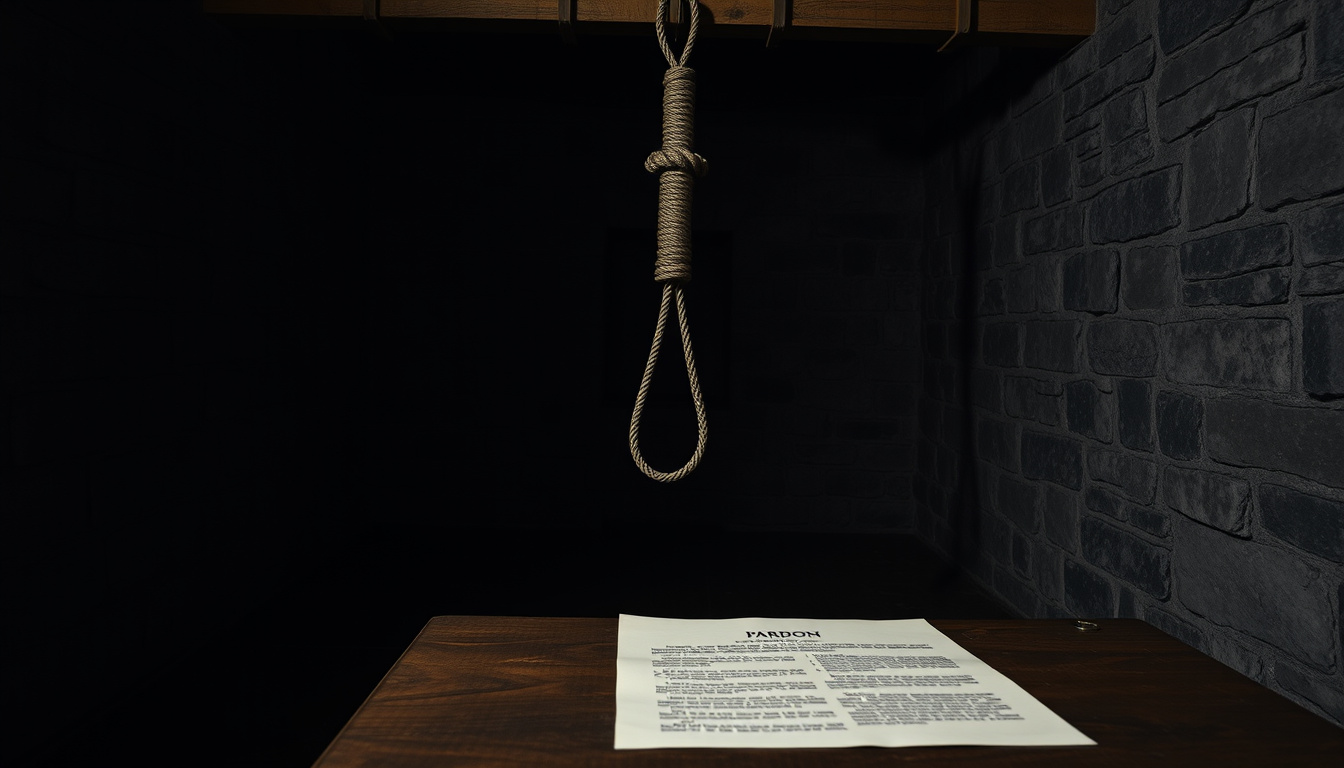
The story of Ruth Ellis doesn’t sit comfortably in the past. Six decades after her execution, her grandchildren are still fighting to clear her name — and a new TV series has brought the debate roaring back to life.
Last woman hanged in the UK: 13 July 1955 ·
Victim: David Blakely ·
Age at execution: 28 years old ·
Place of execution: Holloway Prison, London ·
Surviving children: Two: son Andy and daughter Georgina
Quick snapshot
- Ruth Ellis shot and killed David Blakely on 10 April 1955 (Mishcon de Reya, law firm for the family)
- She was executed at Holloway Prison at 09:01 on 13 July 1955 (Mishcon de Reya)
- She left two children: Georgina and Andre (Andy) (Mishcon de Reya)
- Desmond Cussen supplied the revolver used in the shooting (BBC News, UK public service broadcaster)
- Whether Ellis acted under sudden provocation or with premeditation (Mishcon de Reya)
- Full extent of Desmond Cussen’s coercive influence (BBC News)
- How modern domestic-abuse laws might have affected the verdict (Mishcon de Reya)
- Current status of the CCRC review as of 2025 (Mishcon de Reya)
- 1955: Ellis hanged 22 days after conviction (Mishcon de Reya)
- 2024: Grandchildren submit application to CCRC for posthumous pardon (Mishcon de Reya)
- 2025: “A Cruel Love: The Ruth Ellis Story” premieres (IMDb, film database)
- CCRC to decide whether to refer the case back to the Court of Appeal (Mishcon de Reya)
- Possible posthumous conditional pardon from the Ministry of Justice (Mishcon de Reya)
- New documentary and public debate sparked by the TV series (BBC News)
Nine facts, one pattern: Ellis’s story moves from a brief life to a rapid trial and execution, then a slow, modern reckoning with justice.
Ellis’s case: a working-class woman caught in a violent relationship, convicted in a two-day trial, and hanged 22 days later — a punishment that has haunted British justice ever since.
The implication: her case became a flashpoint for the death penalty debate, but the full context of abuse only gained traction decades later.
| Attribute | Detail |
|---|---|
| Full name | Ruth Ellis, née Neilson |
| Date of birth | 9 October 1926 |
| Date of death | 13 July 1955 |
| Occupation | Nightclub hostess, manageress |
| Victim | David Blakely |
| Weapon | .38 revolver |
| Sentence | Death by hanging |
| Children | Andy (son), Georgina (daughter) |
| Burial location | Amersham, Buckinghamshire |
What is the true story of Ruth Ellis?
- Born Neilson on 9 October 1926 in Rhyl, North Wales (Wikipedia, the user-edited encyclopedia)
- Worked as a nightclub hostess and later managed a club (Mishcon de Reya)
- Convicted of murdering David Blakely in April 1955 (Mishcon de Reya)
- Executed by hanging on 13 July 1955, the last woman to be executed in the United Kingdom (Mishcon de Reya)
The pattern: a life cut short by a justice system that gave her just 22 days between conviction and death.
Bottom line: Ruth Ellis was a working-class woman caught in a violent relationship, convicted in a two-day trial, and hanged 22 days later — a punishment that has haunted British justice ever since.
Why did Ruth Ellis shoot Blakely?
- David Blakely was a racing driver and her lover; the relationship was marked by violence, alcohol, and infidelity (BBC News)
- Ellis shot Blakely outside the Magdala Tavern in Hampstead on 10 April 1955 (Mishcon de Reya)
- She used a .38 revolver supplied by Desmond Cussen (BBC News)
- At trial she said she meant to kill him, but her lawyers later argued she was mentally unstable and provoked (Mishcon de Reya)
What this means: the courtroom narrative omitted the pattern of domestic abuse that modern observers see as central to her state of mind.
Under current UK law, victims of domestic violence who kill their abuser can use the partial defence of loss of control. Ellis never had that chance — and the 50,000-signature petition for clemency was ignored because the trial judge did not put that question to the jury (Wikipedia).
What happened to Ruth Ellis’s children after she was hanged?
- Son Andy was born in November 1944; daughter Georgina was born in October 1951 (Mishcon de Reya)
- After the execution, the children were raised by relatives — Andy kept a low profile; Georgina had a difficult childhood (Centre for Crime and Justice Studies, UK research institute)
- Georgina died in her 40s in 2001; Andy is still alive and supports the pardon campaign (BBC News)
- Four grandchildren — Stephen Beard, Laura Enston, James Enston, and Chloe Beard — are leading the bid for a posthumous conditional pardon (Mishcon de Reya)
The pattern: the children’s suffering became a quiet, decades-long argument for mercy, one that the original authorities refused to hear.
What role did Desmond Cussen play in the Ruth Ellis case?
- Desmond Cussen was a wealthy businessman and a former lover of Ellis (BBC News)
- He provided the .38 revolver used in the murder (BBC News)
- New evidence suggests he drove Ellis to the scene of the shooting and may have coerced her (Mishcon de Reya)
- His role is a central pillar of the pardon campaign, which argues that full culpability was shared (Mishcon de Reya)
The catch: Cussen was never charged, and the trial judge did not allow the jury to hear details of their relationship.
What is the 2025 TV series ‘A Cruel Love: The Ruth Ellis Story’?
- Title: ‘A Cruel Love: The Ruth Ellis Story’ (IMDb)
- Premiered in 2025 on streaming platforms (listed on IMDb) (IMDb)
- Portrays her life, relationship with Blakely, and trial (BBC News)
- Stars Lucy Boynton as Ruth Ellis (IMDb)
- Renews public interest in the case and the pardon bid (BBC News)
Why this matters: the dramatisation has brought new audiences into the debate, with many viewers asking why Ellis was hanged when a modern jury might not have convicted of murder at all.
Within weeks of the series launch, web searches for “Ruth Ellis grandchildren” and “pardon campaign” spiked. The show acts as an accessible entry point, but the legal fight — led by the charity Mishcon de Reya — predates it by years (Mishcon de Reya).
Why are Ruth Ellis’s grandchildren seeking a pardon?
- They argue Ellis was a victim of domestic abuse and coercive control, not a cold-blooded murderer (BBC News)
- The murder conviction, they say, should be reduced to manslaughter under modern partial defences (Mishcon de Reya)
- New evidence about Desmond Cussen’s involvement was never put to the jury (Mishcon de Reya)
- The campaign is supported by the Miscarriages of Justice Organisation (CrowdJustice, legal funding platform)
- In 2024, the grandchildren applied to the Criminal Cases Review Commission (CCRC) (Mishcon de Reya)
The trade-off: a conditional pardon would not quash the conviction, but it would formally acknowledge that the state should not have put a 28-year-old mother to death.
Timeline of the Ruth Ellis case
Eight dates define the arc from birth to posthumous legal fight.
| Date/Period | Event |
|---|---|
| November 1944 | Birth of son Andy |
| 1950 | Marries George Ellis; separation soon after |
| October 1951 | Birth of daughter Georgina |
| 1953–1954 | Relationship with David Blakely begins |
| 10 April 1955 | Shoots and kills David Blakely outside Magdala Tavern |
| 20 June 1955 | Trial concludes; convicted of murder |
| 13 July 1955 | Executed by hanging at Holloway Prison |
| 2024 | CCRC receives application from grandchildren for pardon review |
| 2025 | Premiere of TV mini-series ‘A Cruel Love: The Ruth Ellis Story’ |
What stands out: the 22-day gap between conviction and execution — one of the fastest in modern British history — left no room for proper scrutiny of the evidence.
Confirmed facts vs. what remains unclear
Confirmed facts
- Ruth Ellis was the last woman executed in the UK (Mishcon de Reya)
- She shot and killed David Blakely on 10 April 1955 (Mishcon de Reya)
- She was hanged on 13 July 1955 (Mishcon de Reya)
- She had two children: Andy and Georgina (Mishcon de Reya)
- Desmond Cussen provided the revolver (BBC News)
What’s unclear
- Exact nature of coercion or premeditation at time of shooting (Mishcon de Reya)
- Full extent of Desmond Cussen’s involvement and influence (BBC News)
- Whether reduced culpability due to domestic abuse would have changed the verdict under modern law (Mishcon de Reya)
- Status of the CCRC review as of 2025 (Mishcon de Reya)
Key voices in the Ruth Ellis story
“I meant to kill him.”
– Ruth Ellis, at her trial, as recorded in court transcripts (Wikipedia)
“She was a victim of domestic violence. The person who should have been in the dock with her was Desmond Cussen.”
– Stephen Beard, Ruth Ellis’s grandson, speaking to BBC News in 2024 (BBC News)
“The application for a posthumous conditional pardon will be considered by the Ministry of Justice in due course.”
– CCRC spokesperson, responding to the 2024 submission (Mishcon de Reya)
The fate of Ruth Ellis sits at the intersection of domestic violence, outdated justice, and a family’s decades-long fight for recognition. Unlike the Ronnie Biggs case, where the criminal became a folk anti-hero, Ellis was never allowed a second chance. For her grandchildren, the next step is a formal decision from the CCRC — which could either confirm or finally correct one of the most controversial sentences in British history.
mishcon.com, mishcon.com, npr.org, facebook.com, wkar.org, imdb.com, youtube.com, nyhetskanalen.nu
För den som vill fördjupa sig i hennes historia finns den nya dramatiserade serien som sänder 2025 och skildrar de avgörande händelserna.
Frequently asked questions
Was Ruth Ellis the last woman executed in the UK?
Yes. Ruth Ellis was the last woman to be executed in the United Kingdom, hanged on 13 July 1955 (Mishcon de Reya).
How long was Ruth Ellis in prison before execution?
From her conviction on 20 June 1955 to her execution on 13 July 1955 — just 23 days (Mishcon de Reya).
Did Ruth Ellis have any living relatives today?
Yes. Her son Andy is still alive, and four grandchildren — Stephen Beard, Laura Enston, James Enston, and Chloe Beard — are leading the pardon campaign (Mishcon de Reya).
What was the public reaction to Ruth Ellis’s execution?
Public sympathy was strong, partly because she was a mother of two. A 50,000-signature petition for clemency was submitted but rejected (Wikipedia).
Has the Ruth Ellis case been re-examined by modern courts?
Not yet. The grandchildren applied to the CCRC in 2024 for a review. If the CCRC refers the case, the Court of Appeal could potentially quash the murder conviction (Mishcon de Reya).
Where can I watch ‘A Cruel Love: The Ruth Ellis Story’?
The series is listed on IMDb as a 2025 release. Check streaming platforms such as ITVX or other UK on-demand services for availability (IMDb).
What changes in UK law came after Ruth Ellis?
Her case contributed to the growing movement against capital punishment. The death penalty for murder was suspended in 1965 and fully abolished in 1969. The Homicide Act 1950, under which she was sentenced, was replaced by the Murder (Abolition of Death Penalty) Act 1965 (Mishcon de Reya).
Related reading: Ronnie Biggs: Escape, Fugitive Years, and Return | Emmeline Pankhurst: Life, Quotes & Suffragette Legacy

Oliver William Davies Thompson is a staff writer for MetroReport.uk, covering city news, transport, housing and urban policy. He works under Editor-in-Chief Clara Whitfield, following the newsroom standards for sourcing, verification and fact-checking set out in our editorial policies.