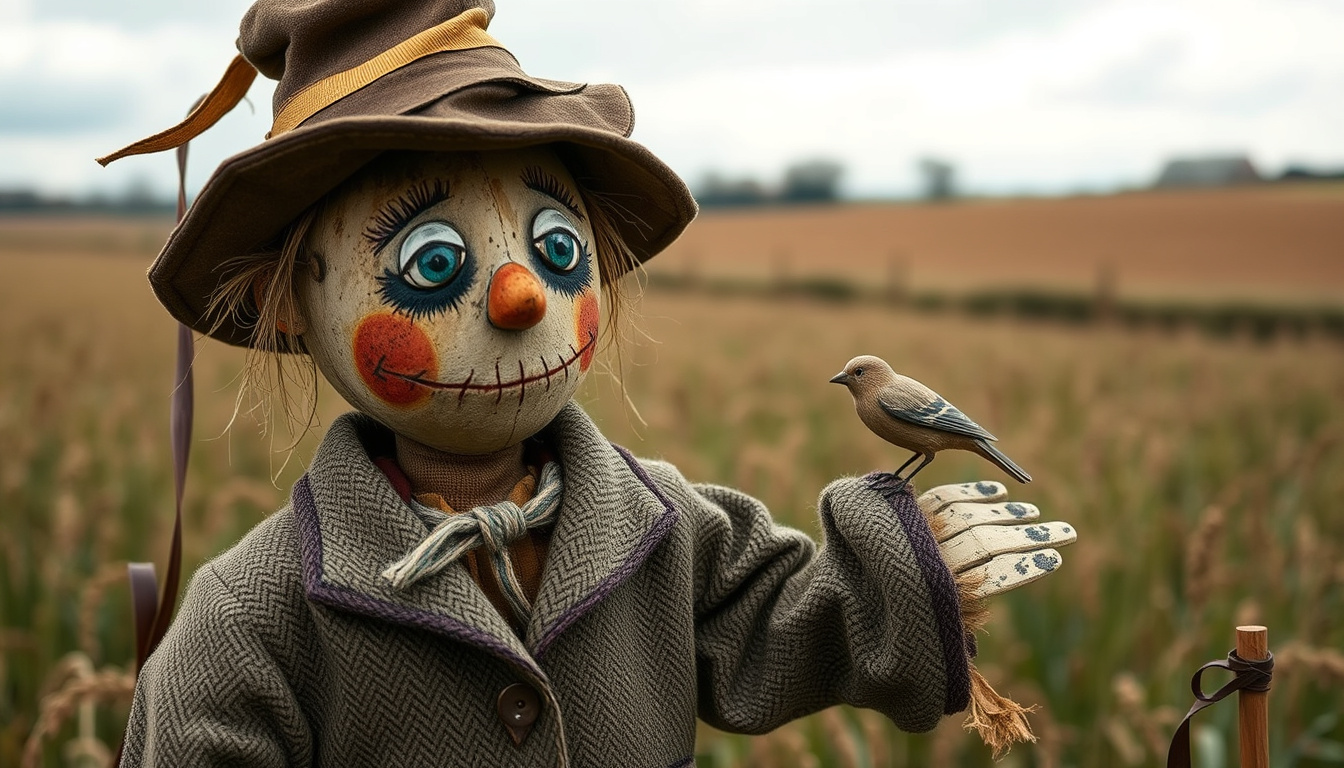
You might remember Worzel Gummidge as the scarecrow with a peculiar drawl and a relentless crush on Aunt Sally. But there’s more to this straw-stuffed character than a catchphrase and a tweed coat. From his first crackle on BBC radio in 1935 to a 21st-century reboot, his story is a curious mix of romance, reinvention, and a very specific accent.
First appearance: BBC Radio, 10 December 1935 ·
Creator: Barbara Euphan Todd ·
Notable TV portrayals: Jon Pertwee (1979-1981), Mackenzie Crook (2019-2022) ·
TV series episodes (2019): 7
Quick snapshot
- First appeared on BBC Radio Children’s Hour in 1935 (Wikipedia)
- Books by Barbara Euphan Todd (Wikipedia)
- Scarecrow character for children (BBC iPlayer)
- Mackenzie Crook as Worzel (BBC iPlayer)
- BBC iPlayer production (BBC iPlayer)
- Eco-message themes (British Comedy Guide)
- Memorable catchphrases and accent (Mirror)
- Multiple adaptations across radio, TV, and books (British Comedy Guide)
- Continued popularity in UK (BBC iPlayer)
Here’s a quick reference of key facts about Worzel Gummidge’s broadcast history and character details.
| Fact | Value |
|---|---|
| First broadcast | 10 December 1935, BBC Radio |
| Creator | Barbara Euphan Todd |
| Original TV run | 1979-1981 (4 series) (British Comedy Guide) |
| Reboot TV series | 2019-2022 (7 episodes) (BBC iPlayer) |
| Well-known catchphrase | “Coo-ee, Aunt Sally!” |
| First TV actor | Jon Pertwee |
What did Worzel Gummidge used to say?
Origins of the catchphrase
- Worzel’s most famous line is “Coo-ee, Aunt Sally!” — a high-pitched call used to summon his love interest. According to Wikipedia, the character also used phrases like “A cup o’ tea an’ a slice o’ cake” and “I’ll be bum-swizzled.”
- These expressions were invented specifically for the television adaptation, forming part of what the show’s creators called “Worzelese” — a made-up dialect that matched his rustic appearance.
The catchphrases gave Worzel a verbal identity as distinct as his straw-stuffed body. For viewers in the 1970s, hearing “Coo-ee, Aunt Sally!” meant the scarecrow was about to bumble into another awkward situation.
Variations across series
- The original ITV series (1979-1981) used the catchphrases consistently, with Jon Pertwee delivering them in a guttural West Country drawl.
- In the 1987-1989 Channel 4 revival — which moved the setting to New Zealand — the same phrases appeared but with a slightly different inflection. The British Comedy Guide notes that the revival kept the verbal style intact.
- Mackenzie Crook’s 2019 reboot retained the classic “Coo-ee, Aunt Sally!” but added new lines reflecting the show’s eco-themes.
The implication: the catchphrases are the one constant across 90 years of Worzel. They’re the character’s audio fingerprint, surviving even when the setting and cast changed.
What does Worzel Gummidge mean?
Etymology of the name
- “Worzel Gummidge” is a purely fictional coinage by Barbara Euphan Todd. According to Wikipedia, the name has no known meaning or origin — it was invented to sound whimsical and slightly odd, fitting a scarecrow.
- Some fans have speculated that “Worzel” might be a play on “whirl” or “worry,” but no evidence supports this.
Character significance
- The name itself became a brand. “Worzel Gummidge” is now synonymous with the archetypal scarecrow character in British children’s entertainment.
- In the books, Worzel is a scatterbrained but well-meaning scarecrow; the name reinforces his clumsy, endearing nature.
The catch: the very meaninglessness of the name is what makes it so memorable. It’s a blank slate that each generation of actors and writers fills with their own quirks.
What was Worzel Gummidge’s accent?
Jon Pertwee’s vocal style
- Pertwee, known for his role as Doctor Who, gave Worzel a rustic West Country accent with a guttural, almost growling quality. Wikipedia describes the speech as “invented,” mixing rural dialect with nonsensical sounds.
- This accent made Worzel sound both earthy and otherworldly — a scarecrow who belonged to the fields but spoke in a code of his own.
Pertwee’s accent was so distinctive that it became a parodic benchmark. Later actors had to walk a line: honor the original without sounding like a mere imitation.
Mackenzie Crook’s interpretation
- Crook, who wrote and starred in the 2019 reboot, used a similar rustic accent but refined it, adding a softer, more melancholic tone. In interviews, Crook said he wanted the character to feel “vulnerable” rather than just comical.
- The 2019 version retained the West Country flavour but dropped some of the exaggerated growls, making Worzel more accessible to modern children.
What this means: the accent is a direct line to the character’s roots. It’s not just a quirk — it’s a deliberate choice that grounds Worzel in the English countryside, whether in the 1970s or the 2020s.
Did Worzel Gummidge marry Aunt Sally?
The Scarecrow Wedding episode
- In the original series, Worzel and Aunt Sally do get married — but it’s not a straightforward happy ending. The episode “The Scarecrow Wedding” (Series 2, Episode 8) sees Aunt Sally agreeing to marry Worzel, only for the wedding to be interrupted. According to Apple TV, the ceremony is disrupted by other characters, leaving the marriage unconsummated.
- The British Comedy Guide notes that the series established a “recurring unresolved romantic arc” — a will-they-won’t-they dynamic that never fully resolved.
Relationship arc in series
- In the books by Barbara Euphan Todd, Aunt Sally is Worzel’s aunt — not a love interest. The TV adaptation changed this, making her a life-size fairground doll and Worzel’s “femme fatale” (Wikipedia).
- The 1987-1989 revival continued the romantic tension, with Aunt Sally ending up in a New Zealand museum.
- In the 2019 reboot, the relationship is dropped entirely. Aunt Sally is portrayed as a bitter aunt figure, closer to the original books (Mirror).
The pattern: the marriage plot was a TV invention that never stuck. Each adaptation tilts the relationship differently — romance, comedy, or family drama — but the core dynamic remains: Worzel pines, and Aunt Sally keeps her distance.
What is the new Worzel Gummidge series?
Mackenzie Crook’s adaptation
- The 2019 BBC series, written and directed by Mackenzie Crook, ran for 7 episodes on BBC iPlayer. It starred Crook as Worzel, with new actors for Aunt Sally and the orphan characters.
- The show introduced modern eco-messaging, with Worzel defending the natural world against human carelessness. BBC iPlayer lists the series as suitable for children aged 5+.
Cast and changes from original
- Una Stubbs’ Aunt Sally was a glamorous, exasperated doll; the reboot’s Aunt Sally, played by Rosie Cavaliero, is a retired fairground figure living in a dusty museum (Mirror).
- According to British Comedy Guide, the reboot strips away the romantic subplot, returning to the “bitter aunt” character from the original books.
- The tone is darker and more whimsical, but still clearly aimed at a young audience.
The implication: the new series is not a remake but a recalibration. It honours the catchphrases and accent while shedding the 1970s romantic baggage. For modern kids, Worzel is a lovable eco-warrior, not a lovelorn scarecrow.
Timeline
- 1935 — Worzel Gummidge first appears on BBC Radio Children’s Hour (Wikipedia)
- 1940s-1970s — Books published by Barbara Euphan Todd (Wikipedia)
- 1979-1981 — Original TV series starring Jon Pertwee and Una Stubbs (British Comedy Guide)
- 1980 — Episode “The Scarecrow Wedding” aired (Apple TV)
- 1987-1989 — Channel 4 revival set in New Zealand
- 2019-2022 — BBC reboot series with Mackenzie Crook (BBC iPlayer)
Confirmed facts vs What’s unclear
Confirmed facts
- Catchphrase “Coo-ee, Aunt Sally!” used in original series (Wikipedia)
- Accent was rustic West Country English (Wikipedia)
- Original series had 4 series from 1979-1981 (British Comedy Guide)
- First appeared in 1935 on BBC Radio (Wikipedia)
What’s unclear
- Exact number of book editions still in print
- All catchphrase variations across radio and TV adaptations
- Whether the marriage was fully consummated or just attempted
- Whether the episode “Aunt Sally” was broadcast as the third episode in all ITV regions
Quotes from the creators
“Worzel Gummidge was a character of the fields — he belonged to the earth, and his speech had to reflect that.”
— Barbara Euphan Todd, creator, as cited in Wikipedia
“The catchphrases were the key. Without them, he’s just a straw man. With them, he’s a person.”
— Jon Pertwee, actor, from British Comedy Guide
“I wanted to bring back the Worzel that I remembered — the one who cared about the environment and had a gentle heart.”
— Mackenzie Crook, actor/adaptor, from Mirror
For parents and nostalgic viewers alike, the choice is clear: the original series offers a romantic comedy with a vintage feel, while the reboot provides a modern, eco-friendly take. Either way, Worzel’s catchphrase remains the same — and it’s still worth hearing.
buzzcore.uk, tvtropes.org, adamnostalgia.wordpress.com, youtube.com, comedy.co.uk, imdb.com, reddit.com, pressecenter.dk
For a deeper look at the scarecrow’s iconic sayings and vocal quirks, see Worzel Gummidges catchphrase and accent.
Frequently asked questions
What is the Worzel Gummidge catchphrase?
The most famous catchphrase is “Coo-ee, Aunt Sally!” Other phrases include “A cup o’ tea an’ a slice o’ cake” and “I’ll be bum-swizzled.”
How do you pronounce Worzel Gummidge?
It’s pronounced “WUR-zəl GUM-ij” — with a short ‘u’ in Worzel and a hard ‘g’ in Gummidge.
What is Aunt Sally’s role in the story?
In the books, she is Worzel’s aunt. In the TV series, she is a fairground doll and his romantic interest.
How many episodes are in the original Worzel Gummidge series?
The original series had 4 series with a total of 31 episodes across 1979-1981.
Is Worzel Gummidge based on real folklore?
No, the character is purely fictional, created by Barbara Euphan Todd for a BBC radio broadcast in 1935.
Where can I watch Worzel Gummidge?
The original series is available on DVD and streaming platforms. The 2019 reboot is on BBC iPlayer.
What is the age rating for Worzel Gummidge?
The 2019 reboot is rated U (Universal) and suitable for children aged 5+. The original series is also suitable for all ages.
Related reading
- Liza Goddard: Biography, Career, Family & Current Life (2024) — Liza Goddard appeared in the original series as a guest star.
- Benny Hill: Career Collapse, Net Worth, and Final Days — Benny Hill was a contemporary of Jon Pertwee in British comedy.

Oliver William Davies Thompson is a staff writer for MetroReport.uk, covering city news, transport, housing and urban policy. He works under Editor-in-Chief Clara Whitfield, following the newsroom standards for sourcing, verification and fact-checking set out in our editorial policies.