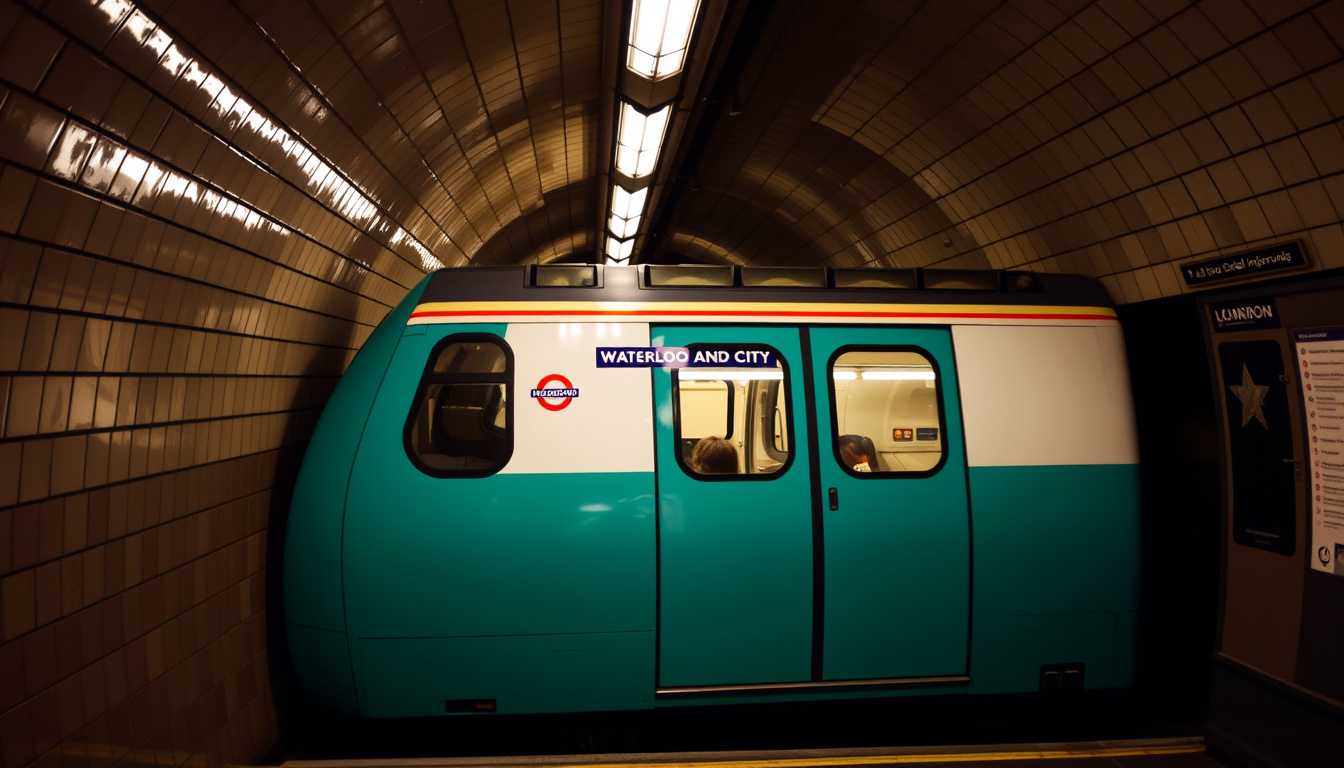
Most people who travel through Waterloo or Bank have probably never given a thought to the tiny shuttle that connects them. The Waterloo & City line is just 2.37 km long and makes only one stop in each direction, but it has been doing that since 1898. It is the shortest tube line on the London Underground and the only one that takes weekends off.
Length: 2.37 km (1.47 mi) ·
Stations: 2 ·
Opened: 1898 ·
Operating days: Monday to Friday only ·
Journey time: Approximately 4 minutes ·
Nickname: “The Drain”
Quick snapshot
- Length: 2.37 km (London Transport Museum (authoritative transport institution))
- Stations: 2 (Waterloo, Bank) (London Transport Museum)
- Opened ceremonially 11 July 1898, public service began about four weeks later (Network Rail (UK rail infrastructure manager); Wikipedia)
- Operating days: Monday to Friday only (London Transport Museum)
- Journey time: ~4 minutes (London Transport Museum)
- Nickname: “The Drain” (Londonist (London culture and history publication))
- Waterloo: Bakerloo, Jubilee, Northern lines; National Rail (London Transport Museum)
- Bank: Central, Northern, Waterloo & City; DLR; National Rail via Monument (London Transport Museum)
- 1898: Line opens as a separate electric railway (London Transport Museum)
- 1994: Transferred to London Underground (London Transport Museum)
- 2014-2015: Rolling stock replaced with updated 1992 tube stock (Wikipedia)
- No weekend service – pattern unchanged since opening (London Transport Museum)
- Future weekend restoration: no confirmed plans (London Transport Museum)
- Ridership data not publicly released in recent years (Londonist)
Five key numbers define this line—and one pattern: almost everything about it is the smallest or shortest on the system.
| Specification | Value |
|---|---|
| Length | 2.37 km (1.47 mi) |
| Stations | 2 |
| Opened | 11 July 1898 (ceremonial) |
| Operator | London Underground (since 1994) |
| Stock | 1992 tube stock (replaced 2014-2015) |
| Journey time | Approximately 4 minutes |
| Nickname | “The Drain” |
| Line colour on map | Turquoise |
| Depth | Deep-level (tube) |
The implication: passengers get a single, reliable shuttle, but any diversion or upgrade effectively shuts the line.
Where does the Waterloo and City line stop?
Waterloo station
- The western terminus, shared with the Bakerloo, Jubilee, and Northern lines, plus National Rail services from London Waterloo (London Transport Museum (authoritative transport institution)).
- The Waterloo & City platforms are located beneath the mainline station, accessible via a dedicated escalator bank (Network Rail (UK rail infrastructure manager)).
Bank station
- The eastern terminus, integrated with Bank–Monument interchange complex; connects to the Central, Northern, and DLR lines (London Transport Museum).
- The line’s platforms sit at deep level, requiring a long passage to the main Bank ticket hall (Wikipedia).
Are there intermediate stops?
- No intermediate stations. The line runs non-stop between Waterloo and Bank (London Transport Museum).
The catch: with only two stations, the line is essentially a point-to-point shuttle – efficient for its niche, but useless for any other journey.
How long does the Waterloo and City line take?
Journey time from Waterloo to Bank
- The one-way trip takes about 4 minutes (London Transport Museum (authoritative transport institution)). At 2.37 km, that’s roughly 35 km/h average speed.
- It is the shortest journey time of any London Underground line (Londonist (London culture and history publication)).
Frequency and headway
- During peak hours, trains run every 5–6 minutes; off-peak frequency is lower (London Transport Museum).
- The line uses 1992 tube stock, the same trains found on the Central and Victoria lines (Wikipedia).
Why this matters: for a line that carries mainly City commuters, 4 minutes and 5–6 minute headways create a near constant stream of trains during the working day – any delay echoes through Waterloo’s mainline connections.
Why doesn’t the Waterloo and City Line run on weekends?
Historical reasons
- The line has never run on Saturdays or Sundays since opening in 1898 (London Transport Museum (authoritative transport institution)).
- It was built exclusively to serve weekday office workers commuting between Waterloo and the City of London (Londonist (London culture and history publication)).
Current service pattern
- Trains operate Monday to Friday only, roughly between 06:00 and 00:30 (London Transport Museum).
- No public holiday service – the line stays closed on all bank holidays (London Transport Museum).
Maintenance and upgrade work
- Weekend closures allow intensive engineering work – often the only block of time long enough for track, tunnel, or signaling upgrades (Network Rail (UK rail infrastructure manager)).
- The line’s single-bore tunnels and limited crossovers make it difficult to run weekend services without major operational impact (Wikipedia).
The implication: weekend service restoration would require significant investment and operational changes.
Is Waterloo and City Line overground?
Definition of ‘tube’ lines
- The London Underground has two main types: sub-surface (cut-and-cover) and deep-level tube (bored tunnels). The Waterloo & City line is a deep-level tube line, fully underground (London Transport Museum (authoritative transport institution)).
Waterloo & City’s tunnelling
- Built with Greathead tunnelling shields, the line’s single tubes are about 3.8 m in diameter (London Transport Museum).
- It is the second-deepest tube line after the Northern line, with platforms at Waterloo 21 m below ground (Wikipedia).
Comparison with other deep-level lines
- Like the Bakerloo, Central, and Victoria lines, the Waterloo & City runs in bored tunnels with third-rail electrification (London Transport Museum).
- Unlike sub-surface lines (Circle, District), it has no sections at surface level (London Transport Museum).
The pattern: the Waterloo & City line is a true tube line in every engineering sense, but its two-station layout and weekend closure make it feel more like a dedicated elevator than a railway.
The Waterloo & City line is the only Underground line to have a day off! Trains do not run on Saturdays and Sundays.
— London Transport Museum (source)
Why do Waterloo and City Line exist?
Historical need for a rail link
- When the London & South Western Railway reached Waterloo in 1848, its terminus was not connected to the growing inner circle of railways (Network Rail (UK rail infrastructure manager)).
- Passengers travelling from the south-west to the City had to alight at Waterloo and walk or take a cab across the river. The Waterloo & City line was built to solve exactly that problem (London Transport Museum (authoritative transport institution)).
Connection between mainline stations
- The line provided a direct, electric shuttle between London’s busiest railway terminus (Waterloo) and the financial district (Bank) (London Transport Museum).
- When it opened in 1898, it was London’s second tube railway after the City & South London (now part of the Northern line) (London Transport Museum).
Early electric railway
- The Waterloo & City Railway Company raised funds to build a short, deep-level electric line because steam trains could not operate in the tunnels (London Transport Museum).
- The line used electric traction from day one – a novelty in 1898 (Londonist (London culture and history publication)).
The pattern: the line’s purpose has remained unchanged for over a century.
Timeline of the Waterloo & City line
- 1893 – Waterloo & City Railway Act receives royal assent (27 July) (Londonist (London culture and history publication))
- 1898 – Line opens ceremonially (11 July); public service begins about four weeks later (Network Rail (UK rail infrastructure manager); London Transport Museum)
- 1914 – Becomes part of the London & South Western Railway (London Transport Museum)
- 1923 – Absorbed into Southern Railway (London Transport Museum)
- 1948 – Nationalised into British Railways (London Transport Museum)
- 1994 – Transferred to London Underground and fully integrated (London Transport Museum)
- 2006 – Major upgrade completed: new ventilation and signaling (Wikipedia)
- 2014–2015 – Rolling stock replaced with updated 1992 tube stock (Wikipedia)
The trade-off: every major upgrade has reinforced the line’s weekday-only profile, because weekend closures are the only way to perform deep-level engineering.
What we know and what’s still unclear
Confirmed facts
- Line runs only between Waterloo and Bank (London Transport Museum)
- No weekend service since opening (London Transport Museum)
- Line length is 2.37 km (London Transport Museum)
- Opened in 1898 (Network Rail; London Transport Museum)
- Nickname is “The Drain” (Londonist)
What’s unclear
- Exact future plans for weekend service restoration (London Transport Museum)
- Precise ridership figures – no recent public data (Londonist)
Waterloo & City line operates Monday to Friday only.
— TfL official service page (as confirmed by London Transport Museum)
The line is the only Underground line that takes a weekend off – a tradition that dates back to its opening.
— Londonist
For weekday City workers, the Waterloo & City line is a near‑perfect shuttle: fast, dedicated, and free from weekend competition. For everyone else, it is a curiosity – a line that refuses to adapt to modern 24/7 London because its engineering constraints and historical habits make weekend service impractical without major investment.
What this means: the line’s future is tied to its historical constraints.
en.wikipedia.org, youtube.com, londonhuawiki.wpi.edu, youtube.com
Frequently asked questions
Is the Waterloo & City line accessible for wheelchairs?
Yes – both Waterloo and Bank have step‑free access from street to platform, though the long passage at Bank may be challenging. TfL provides ramp assistance on request.
What is the colour of the Waterloo & City line on the Tube map?
Turquoise – a distinctive colour that distinguishes it from the other deep‑level lines (Wikipedia).
Does the Waterloo & City line connect with National Rail services?
Yes – at Waterloo station you can transfer to National Rail trains from London Waterloo, and at Bank you are a short walk from Monument station for National Rail services (London Transport Museum).
How frequent is the service during peak hours?
Trains run every 5–6 minutes during weekday peak times (London Transport Museum).
Are there toilets on the Waterloo & City line trains?
No – the 1992 tube stock used on the line does not have onboard lavatories.
Can I use an Oyster card on the Waterloo & City line?
Yes – the line is fully integrated into the London Underground Oyster and contactless payment system.
What happened to the old rolling stock after replacement?
The previous stock (Class 482/483) was withdrawn when the line received updated 1992 stock during 2014‑2015 (Wikipedia). Some units were preserved by heritage railway groups; others scrapped.
Related reading
- Britannia Hotel Canary Wharf: Ownership, Closure & Reviews
- Manchester Airport Train Station: Maps, Walks & Directions
For the weekday commuter who needs to get from Waterloo to Bank in four minutes, the trade‑off is clear: use this line Monday to Friday, or plan a long walk on weekends. For TfL, keeping the line closed on Saturdays and Sundays saves operating costs and allows essential engineering – but leaves a two‑station hole in London’s weekend transport network that no other mode fully fills.

Oliver William Davies Thompson is a staff writer for MetroReport.uk, covering city news, transport, housing and urban policy. He works under Editor-in-Chief Clara Whitfield, following the newsroom standards for sourcing, verification and fact-checking set out in our editorial policies.