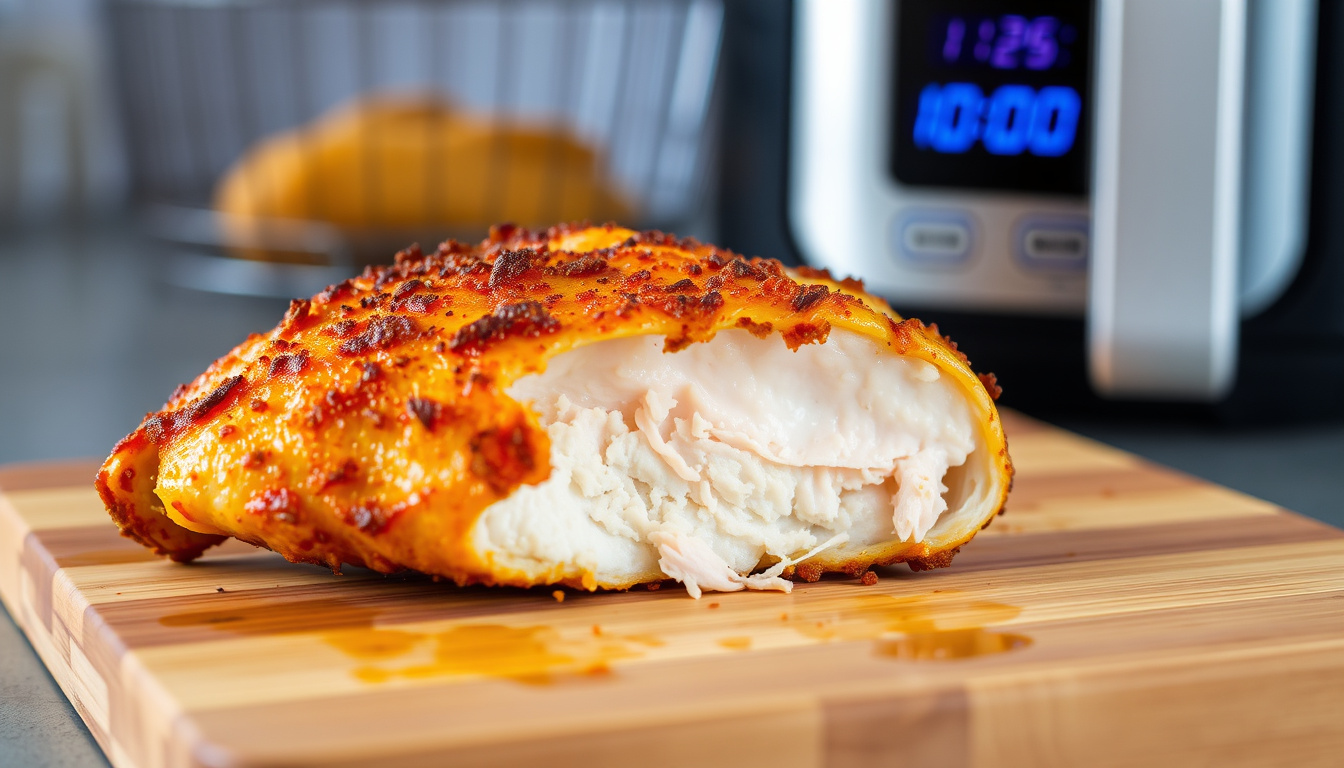
You’ve got boneless chicken breasts, an air fryer, and high hopes for a juicy dinner. But nailing the right temperature and timing can feel like a guessing game — especially when one wrong move turns tender meat into a dry disappointment. This guide pulls together tested temps, timings, and simple techniques so you can consistently cook chicken breast that’s moist, flavorful, and safe.
Cooking time: 12‑20 min ·
Temp: 375°F (190°C) ·
Safe internal temp: 165°F (74°C) ·
Key to juiciness: Brine 30 min ·
Flip halfway: Yes
Quick snapshot
- Safe internal temp is 165°F (USDA FSIS)
- Time depends on thickness (Springer Mountain Farms)
- Flip halfway for even cooking (Well Plated)
- How different brands affect exact cook time (Iowa Girl Eats notes variations)
- Optimal preheating duration – most say 3‑5 min, but no single standard (Springer Mountain Farms)
- Thin breast (150g): 10‑12 min at 375°F (Iowa Girl Eats)
- Medium (200g): 14‑16 min (Well Plated)
- Thick (250g+): 18‑20 min (Springer Mountain Farms)
- Rest 5‑10 min before slicing (The Pioneer Woman)
- Serve with sides or slice for salads (The Pioneer Woman)
How long do you cook chicken breast in the air fryer?
Standard cooking times by thickness
- Thin fillets (about 150g): 10‑12 minutes at 375°F – flip halfway. (Iowa Girl Eats recipe testing)
- Medium breasts (200g): 14‑16 minutes. (Well Plated test kitchen)
- Thick breasts (250g+): 18‑20 minutes. (Springer Mountain Farms guide)
Temperature guidelines for different air fryer models
- Most recipe testers agree: 375°F is the sweet spot. (Well Plated)
- Some models run hot or cool – Iowa Girl Eats recommends 360°F as a safe baseline. (Iowa Girl Eats)
- Platings + Pairings uses 370°F and gets consistent results. (Platings + Pairings recipe)
The implication: stick with 375°F for most air fryers, but if your machine runs hot, dropping by 10‑15°F won’t ruin the cook — just add a minute or two.
How to cook chicken breast in an air fryer without drying it out?
Brining techniques
- A quick 30‑minute brine (1 litre water + 3 tbsp salt) dramatically boosts moisture retention. (Well Plated)
- Dry brining (seasoning with salt and resting uncovered in the fridge for 2‑4 hours) is equally effective. (The Pioneer Woman test kitchen)
Using oil or marinades
- Lightly coat breasts with a high‑smoke‑point oil (avocado, canola, or grapeseed) – about 1‑2 tsp per breast. (Iowa Girl Eats)
- Marinades add flavor but can cause excess steam – pat dry before air frying to avoid soggy skin. (Springer Mountain Farms)
Too much oil creates smoke inside the basket; too little leaves the surface dry. One teaspoon per 200g breast is the balance most recipe developers settle on.
Avoiding overcooking
- Use an instant‑read thermometer – remove the breast when it hits 155‑160°F (carryover heat brings it to 165°F). (Well Plated)
- Rest for 5‑10 minutes under a loose foil tent; this allows juices to redistribute. (The Pioneer Woman)
Why this matters: pulling the breast a few degrees early means you never hit the rubbery, dry zone that comes from a full cook to 165°F inside the fryer.
How do you cook raw chicken in the air fryer?
Prepping raw chicken
- Pat the chicken dry with paper towels – moisture is the enemy of browning and crisp edges. (Springer Mountain Farms)
- If the breasts are unevenly thick, gently pound them to an even size (about 1‑inch thickness). (Iowa Girl Eats)
Seasoning options
- A simple salt‑pepper‑garlic‑powder blend works, but add herbs for variety – no oil needed for the rub. (Well Plated)
- Pre‑seasoned spice mixes (like Cajun or lemon‑pepper) are fine – just watch the sodium content if brining first. (Platings + Pairings)
Cooking process
- Preheat air fryer to 375°F for 3‑5 minutes. (Springer Mountain Farms)
- Place breasts in a single layer – they can touch but must not overlap. (Iowa Girl Eats)
- Cook for half the estimated time, then flip. Continue cooking until internal temperature reaches 155‑160°F (for carryover) or 165°F (if not resting). (Well Plated)
The trade‑off: skipping the preheat adds 2‑3 minutes of cook time and risks an uneven crust. Preheating is a small step with a big impact.
Do you wrap chicken breast in foil in an air fryer?
Pros and cons of foil
- Pro: foil catches drips and simplifies cleanup. (The Pioneer Woman)
- Con: foil blocks air circulation, steaming the chicken instead of crisping it. (Springer Mountain Farms)
When to use foil
- For very lean breasts that need extra moisture retention, a partial foil tent for the first half of cooking can help – but remove it for the second half. (Iowa Girl Eats)
- Avoid wrapping entirely – you lose the air fryer’s main advantage. (Well Plated)
Alternatives to foil
- Perforated parchment paper liners allow air to flow while catching drips. (Platings + Pairings)
- Nothing beats direct contact with the basket for a golden, crispy crust. (The Pioneer Woman)
Lining the basket with foil may also restrict the air fryer’s fan, causing hot spots. If you must use foil, leave gaps at the edges for airflow.
What are common air fryer mistakes?
Overfilling the basket
- Crowding creates steam instead of hot air circulation – cook in batches if needed. (Springer Mountain Farms)
Not preheating
- Starting with a cold basket extends cook time and reduces browning. (Iowa Girl Eats)
Using too little oil
- A dry surface won’t brown – a light coating of oil helps Maillard reaction and seals in moisture. (Well Plated)
Not flipping
- The bottom side stays wet if not flipped – flip halfway for even doneness and a crisp exterior. (Well Plated)
The pattern: nearly every common mistake boils down to blocking airflow or skipping a moisture‑management step – fix those and your chicken will improve dramatically.
Confirmed facts
- Safe internal temperature is 165°F – verified by the USDA (USDA FSIS)
- Cooking time scales with thickness – every recipe source agrees (Springer Mountain Farms)
- Patting chicken dry before seasoning is a must (Springer Mountain Farms)
- Flipping halfway through cooking is recommended by all tested recipes (Well Plated)
What’s unclear
- How different air fryer brands (Ninja, Philips, Cosori) affect exact cook time – limited side‑by‑side testing (Iowa Girl Eats)
- Optimal preheating duration – recipe sources range from 3 to 5 minutes without a single consensus (Springer Mountain Farms)
“Poultry is safe to eat at 165°F measured with a food thermometer.”
— U.S. Department of Agriculture (USDA FSIS), official poultry safety guidance
“The test kitchen recommends air‑frying chicken breast at 180°C (356°F) for 18‑20 minutes for a boneless breast.”
— BBC Good Food, test kitchen
For the home cook, the choice is clear: invest in a reliable instant‑read thermometer and commit to preheating, or risk dry, unevenly cooked chicken every time. A little prep work up front means you get juicy, perfectly cooked air‑fryer chicken breast – meal after meal.
For precise air fryer chicken breast timing, be sure to check this air fryer chicken breast timing guide that breaks down exact times and temperatures.
Frequently asked questions
Can I cook frozen chicken breast in an air fryer?
Yes, but add 5‑8 minutes to the cook time and season after cooking – frozen meat won’t hold a rub well. Ensure the internal temperature reaches 165°F.
Do I need to preheat the air fryer?
Most sources say yes – 3‑5 minutes at your target temperature. Preheating ensures consistent cooking and better browning.
How do I know when chicken breast is done?
The only reliable way is a food thermometer: 165°F at the thickest part. Color and juices can mislead.
What is the best oil to use?
High‑smoke‑point oils like avocado, canola, or grapeseed. Olive oil is fine but may smoke slightly at 375°F.
Can I use bone-in chicken breast?
Yes – expect 18‑26 minutes at 375°F. Flip halfway and verify internal temperature near the bone.
How do I store leftover air fried chicken?
Refrigerate in an airtight container for up to 3 days. Reheat in the air fryer at 350°F for 3‑4 minutes.
Can I marinate chicken before air frying?
Yes, but pat it dry first to avoid excess moisture in the basket. Marinating also helps moisture retention.
Why is my chicken dry?
Likely overcooked (temp exceeded 165°F), not rested, or the breast was too thin for the cook time. Use a thermometer and rest 5 minutes.

Oliver William Davies Thompson is a staff writer for MetroReport.uk, covering city news, transport, housing and urban policy. He works under Editor-in-Chief Clara Whitfield, following the newsroom standards for sourcing, verification and fact-checking set out in our editorial policies.