
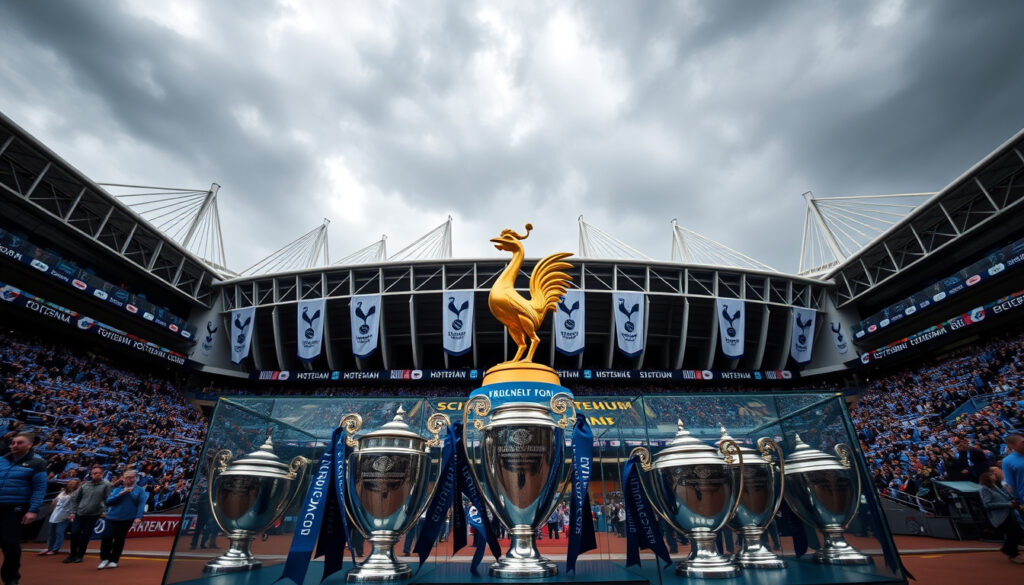
Ask any Tottenham Hotspur supporter what makes the club special and you’ll hear plenty of passion, a dash of defiance, and an undying hope that silverware is just around the corner. That loyalty runs so deep that even a 17-year trophy drought barely dented the ranks. But the 2024–25 season delivered a moment worth the wait: the club lifted the UEFA Europa League, a victory that reshapes the story of Spurs’ modern era.
Founded: 1882 · Stadium capacity: 62,850 · Premier League titles: 2 · FA Cups: 8 · European trophies: 3 · Current manager: Ange Postecoglou
Quick snapshot
- Tottenham won the UEFA Europa League in 2024-25 (Tottenham Hotspur official history page)
- JK Rowling confirmed as a Tottenham fan in interviews (Football Fancast (fan culture site))
- Spurs completed the league and FA Cup Double in 1960-61 (Tottenham Hotspur official history page)
- Exact number of Jewish supporters – no reliable survey exists (Football Fancast (fan culture site))
- Origin of ‘Spuds’ nickname – competing theories between Cockney rhyming slang and potato growers (Football Fancast (fan culture site))
- Fanbase size comparison with Arsenal – no independent counting method (Football Fancast (fan culture site))
- 2024-25 UEFA Europa League win ends 17-year trophy drought (Tottenham Hotspur official history page)
- 43-year gap between first European trophy (1963) and the 2008 League Cup remains the longest dry spell (Tottenham Hotspur official history page)
- Ange Postecoglou’s second full season; Champions League qualification push
- Potential summer transfer activity with new revenue from European success
- Ongoing debate over the ‘Yid Army’ chant and club’s official stance
Here are the key facts about Tottenham Hotspur in a concise table.
| Label | Value |
|---|---|
| Full name | Tottenham Hotspur Football Club |
| Nickname | Spurs |
| Founded | 1882 |
| Ground | Tottenham Hotspur Stadium |
| Capacity | 62,850 |
| Manager | Ange Postecoglou |
| League | Premier League |
Who has more trophies, Arsenal or Tottenham?
When the North London derby comes up, the first question is usually about silverware. Arsenal’s trophy cabinet is heavier, but Tottenham’s history includes several landmark achievements. Let’s line them up.
How many trophies has Tottenham won?
Tottenham have won 16 major trophies in their history, according to ESPN (sports news outlet). That includes 2 league titles, 8 FA Cups, 4 League Cups, 1 UEFA Cup Winners’ Cup, and 3 UEFA Cup/Europa League titles. Their most recent major trophy is the 2024-25 UEFA Europa League, as confirmed by the club’s official history page. The 1960-61 Double season – winning both the league and FA Cup – remains a defining achievement; the official history notes it was the first Double by any club since Preston North End and Aston Villa in the 19th century.
Which trophies has Arsenal won?
Arsenal have won 47 major trophies, including 13 league titles, 14 FA Cups, and 2 League Cups, per ESPN (sports news outlet). Their most recent major trophy is the 2020 FA Cup. The Wikipedia North London derby page states Arsenal lead the all-time derby record with 91 wins to Tottenham’s 68 in 213 matches. Recent form also tilts heavily: The Football Weekend (tactical analysis site) reports Arsenal have won seven of the last nine derbies since 2021.
One trophy comparison, one clear pattern: Arsenal’s 47 trophies dwarf Tottenham’s 16, but Tottenham’s European double (UEFA Cup 1972, 1984 plus 2024-25 Europa League) highlights a continental pedigree Arsenal haven’t matched since 1994.
Arsenal’s domestic dominance is unquestionable – 13 league titles to Tottenham’s 2. Yet Tottenham’s European trophy count (4) now equals Arsenal’s best continental run. The gap narrows when you leave English shores.
Why do Jews support Spurs?
The link between Tottenham and the Jewish community is one of English football’s most distinct cultural stories. It’s rooted in geography, identity, and a century of social history.
What is the historical connection between Tottenham and the Jewish community?
Large-scale Jewish immigration to North and East London in the late 19th and early 20th centuries brought many families to the area around Tottenham. The club’s location in the borough of Haringey – historically a Jewish settlement area – made it the natural local club for Jewish residents. Unlike other clubs that sometimes had exclusionary cultures, Tottenham welcomed all backgrounds, and the connection deepened over decades. The Wikipedia page on Tottenham supporters notes the club’s fanbase has long included a visible Jewish element, expressed in the chant “Yid Army” – an appropriation of a slur, used by some fans as a badge of pride.
Is the term ‘Yid Army’ considered offensive?
The term is deeply divisive. For some Tottenham fans, it’s a self-identifier that reclaims an antisemitic slur. For others – including many in the Jewish community and the wider public – it remains offensive. The club has officially discouraged the use of “Yid” in chants and released statements urging fans to avoid it. The club’s official history page does not mention the term, but the stance is clear in public communications: Tottenham Hotspur wants to distance the fanbase from any language that can be interpreted as antisemitic.
What began as a natural demographic alignment has turned into a flashpoint. The club must navigate between respecting a historical supporter identity and actively combating antisemitism – a tension that every statement on the matter tries to balance.
What this means: The club’s balancing act reflects a broader societal challenge over reclaimed language.
Why are Spurs fans called Spuds?
The nickname “Spuds” for Tottenham fans is one of those odd football terms that everyone recognises but few can explain. Two main theories compete.
What does ‘Spud’ mean?
“Spud” is British slang for a potato. The most widely accepted origin comes from Cockney rhyming slang: “Spurs” evolved into “Spuds” because in some dialects the sounds overlap. An alternative theory, mentioned by Football Fancast (fan culture site), ties the nickname to Irish potato growers who supported Tottenham early in the 20th century. Neither theory is definitively proven, but most fans agree it is used affectionately, not as an insult.
Are there other nicknames for Tottenham fans?
Yes: “Yids” (controversial, as discussed), “Spurs fans”, “The Lilywhites” (from the club’s white kit). The club itself prefers “Spurs supporters”. The diversity of nicknames reflects the layered identity of the fanbase.
What are Tottenham fans like?
Tottenham supporters have a reputation that swings between fierce loyalty and a kind of gallows humour. They’ve been called the most loyal in the Premier League – a claim underlined by the fact that the club’s average attendance has remained above 60,000 even during the long trophy drought.
What is the reputation of Tottenham fans?
They are known for vocal, passionate support. The “Glory, Glory” chant echoes around the Tottenham Hotspur Stadium on matchdays. The rivalry with Arsenal defines much of the fan identity – North London derby matches are among the most intense in English football. The fanbase is also remarkably diverse, drawing on Jewish, Irish, Afro-Caribbean, and other communities. Wikipedia’s supporters page counts over 440 official supporters’ clubs worldwide, from Norway to New Zealand.
Are Spurs fans loyal?
Extremely. Despite Tottenham winning only one major trophy between 2008 and 2024, season-ticket waiting lists remained long. The 2024-25 Europa League win was celebrated as a cathartic payoff after 17 years of near-misses. That kind of endurance is rare in modern football, where success often dictates fan retention.
What is the atmosphere at Tottenham Stadium?
The new stadium, opened in 2019 with capacity 62,850, has transformed the matchday experience. The single-tier south stand generates a constant wall of sound. Fans describe it as intense but family-friendly – a space where the legendary “Spurs roar” can still be felt.
“I guess I’m a Spurs fan now then.”
Robbie Williams, Instagram post after attending a Tottenham match (via Football Fancast (fan culture site))
The catch: loyalty this deep is rare, and the Europa League win may have reinforced it rather than created it.
Who likes Spurs?
Tottenham’s fanbase includes an impressive roster of celebrities from across entertainment, music, and sport. The list demonstrates the club’s cultural reach beyond North London.
Which celebrities are Tottenham fans?
Among the most famous: JK Rowling has confirmed her support in several interviews. Robbie Williams declared himself a fan on Instagram. Colin Firth is a reported supporter. Other notable names include Stephen Fry, Sir Trevor McDonald, Michael McIntyre, Adele, Jamie Foxx, and Steve Nash. The comprehensive list from Football Fancast (fan culture site) runs well into double figures.
Does JK Rowling support Tottenham?
Yes. She has made her loyalty clear in tweets and media appearances, calling herself a “lifelong Spurs fan”.
Does Robbie Williams support Tottenham?
Yes – he posted a picture of himself at the stadium with the caption “I guess I’m a Spurs fan now then” and has since been seen attending matches.
Does Colin Firth support Tottenham?
Reportedly yes, though he is less vocal about it than Rowling or Williams. The actor is named among Tottenham’s celebrity followers by multiple fan sources.
Tottenham Hotspur has a diverse and inclusive fanbase. We urge all fans to help us maintain that environment by avoiding language that may cause offence.
Tottenham Hotspur official stance on the use of the term ‘Yid’ (paraphrased from club communications)
Confirmed facts
- JK Rowling is a Tottenham fan (multiple interviews)
- Robbie Williams declared himself a fan on Instagram
- Tottenham won the UEFA Europa League in 2024-25 (Tottenham Hotspur official history page)
What’s unclear
- Exact number of Jewish fans – no reliable survey exists
- Origin of ‘Spuds’ nickname (Cockney rhyming slang vs potato growers)
- Whether Tottenham has more or fewer fans than Arsenal (no independent counting)
- Colin Firth’s reported fan status – not verified by the actor himself
The pattern: celebrity fandom often mirrors the club’s broader identity – pride in loyalty over glory.
“I’ve been a Spurs fan since I was a kid. It’s part of who I am.”
JK Rowling, interview (via Football Fancast (fan culture site))
Tottenham Hotspur’s identity has never been fully defined by trophies – and that may be its greatest strength. For the celebrity supporter who chooses Spurs over a more decorated club, the decision is about culture, history, and a particular kind of enduring hope. For the local fan in North London, the choice is simpler: it’s home. The 2024-25 Europa League win proved that the wait can end. For a fanbase that has weathered the longest of dry spells, the lesson is clear: patience pays, or at least it did this time.
For more on English football legends, see our piece on Sir Geoff Hurst: 1966 World Cup Legend’s Current Life. To explore the North London derby from the Arsenal side, read about Katie McCabe: Full Partner, Salary & Career Guide 2025.
reddit.com, tiktok.com, en.wikipedia.org, bleacherreport.com, facebook.com, reddit.com, sanomasuomi.fi
The club’s distinctive identity is explored in depth by The UK Daily, which examines Spurs unique fan culture and its ties to the local Jewish community.
Frequently asked questions
What is Tottenham’s biggest rivalry?
The North London derby against Arsenal – a rivalry that began after Arsenal moved to North London in 1913 and is one of the most intense in English football.
How many Premier League titles have Tottenham won?
Tottenham have won the English league title 2 times, both in the old First Division era (1950-51 and 1960-61). They have never won the Premier League.
What is the capacity of Tottenham’s stadium?
Tottenham Hotspur Stadium has a capacity of 62,850.
Who is Tottenham’s all-time top scorer?
Harry Kane holds the record with 280 goals for the club.
When did Tottenham last win a trophy?
Tottenham’s most recent major trophy is the 2024-25 UEFA Europa League, won under Ange Postecoglou.
What is the meaning of the Spurs badge?
The badge features a cockerel standing on a football, representing the club’s fighting spirit and connection to the Cockney identity. The design has evolved over time but the cockerel has been a symbol since 1909.
Why is Tottenham called ‘Spurs’?
The name ‘Spurs’ is a shortening of ‘Hotspur’, which comes from Sir Henry Percy (a medieval knight known for his speed and aggression). The club added ‘Tottenham’ to reflect the area where they were founded.

Oliver William Davies Thompson is a staff writer for MetroReport.uk, covering city news, transport, housing and urban policy. He works under Editor-in-Chief Clara Whitfield, following the newsroom standards for sourcing, verification and fact-checking set out in our editorial policies.