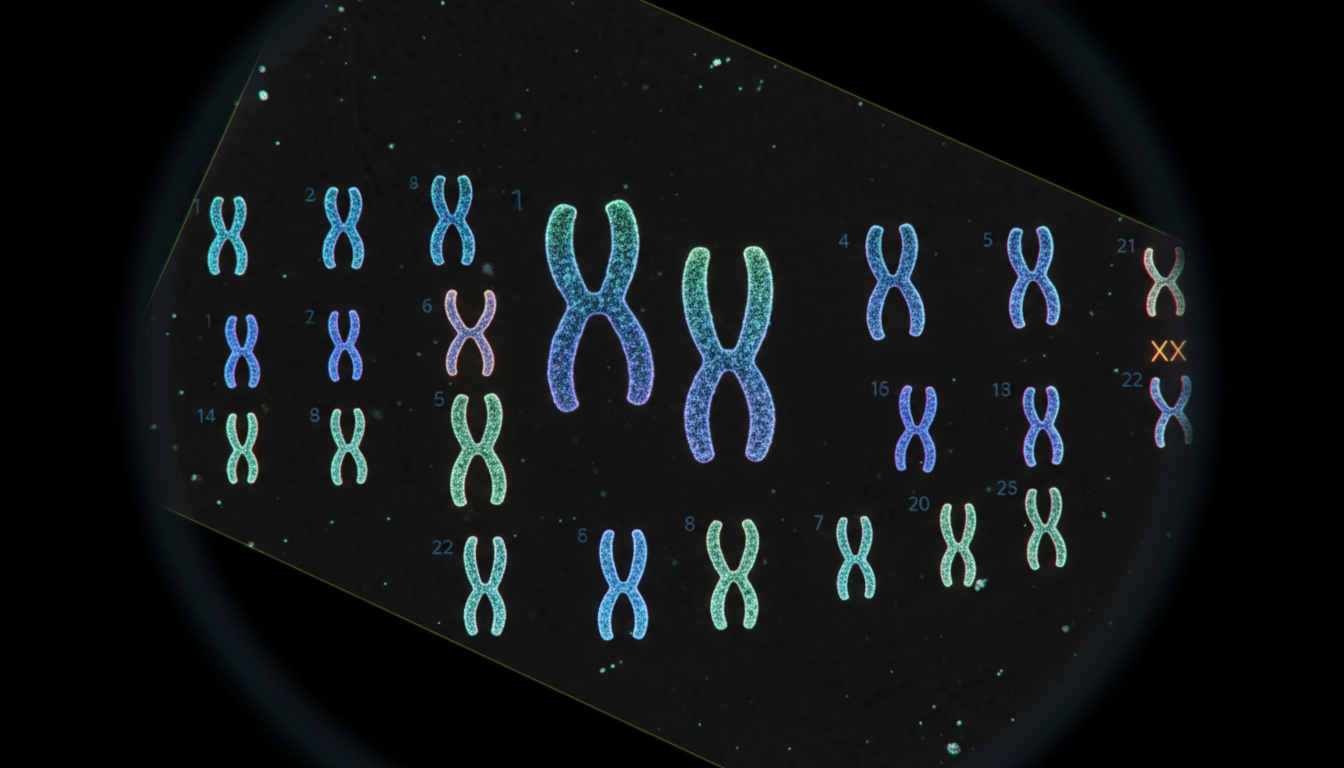
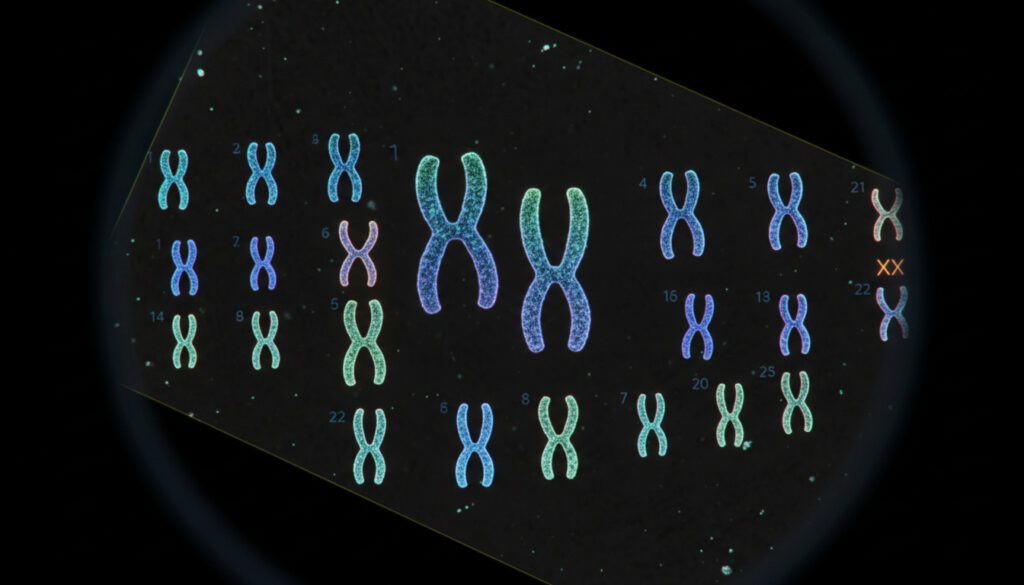
Humans typically possess 46 chromosomes arranged in 23 pairs within most body cells, a number that remained contentious until the mid-20th century. These thread-like structures, composed of DNA tightly coiled around proteins, carry the genetic instructions essential for growth, development, and cellular function.
While the figure of 46 applies to the vast majority of human somatic cells, critical exceptions exist in reproductive cells and certain developmental conditions. Medical genetics research establishes this count as the diploid standard, though understanding the full context requires examining how these chromosomes distribute between sexes and what occurs when numerical abnormalities arise.
The arrangement follows a precise pattern: 22 pairs of autosomes governing inherited traits unrelated to sex, plus one pair of sex chromosomes determining biological development as female (XX) or male (XY).
How Many Chromosomes Do Humans Have?
46 chromosomes arranged in 23 pairs in somatic cells
44 chromosomes forming 22 homologous pairs (numbered 1-22 by size)
2 chromosomes determining biological sex (XX or XY configuration)
46 in body cells (diploid), 23 in gametes (haploid)
- Universal Somatic Standard: Nearly all non-reproductive cells contain exactly 46 chromosomes, a count definitively established in 1956 after decades of scientific debate.
- Historical Correction: Early 20th-century scientists incorrectly counted 48 chromosomes; the accurate number required improved cell culture techniques.
- Gamete Reduction: Sperm and egg cells each contain 23 chromosomes, ensuring fertilization restores the diploid complement.
- Viable Monosomy Exception: Turner syndrome (45,X) represents the only survivable condition where an individual lacks one sex chromosome entirely.
- Karyotype Visualization: Laboratory analysis arranges all 46 chromosomes into a standardized photographic display called a karyotype.
- Size Variation: Chromosome 1 contains approximately 249 million base pairs, making it the largest, while the Y chromosome is among the smallest.
| Category | Number | Description |
|---|---|---|
| Somatic Cells | 46 | Diploid (2n) complete set inherited from both parents |
| Gametes (Sperm/Egg) | 23 | Haploid (n) half set produced through meiosis |
| Autosome Pairs | 22 pairs | Non-sex chromosomes carrying most genetic traits |
| Sex Chromosome Pairs | 1 pair | XX in females, XY in males |
| Female Karyotype | 46,XX | Two X chromosomes, one maternal, one paternal |
| Male Karyotype | 46,XY | One X (maternal) and one Y (paternal) chromosome |
| Turner Syndrome | 45,X | Single X chromosome; only viable monosomy |
| XXYY Syndrome | 48,XXYY | Tetrasomy with extra X and Y chromosomes |
Do Males and Females Have the Same Number of Chromosomes?
Both biological males and females possess 46 chromosomes in their somatic cells, maintaining numerical equality despite compositional differences. Genetic variation research confirms that while the total count remains constant, the genetic content and regulatory mechanisms differ significantly between sexes.
Sex Chromosome Composition
Females inherit two X chromosomes, receiving one from each parent. The X chromosome carries over 1,000 genes essential for survival beyond sex determination. Males inherit one X chromosome from their mother and one Y chromosome from their father. The Y chromosome primarily drives male reproductive development and contains fewer genes overall.
Gamete Formation Differences
Sexual differentiation becomes apparent in gamete production. Eggs consistently contain 22 autosomes plus one X chromosome. Sperm undergo segregation during meiosis, resulting in equal populations carrying either 22 autosomes plus X or 22 autosomes plus Y. Stanford Children’s Health notes that this segregation mechanism determines the biological sex of offspring at fertilization.
Females possess a compensatory mechanism called Lyonization, where one X chromosome in each cell randomly deactivates to balance gene dosage with males. This process ensures that despite having two X chromosomes, females do not produce double the amount of X-linked gene products.
What Happens with Abnormal Chromosome Numbers?
Aneuploidy—possessing an abnormal number of chromosomes—represents one of the most common categories of genetic disorder in humans. These conditions arise from errors during cell division, particularly meiosis, resulting in extra or missing chromosomes.
Sex Chromosome Aneuploidies
Conditions involving sex chromosomes occur more frequently than autosomal abnormalities because the X chromosome can undergo inactivation, and the Y chromosome carries relatively few essential genes. Basic genetics resources document several viable configurations beyond the standard 46,XX or 46,XY.
Trisomies involve three copies of a sex chromosome, producing karyotypes such as 47,XXY (Klinefelter syndrome) or 47,XYY. Tetrasomies (48,XXYY or 48,XXXY) and pentasomies (49,XXXXY) produce progressively more pronounced symptoms. Turner syndrome (45,X) remains the only survivable monosomy, characterized by short stature and infertility.
Autosomal Abnormalities
Abnormalities in autosomes generally produce more severe effects because these chromosomes carry essential genes for development. Clinical genetics identifies Down syndrome, resulting from trisomy 21 (three copies of chromosome 21), as the most common autosomal aneuploidy compatible with survival into adulthood.
Most autosomal monosomies (missing one copy of a non-sex chromosome) are lethal during early embryonic development. Similarly, trisomies of larger autosomes (such as chromosomes 1-12) rarely survive to birth, making chromosomal 21, 18, and 13 the primary survivable trisomies, though all involve significant developmental challenges.
What Are Chromosomes and Their Function?
Chromosomes function as the organized packaging system for an organism’s DNA. Molecular biology research describes them as long DNA molecules wrapped tightly around histone proteins, creating a compact structure that fits within the cell nucleus while protecting genetic information.
Structural Components
Each chromosome consists of a single DNA double helix extending millions of base pairs in length. Genes serve as the functional units along this DNA, providing instructions for protein synthesis. Autosomes exist as homologous pairs—similar in size, shape, and gene order between the two copies, though carrying different DNA variations (alleles) that create genetic diversity.
Functional Significance
Beyond storage, chromosomes ensure accurate DNA replication during cell division. Mitosis produces identical diploid daughter cells for growth and repair, while meiosis generates haploid gametes with genetic recombination. Cytogenetics research emphasizes that this ploidy system—diploid somatic cells and haploid gametes—remains conserved across virtually all eukaryotic organisms.
Medical laboratories use karyotyping to photograph chromosomes during metaphase, when they are most condensed and visible. Technicians arrange these images in descending order by size, creating a visual map that reveals numerical abnormalities, large deletions, or translocations invisible through standard genetic testing.
When Was the Human Chromosome Number Discovered?
- The Chromosomal Theory: Walter Sutton and Theodor Boveri independently propose that chromosomes carry genetic material, establishing the chromosomal theory of inheritance.
- Initial Miscount: Theodosius Dobzhansky suggests humans possess 48 chromosomes based on limited microscopic observations, a figure accepted for three decades.
- Definitive Correction: Joe Hin Tjio and Albert Levan, using improved cell culture techniques and hypotonic solutions to spread chromosomes, definitively establish the count as 46 chromosomes.
- Disease Correlation: Jérôme Lejeune discovers that Down syndrome results from trisomy 21, linking specific chromosome abnormalities to clinical conditions.
- Next-Generation Sequencing: Modern techniques identify submicroscopic variations and single nucleotide polymorphisms invisible to traditional karyotyping.
What Is Definitively Known About Human Chromosomes?
| Established Facts | Remaining Uncertainties |
|---|---|
| Somatic cells contain exactly 46 chromosomes in 23 pairs | Exact mechanisms triggering nondisjunction (improper chromosome separation) remain partially unexplained |
| XX/XY sex determination system is universal in typical human development | Rare mosaicism cases where individuals possess multiple cell lines with different chromosome counts |
| Turner syndrome (45,X) is the only survivable complete monosomy | Variable expressivity—why identical karyotypes produce different symptom severity in different individuals |
| X-inactivation compensates for double X chromosome dosage in females | Epigenetic factors influencing which X chromosome inactivates in specific tissues |
| Trisomy 21 (Down syndrome) is the most common survivable autosomal aneuploidy | Maternal age effects on meiotic error rates require further elucidation |
How Do Chromosomes Fit Into Broader Genetic Context?
Understanding chromosome number provides foundational context for modern medicine and evolutionary biology. Comparative genetics reveals that while humans possess 46 chromosomes, other mammals maintain different diploid numbers—dogs carry 78, mice 40, and horses 64—yet all utilize similar autosome and sex chromosome systems.
This variation demonstrates that chromosome number itself matters less than the genetic information carried. During Anatomy of a Scandal discussions of genetic evidence, experts emphasize that structural integrity and gene sequence accuracy prove more critical than the total count alone.
Clinical applications extend from prenatal screening to cancer diagnostics. Tumor cells frequently exhibit aneuploidy, making chromosome analysis essential for oncology. Meanwhile, preimplantation genetic testing helps identify embryo abnormalities before in vitro fertilization transfer, reducing the incidence of lethal trisomies.
What Do Leading Medical Authorities Say?
“Chromosomes are thread-like structures located inside the nucleus of animal and plant cells. Each chromosome is made of protein and a single molecule of deoxyribonucleic acid (DNA). Passed from parents to offspring, DNA contains the specific instructions that make each type of living creature unique.”
“Humans have 23 pairs of chromosomes, for a total of 46 chromosomes. In fact, each species of plants and animals has a set number of chromosomes. A fruit fly, for example, has four pairs of chromosomes, while a rice plant has 12 and a dog, 39.”
— Stanford Children’s Health
What Are the Essential Facts About Human Chromosomes?
Humans maintain 46 chromosomes in 23 pairs across most body cells, comprising 22 autosome pairs and one sex chromosome pair determining biological development. While males and females share this count equally, gametes contain exactly half—23 chromosomes—to ensure genetic diversity through sexual reproduction. Abnormalities such as those seen in Pain Left Side of Stomach genetic screening contexts can occasionally reveal mosaic patterns, though standard somatic cells consistently display the diploid 46-chromosome complement established by Tjio and Levan in 1956.
Frequently Asked Questions
Do all human cells have 46 chromosomes?
No. While somatic (body) cells contain 46 chromosomes, gametes (sperm and egg cells) contain 23. Additionally, mature red blood cells lack nuclei entirely and therefore contain no chromosomes.
What is the function of chromosomes?
Chromosomes package DNA into compact structures that fit within the cell nucleus, protect genetic material from damage, and ensure accurate DNA replication and distribution during cell division.
How many chromosomes do you inherit from each parent?
You inherit 23 chromosomes from your mother (through the egg) and 23 chromosomes from your father (through the sperm), totaling 46 chromosomes in your somatic cells.
Can you live with missing chromosomes?
Only one complete monosomy is survivable: Turner syndrome (45,X), where an individual has a single X chromosome. All autosomal monosomies and most sex chromosome monosomies are lethal during early development.
Do all animals have 46 chromosomes?
No. Chromosome numbers vary widely by species. Dogs have 78, mice have 40, chimpanzees have 48, and fruit flies have only 8 chromosomes.
What is Down syndrome?
Down syndrome is a genetic condition caused by trisomy 21—having three copies of chromosome 21 instead of two. It represents the most common survivable autosomal aneuploidy in humans.
How are chromosome abnormalities detected?
Medical professionals use karyotyping (microscopic chromosome analysis), fluorescence in situ hybridization (FISH), and chromosomal microarray analysis to detect numerical and structural abnormalities.

Oliver William Davies Thompson is a staff writer for MetroReport.uk, covering city news, transport, housing and urban policy. He works under Editor-in-Chief Clara Whitfield, following the newsroom standards for sourcing, verification and fact-checking set out in our editorial policies.