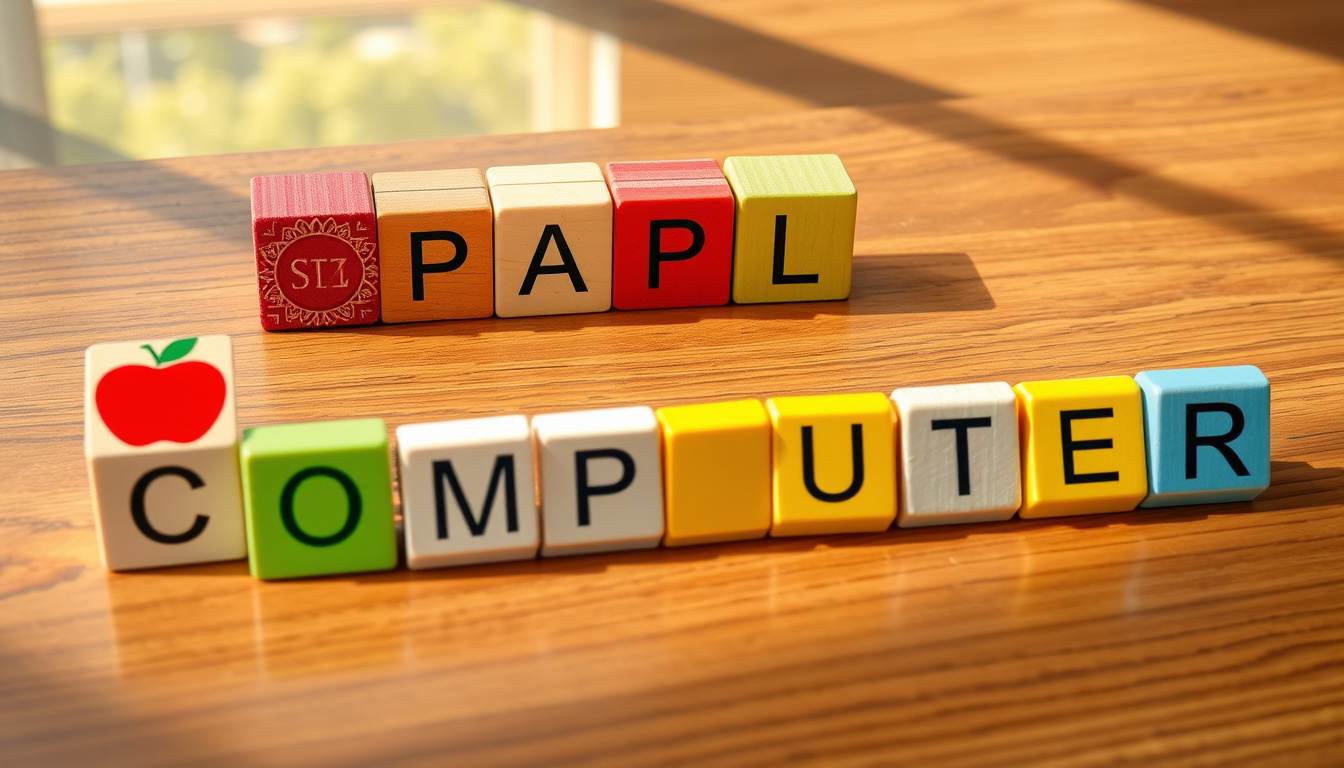
Chances are your child has already started counting syllables without knowing what to call them. When they clap along to “ba-na-na” in a song or stomp each beat in a word, they’re practicing one of the foundational skills for reading and spelling. This guide breaks down exactly what a syllable is, how to spot them in everyday words, and fun activities to make syllable practice stick.
Core Definition: Basic unit of speech sounds with a nucleus (Wikipedia) ·
Banana Count: 3 syllables (ba-na-na) ·
Smile Count: 1 syllable ·
Counting Method: Clap once per syllable
Quick snapshot
- A syllable is a single, unbroken vowel sound within a spoken word (Twinkl)
- Each syllable contains at least one vowel sound (a, e, i, o, u, and sometimes y) (Hooked on Phonics)
- Breaking words into syllables aids pronunciation and spelling (Study.com)
- Regional variations in English syllable rules (British vs. American) not fully documented across sources
- Quantitative data on syllable learning outcomes from controlled studies remains limited
- Kindergarten: Start with CVC words (1 syllable) and compound words (2 syllables) (Mrs Learning Bee)
- Early elementary: Progress to 3+ syllables with manipulatives and games (Mrs Learning Bee)
- Introduce syllable types like closed syllables and consonant-le after basic vowel sounds
- Build fluency through syllable-based word games and reading practice
These example words and their syllable breakdowns illustrate the range from simple one-beat words to complex five-beat terms:
| Word | Syllable Count | Breakdown |
|---|---|---|
| banana | 3 | ba-na-na |
| electricity | 5 | e-lec-tri-ci-ty |
| activity | 4 | ac-tiv-i-ty |
| butterfly | 3 | but-ter-fly |
| rescue | 2 | res-cue |
| avocado | 4 | a-vo-ca-do |
What is a syllable with example?
A syllable is the smallest unit of speech that contains a single, unbroken vowel sound. Think of it as one “beat” in a word—you can say it in one breath without pausing. Every syllable must have at least one vowel (or vowel sound), though it may also include consonants before or after that vowel.
For instance, the word “window” has two beats: win-dow. Each beat contains its own vowel sound, making window a two-syllable word, as explained by BBC Bitesize in their literacy resources.
Core definition from linguistics
Linguists define syllables as units of speech organized around a vowel sound. According to Twinkl, an educational publisher specializing in classroom resources, syllables are “like a beat that can be heard” when you speak a word aloud. The technical center of any syllable is called the nucleus—a vowel (a, e, i, o, u, and sometimes y) that carries the sound.
Simple spoken word breakdown
The easiest way to understand syllables is to listen for vowel sounds in a word. Count how many vowel sounds you hear, and you’ve counted the syllables. For example:
- “Cat” has one vowel sound (a) = 1 syllable
- “Apple” has two vowel sounds (a, e) = 2 syllables
- “Banana” has three vowel sounds (a, a, a) = 3 syllables
Teaching children to hear vowel sounds first—before they can read or write—builds a critical foundation for decoding words later on, according to Reading Rockets, a literacy research organization.
How do you explain a syllable to a child?
The key to teaching syllables to young children is to make it physical and fun. Instead of abstract definitions, use their bodies and voices as tools. Children learn best when they can see, hear, and move while learning.
Kid-friendly beat analogy
Tell your child that syllables are like beats in a song—just like you clap to music, words have beats too. Say a word slowly and clap or tap each beat. All About Learning Press recommends saying: “Every time you hear a vowel sound, that’s one beat—one syllable.”
Use familiar words as practice. Start with their name: if their name is “Lucy,” they should feel one beat. If their name is “Isabella,” they should feel three beats (Is-a-bel-la). Let them guess which words have one beat versus many.
Hand-clapping method
The clap method is the most widely used technique for teaching syllable counting to children. Say the word clearly, then clap once for each syllable you hear. All About Learning Press outlines several variations:
- Clap: Say the word, clap once per syllable (e.g., ba-na-na = 3 claps)
- Hum: Hum the word steadily, and count how many hums you hear
- Robot talk: Speak the word in a stiff, mechanical voice to hear each syllable clearly (e.g., ba|na|na)
- Jump or stomp: Jump up and down once per syllable—great for burning energy while learning
The Jack Hartmann YouTube channel, a popular educational resource for children, demonstrates syllable clapping with songs that make the beat method stick through music and movement.
Children who master syllable counting through physical movement—clapping, stomping, jumping—retain the skill longer than those who only listen passively. Movement anchors the learning in muscle memory, making it easier to recall during reading and spelling tasks.
What are 3 syllables examples?
Three-syllable words are everywhere once you start looking. These words contain exactly three vowel sounds and three beats. For young readers, knowing how to break these words into parts makes them less intimidating and easier to pronounce.
Common 3-syllable words
Here are some frequently used three-syllable words to practice with children, as listed by Twinkl:
- Alphabetic: al-pha-bet (3 syllables)
- Butterfly: but-ter-fly (3 syllables)
- Amazing: a-maz-ing (3 syllables)
- Excited: ex-ci-ted (3 syllables)
- Spaghetti: Spa-ghet-ti (3 syllables)
Banana breakdown
Banana is the go-to example for teaching syllables because it’s fun to say and easy to count. Say it slowly: ba-na-na. Three beats, three vowel sounds, three syllables.
Use banana in syllable games like “I Spy”—say “I spy something with three syllables” and let your child guess “banana.” This reinforces the count through play. The Jack Hartmann channel has a popular banana song that makes this breakdown memorable through rhythm and movement.
What are 5 syllables examples?
Five-syllable words challenge children to stretch their listening skills and practice longer word breakdowns. These words are often scientific, medical, or technical terms that older students encounter as they advance in reading.
Advanced 5-syllable words
According to Twinkl, five-syllable words include:
- Electricity: e-lec-tri-ci-ty (5 syllables)
- Refrigerator: re-fri-ge-ra-tor (5 syllables)
- Opportunity: op-por-tu-ni-ty (5 syllables)
- Celebration: cel-e-bra-tion (5 syllables)
Pronunciation tips
When teaching five-syllable words, break them into smaller chunks first. For “electricity,” practice each chunk separately: e-lec, tri, ci, ty. Then blend them together slowly. According to Study.com, breaking complex words into syllables aids both pronunciation and spelling—children who can segment “im-poss-i-ble” spell it correctly far more often than those who try to memorize it as one chunk.
Children often rush through longer words and miss syllables. If your child says “re-frig-er-a-tor” instead of the correct five syllables, encourage them to stretch the word slowly like taffy, saying each sound deliberately until they hear all five beats.
How many syllables are in the word “banana”?
Banana has exactly three syllables: ba-na-na. This is one of the most commonly cited examples in syllable education because the three syllables are evenly spaced, easy to hear, and fun to clap out loud. Multiple educational sources confirm this count, including Jack Hartmann’s YouTube lesson and Twinkl’s teaching wiki.
Smile and 77 counts
Smile is a one-syllable word—the “ie” makes a single vowel sound, even though two letters are involved. Some children initially think it has two syllables because of the two vowel letters, but the key is listening for vowel sounds, not letters.
The number 77 is tricky for syllable counting because it depends on how you say it. If pronounced “seventy-seven,” it’s 4 syllables. If abbreviated as “seven-seven,” it’s 2 syllables. This shows why listening carefully matters more than counting letters.
General counting rules
A few guidelines help children count syllables accurately:
- Every syllable needs a vowel sound: If you can’t hear a vowel, it might not be a separate syllable (e.g., the “e” in “apple” is silent, so apple = 2 syllables: ap-ple)
- Compound words split between syllables: “Rainbow” = rain-bow (2 syllables)
- Practice with the jaw drop method: Drop your jaw once for each vowel sound you hear
Parents and teachers who make syllable practice physical, frequent, and fun give children a stronger foundation for reading and spelling. Children who can reliably count syllables in spoken words develop stronger decoding skills because they can chunk unfamiliar words into manageable pieces.
How to count syllables step by step
Teaching children a systematic approach to counting syllables ensures they can tackle any word. Follow these steps in order, starting with the simplest methods and progressing to more advanced techniques.
Listen for vowel sounds
Say the word clearly and slowly. Count how many vowel sounds you hear. Each vowel sound (a, e, i, o, u, and sometimes y) represents one syllable.
Use the clap method
While saying the word, clap once for each vowel sound. This physical action helps reinforce the count and makes the syllables tangible. All About Learning Press recommends this as the first counting technique for beginners.
Try the jaw drop method
Place your hand under your chin. Say the word slowly. Each time you feel your jaw drop, you’ve hit a syllable. Mrs Learning Bee notes this works because each vowel sound requires an open jaw.
Practice with manipulatives
For hands-on learners, use blocks, cubes, or tokens. Say the word and place one item in a row for each syllable. This visual and tactile method helps solidify the concept. Reading Rockets recommends manipulatives for children who struggle with auditory-only methods.
Apply to reading and spelling
Once children can count syllables confidently, introduce syllable division for spelling. Break longer words at the syllable level before attempting to spell them. For example, to spell “impossible,” break it into im-poss-i-ble, then tackle each chunk separately.
“Syllables are really parts of a word and they are like a beat that can be heard.”
— Jack Hartmann, Educator (Jack Hartmann YouTube)
“A syllable is a single, unbroken vowel sound within a spoken word.”
— Twinkl, Educational Publisher (Twinkl Teaching Wiki)
“Syllables are the building blocks of multisyllabic words.”
— Mrs Learning Bee, Kindergarten Teacher (Mrs Learning Bee)
Related reading: What Does PDA Mean · How Many Chromosomes Do Humans Have
happytotshelf.com, beginlearning.com, youtube.com, youtube.com
Frequently asked questions
What is a syllable type?
Syllable types describe patterns based on vowel sounds and consonants. The main types include closed syllables (short vowel followed by consonant, e.g., “hat”), open syllables (ends in vowel, e.g., “go”), and consonant-le syllables (ends in consonant + le, e.g., “maple”). Understanding these types helps children decode and spell words more accurately, according to Reading Rockets.
How many syllables?
Most words contain between 1 and 5 syllables. One-syllable words (monosyllabic) include “cat,” “dog,” and “hat.” Two-syllable words include “apple,” “zebra,” and “rocket.” Three-syllable words include “banana,” “butterfly,” and “amazing.” Four-syllable words include “activity,” “avocado,” and “incredible.” Five-syllable words include “electricity” and “refrigerator.”
What is a syllable in grammar?
In grammar, a syllable is a phonological unit—not a grammatical one. It refers to the way words are divided when speaking, based on vowel sounds. Syllables don’t correspond to parts of speech or grammatical functions; they’re purely about sound structure.
What is a syllable for kids?
For kids, a syllable is a “beat” in a word. When they clap along to a song or stomp while saying a word, they’re counting syllables. Hooked on Phonics explains that each syllable has at least one vowel sound that can be heard when the word is spoken clearly.
Is smile 1 syllable or 2?
Smile is one syllable. The “ie” combination makes a single vowel sound (the long “i” sound), not two separate sounds. Even though two vowel letters are present, they create one vowel sound, so smile counts as one syllable.
How many syllables are in 77?
It depends on pronunciation. If you say “seventy-seven,” that’s four syllables (sev-en-ty-sev-en). If you say “seven-seven,” that’s two syllables. Always clarify the pronunciation before counting.
What are syllable games?
Syllable games are activities that help children practice counting syllables through play. Examples include Mystery Bag (pull an object and tap syllables), Syllable Hunt (find items in a room by syllable count), and Syllable I Spy (“I spy something with two syllables”). According to Reading Rockets, these games support decoding speed and reading fluency.
For parents and teachers, the takeaway is clear: make syllable practice physical, frequent, and fun. Children who can reliably count syllables in spoken words develop stronger reading and spelling skills because they can chunk unfamiliar words into manageable pieces. Start with banana—three claps, three beats, three syllables—and build from there.

Oliver William Davies Thompson is a staff writer for MetroReport.uk, covering city news, transport, housing and urban policy. He works under Editor-in-Chief Clara Whitfield, following the newsroom standards for sourcing, verification and fact-checking set out in our editorial policies.