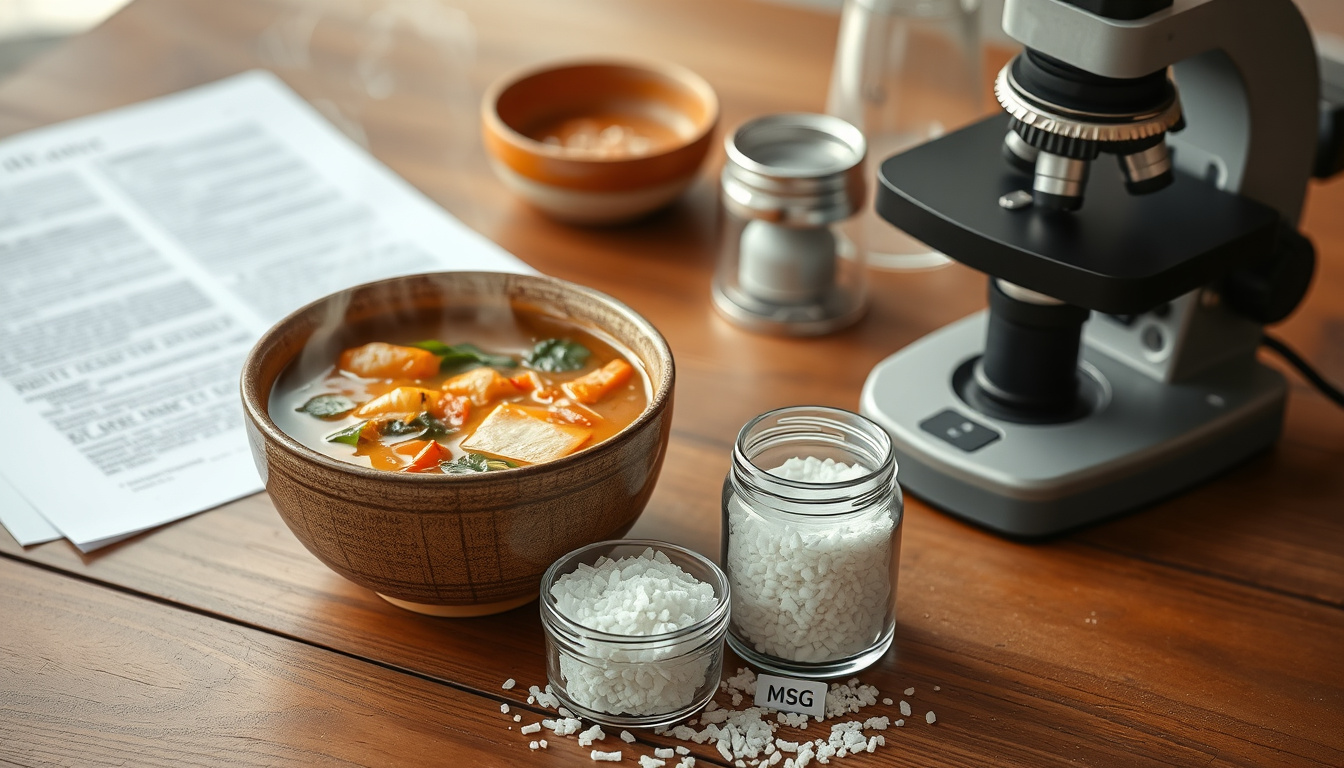
If you have ever paused before sprinkling white crystals from a packet labeled “MSG,” you are not alone. The reputation of monosodium glutamate — blamed for headaches, flushing, and a whole syndrome named after Chinese restaurants — has stuck around for decades despite a growing mountain of evidence saying it is safe. This article traces where that fear came from, what the science actually shows, and whether you should worry about the umami booster in your pantry.
FDA classification: Generally Recognized as Safe (GRAS) ·
Average daily intake: 0.5–1.5 grams (typical diet) ·
Population with reported sensitivity: < 1% ·
Number of peer-reviewed studies on safety: Hundreds, with consensus on safety at normal levels ·
Year of discovery: 1908
Quick snapshot
- MSG is safe for the general population at normal dietary intake (Mayo Clinic (leading health system))
- MSG is not banned in Ireland, the EU, or the US (Harvard Health (academic medical publisher))
- The exact prevalence of MSG sensitivity (estimates range from <1% to a few percent) (Mayo Clinic)
- Whether very high intakes (e.g., >10g per day) have long-term effects (PubMed Central review (NIH database))
- 1968: Dr. Ho Man Kwok’s letter coins “Chinese Restaurant Syndrome” (Harvard Health)
- 2020s: Consensus that MSG is safe for the general population (FDA (U.S. regulatory agency))
- Ongoing research into individual sensitivity thresholds (PubMed Central review)
- Growing adoption of MSG in Western food product reformulation to reduce sodium (Harvard Health)
Six key facts, one pattern: the gap between public fear and regulatory consensus is unusually wide.
| Label | Value |
|---|---|
| Chemical name | Monosodium glutamate |
| Sodium content | 12.2% by weight (vs salt 39%) |
| Discovery | 1908 by Kikunae Ikeda (Japan) |
| EU additive code | E621 |
| FDA status | Generally Recognized as Safe (GRAS) |
| EFSA ADI | 30 mg per kg body weight per day |
What this means: Every major health regulator that has examined MSG — from the FDA in the US to the EFSA in Europe to the WHO-backed JECFA — has cleared it for normal dietary use. The numbers consistently undercut the scare stories.
Why do people say MSG is bad for you?
The origin of the Chinese Restaurant Syndrome myth
- In 1968, Dr. Ho Man Kwok published a letter in the New England Journal of Medicine describing transient symptoms — headache, flushing, palpitations — after eating at Chinese restaurants (Harvard Health (academic medical publisher)).
- The letter was not a peer-reviewed study, but it ignited a media firestorm that lasted decades (Mayo Clinic (leading health system)).
How media fueled the MSG controversy
- Throughout the 1970s and 1980s, anecdotal reports and sensational headlines linked MSG to a wide range of ailments, from asthma to brain damage (Harvard Health).
- Restaurants began advertising “No MSG” as a health selling point, a practice that persists today (Cleveland Clinic (leading U.S. hospital system)).
Scientific reassessment in the 1990s and 2000s
- The FDA re-evaluated MSG in 1995 and reaffirmed its GRAS status (FDA (U.S. regulatory agency)).
- Multiple systematic reviews found no consistent evidence of harm at normal intake levels (PubMed Central review (NIH database)).
- The term “Chinese Restaurant Syndrome” is now considered a misnomer and has been largely abandoned by the scientific community (Mayo Clinic).
The pattern: A single unverified letter from 1968 shaped public opinion for half a century, while hundreds of subsequent studies struggled to catch up.
The same compound that sparked a global panic is a natural amino acid your body already processes daily in foods like tomatoes, cheese, and mushrooms. The fear is about the synthetic form, yet your liver metabolizes both identically.
Is MSG banned in Ireland?
EU food additive regulations for MSG
- MSG is listed as an authorized food additive in the European Union under code E621 (EFSA (European food safety authority)).
- The EFSA has set an Acceptable Daily Intake (ADI) of 30 mg per kg of body weight — roughly 2.1 grams for a 70 kg adult (EFSA).
Why Ireland is not an outlier
- Ireland, like all EU member states, follows the same additive regulations set by the European Commission (FSAI (Irish food safety regulator)).
- No EU country has independently banned MSG based on health concerns (EFSA).
Countries with actual MSG restrictions
- No country worldwide has banned MSG for health reasons (FDA).
- Some countries require labeling, but this is a transparency measure, not a ban (Mayo Clinic).
The implication: The persistent myth that MSG is banned in Ireland or elsewhere is unfounded. The EU’s regulatory review in 2017 set a safe intake level — but never proposed a prohibition.
What does MSG do to your body?
How glutamate is metabolized
- Glutamate is a natural amino acid that your body produces and also gets from protein-rich foods (Mayo Clinic).
- Your gut and liver metabolize added MSG the same way as naturally occurring glutamate (Harvard Health).
Reported side effects: headache, flushing, palpitations
- The MSG symptom complex can include headache, flushing, tingling, palpitations, chest heaviness, nausea, and muscle aches (Mayo Clinic).
- However, researchers have found no clear proof linking MSG to these symptoms in controlled settings (Mayo Clinic).
- One 2019 review noted that some studies using 2.5 to 5 grams of MSG reported increased headache incidence in four out of five clinical studies (PubMed Central review (NIH database)).
Is MSG harmful to the heart, stomach, or kidneys?
- The same 2019 review reported preclinical associations between MSG and cardiotoxicity, hepatotoxicity, and other effects in animal studies (PubMed Central review).
- But the review also argued that many animal findings have limited relevance to human dietary exposure due to methodological flaws (PubMed Central review).
- No conclusive evidence links MSG to heart disease, kidney damage, or chronic stomach issues at normal intake (Harvard Health).
MSG and cancer risk: what research says
- A 2019 review noted premalignant alterations in some animal studies, but no human evidence supports a cancer link at dietary levels (PubMed Central review).
- The FDA, EFSA, and WHO all state that MSG does not pose a cancer risk at normal consumption levels (FDA).
MSG safety for children
- The EFSA’s ADI of 30 mg/kg applies to children as well as adults (EFSA).
- No specific studies have identified unique risks for children at normal intake (Mayo Clinic).
MSG and cholesterol
- No established link exists between MSG consumption and cholesterol levels in humans (Harvard Health).
- Animal studies showing metabolic changes used doses far exceeding human dietary exposure (PubMed Central review).
The trade-off: The threshold for MSG side effects appears to be around 3 grams on an empty stomach — roughly six times what you would get in a typical restaurant meal. For the vast majority of people, that gap creates a wide safety margin.
For the less than 1% of the population who may be sensitive, the risk is not toxicity — it is temporary discomfort. The FDA says symptoms are most likely after consuming 3 grams of MSG without food, a scenario that is hard to reach in normal eating.
Is MSG worse for you than salt?
Three key metrics show MSG delivers flavor with significantly less sodium.
| Metric | MSG | Table Salt (NaCl) |
|---|---|---|
| Sodium content by weight | 12.2% | 39.0% |
| Daily intake needed to exceed sodium limits (typical serving) | Difficult in normal eating | Easy in processed foods |
| Effect on blood pressure | No evidence of raising BP at normal intake | Well-established link to hypertension |
The implication: The WHO recommends limiting sodium to under 2,000 mg per day. Substituting half your salt with MSG can cut sodium by up to 30% while maintaining or enhancing flavor — a rare win for taste and health.
Sodium content: MSG vs table salt
- MSG contains about 12.2% sodium by weight; table salt contains 39.3% (Harvard Health (academic medical publisher)).
- That means MSG has roughly one-third the sodium of salt for the same weight (Mayo Clinic (leading health system)).
Health impact of high sodium vs MSG
- High sodium intake is a leading risk factor for hypertension, stroke, and heart disease worldwide (WHO (global health authority)).
- MSG consumption has not been linked to hypertension in epidemiological studies (Cleveland Clinic (leading U.S. hospital system)).
Which is more likely to raise blood pressure?
- Salt is a proven driver of hypertension; MSG is not (Harvard Health).
- Some studies suggest MSG may even help reduce overall sodium intake when used as a partial salt replacement (Cleveland Clinic).
Upsides
- Can reduce overall sodium intake when replacing salt
- Enhances umami flavor without bitterness or metallic aftertaste
- Safe for the vast majority of the population
- Naturally occurring compound — body metabolizes it efficiently
Downsides
- Rare sensitivity reactions in less than 1% of people
- Negative public perception can be a marketing liability
- Overuse adds sodium like any other seasoning
- Uncertain long-term effects at very high, non-dietary doses
Why do Japanese use so much MSG?
History of umami discovery in Japan
- Dr. Kikunae Ikeda of Tokyo Imperial University isolated glutamic acid from seaweed in 1908 and identified the fifth basic taste: umami (Harvard Health (academic medical publisher)).
- He commercialized MSG as “Ajinomoto” (essence of taste) — a brand that still dominates the global market (BBC (international news publisher)).
MSG as a flavor enhancer in Japanese cuisine
- MSG is a standard ingredient in dashi broth, soy sauces, and packaged seasonings (Harvard Health).
- Japanese dietary patterns show no higher incidence of MSG-related adverse effects than Western diets (Cleveland Clinic (leading U.S. hospital system)).
Cultural acceptance and regulatory differences
- Japan and other East Asian countries have no cultural stigma against MSG — it is viewed as a normal seasoning (BBC (international news publisher)).
- Regulatory bodies in Japan, South Korea, and China all approve MSG without restrictions beyond general food safety (EFSA (European food safety authority)).
The implication: The Japanese relationship with MSG is not reckless overuse — it shows rational acceptance of a flavor tool that most of the world reserves for salt and pepper.
What does MSG taste like?
The fifth taste: umami
- Umami is described as savory, meaty, or brothy — a distinct taste that sits alongside sweet, sour, salty, and bitter (Harvard Health (academic medical publisher)).
- The human tongue has specific receptors for glutamate, confirming umami’s status as a primary taste (Cleveland Clinic (leading U.S. hospital system)).
How MSG enhances savory flavors
- MSG does not have a strong taste on its own but amplifies the savory notes of other ingredients (Mayo Clinic (leading health system)).
- It works synergistically with salt — you can use less salt and still get a satisfying flavor (Harvard Health).
Comparison to natural glutamate-rich foods
- Natural sources of glutamate include tomatoes (140 mg per 100g), Parmesan cheese (1,200 mg), mushrooms (180 mg), and seaweed (1,300 mg) (Cleveland Clinic).
- The glutamate in these foods is chemically identical to the glutamate in added MSG (Mayo Clinic).
The trade-off: Avoiding MSG means missing out on the same flavor your body already craves from Parmesan, ripe tomatoes, and aged cheese. The only difference is the delivery method.
For home cooks looking to reduce sodium: replacing a quarter of the salt in a recipe with MSG can cut sodium by roughly 10-15% while keeping food satisfying. The flavor difference is subtle; the health benefit is not.
Timeline: MSG from discovery to today
- 1908: Kikunae Ikeda isolates glutamic acid from seaweed, discovers umami (BBC (international news publisher)).
- 1968: Dr. Ho Man Kwok’s letter describes “Chinese Restaurant Syndrome” (Harvard Health (academic medical publisher)).
- 1970s-1980s: Media and anecdotal reports amplify the MSG panic (Mayo Clinic (leading health system)).
- 1995: FDA re-evaluates MSG; reaffirms GRAS status (FDA (U.S. regulatory agency)).
- 2000s: Multiple systematic reviews find no consistent evidence of harm at normal intake (PubMed Central review (NIH database)).
- 2017: EFSA updates safety assessment; sets ADI of 30 mg/kg (EFSA (European food safety authority)).
- 2020s: Consensus that MSG is safe for the general population (Cleveland Clinic (leading U.S. hospital system)).
Confirmed facts
- MSG is safe for the general population at normal dietary intake (Mayo Clinic)
- MSG is not banned in Ireland, the EU, or the US (Harvard Health)
- MSG contains significantly less sodium than table salt (12.2% vs 39%) (Harvard Health)
- Glutamate is a natural amino acid found in many foods (Mayo Clinic)
What’s unclear
- The exact prevalence of MSG sensitivity (estimates range from <1% to a few percent) (Mayo Clinic)
- Whether very high intakes (e.g., >10g per day) have long-term effects (PubMed Central review)
- The biological mechanism behind reported symptoms in sensitive individuals (Cleveland Clinic)
“MSG is safe for the general population at typical levels of consumption. Scientists have not been able to find a consistent link between MSG and the symptom complex that has been attributed to it.”
Dr. John Fernstrom, University of Pittsburgh, quoted in BBC Future (international science journalism)
“The FDA considers MSG to be a food ingredient that is safe for its intended use. Most people can eat MSG in small amounts as part of a meal without any negative effects.” For more information on the safety of MSG, please visit Het Monster van Loch Ness.
FDA spokesperson, via FDA (U.S. food regulatory authority)
“I discovered that glutamate gives a distinct taste sensation that is different from the four basic tastes. I named this taste umami.”
Dr. Kikunae Ikeda, in his 1909 paper “On the Taste of the Amino Acid Glutamic Acid,” via BBC Future
“For the small subset of people who are sensitive to MSG, symptoms are usually mild and resolve on their own. They do not require medical treatment.”
Mayo Clinic (U.S. academic medical center)
The evidence accumulated over six decades is clear: MSG, when consumed in amounts found in a normal diet, poses no health risk for the overwhelming majority of people. The real public health casualty of the MSG myth is the missed opportunity to reduce sodium intake at a population level. For the average home cook or restaurant diner in Ireland, the UK, or the US, the choice is not between MSG and safety — it is between MSG and salt. And on that comparison, MSG wins decisively. For consumers worried about sodium, the pragmatic step is clear: swap half your salt for MSG in cooking and enjoy better flavor with less cardiovascular risk. For the very small percentage who experience mild sensitivity, the remedy is equally simple — avoid large, standalone doses. The rest of us can stop worrying and start seasoning.
healthline.com, pmc.ncbi.nlm.nih.gov, copy.fshn.illinois.edu, health.clevelandclinic.org
Frequently asked questions
Is MSG addictive?
No evidence supports claims that MSG is addictive. Glutamate is a naturally occurring amino acid that the body processes normally. Unlike substances with known addictive properties, MSG does not trigger dopamine release in the brain’s reward centers (Mayo Clinic (leading health system)).
Does MSG cause weight gain?
Controlled studies have not found a causal link between MSG and weight gain in humans. Some animal studies using extremely high doses have shown metabolic changes, but these findings have limited relevance to human dietary exposure (PubMed Central review (NIH database)).
How much MSG is safe per day?
The EFSA has set an Acceptable Daily Intake (ADI) of 30 mg per kg of body weight. For a 70 kg adult, that is about 2.1 grams per day — far more than the 0.5 grams typically found in a restaurant meal (EFSA (European food safety authority)).
Is MSG natural or artificial?
MSG is the sodium salt of glutamic acid, a natural amino acid found in all proteins. Commercially produced MSG is made through fermentation — similar to how yogurt or beer is produced — not from artificial chemical synthesis (Harvard Health (academic medical publisher)).
Can MSG trigger migraines?
Some studies have found that doses of 2.5 to 5 grams of MSG increased headache incidence in clinical settings, but other studies found no effect. The evidence is mixed, and most people do not experience migraines from typical dietary amounts (PubMed Central review (NIH database)).
Is there a difference between MSG and glutamate?
Glutamate is the amino acid; MSG is its sodium salt, which dissolves into glutamate and sodium in the body. Your body treats the glutamate from MSG identically to the glutamate naturally present in foods like tomatoes and cheese (Mayo Clinic (leading health system)).
Does cooking with MSG reduce sodium intake?
Yes. Because MSG contains only 12.2% sodium by weight compared to salt’s 39.3%, replacing half the salt in a recipe with MSG can cut sodium by roughly 15-30% while maintaining flavor (Harvard Health (academic medical publisher)).
Is MSG banned in any country for health reasons?
No country has banned MSG based on health concerns. Some countries require labeling, but this is a transparency measure. The EU, US, Japan, and Australia all permit MSG use without restrictions beyond general food safety standards (FDA (U.S. regulatory agency)).

Oliver William Davies Thompson is a staff writer for MetroReport.uk, covering city news, transport, housing and urban policy. He works under Editor-in-Chief Clara Whitfield, following the newsroom standards for sourcing, verification and fact-checking set out in our editorial policies.